Other motivations
That’s another snap at Mark McGuiness’s blog, which you can find here.
Extrinsic factors may have limited value as motivators but you can’t afford to ignore them — because they make excellent demotivators. Below some of these factors, which you – as a creative person – need to bear in mind, and possibly to implement in your profession.
Money: it is a clearly defined way of ‘keeping score’, measuring how highly regarded you are by your employer or your audience. Violinist Nigel Kennedy writes in his autobiography ‘I think if you’re playing music or doing art you can in some way measure the amount of communication you are achieving by how much money it is bringing in for you and for those around you’.
Recognition: the term ‘egoboo’ is used within the open source programming community, referring to the ‘ego boost’ you receive from being publicly credited for good work. So even though there’s no money involved, it’s not strictly true to say that open source programmers work ‘for nothing’. Poetry, or literature, is another creative medium with very little cash on offer, but which operates on a kind of ‘reputation economy’ — the higher your reputation, the more prestigious your publisher will be, the more magazines will want to take your work, the higher up the bill you will be on readings, etc.
Deadlines: as soon as you make a promise to someone else, you have an obligation to fulfil. Sometimes this can be just the push you need to get you through the wall of resistance that would otherwise lead to procrastination. ‘I know exactly what I need to do, but I’m more likely to do it if I’ve promised you do it by a certain date’. To get you going in the first place place, you sometimes need the extrinsic motivation of ‘deadline magic’.
There are probably other external motivations that come into the picture, but I believe the three above are the most essential ones. Also, very often they are those we encouter first, and only along the path other types of motivation may reveal to ourselves. (Such as those intrinsic, described in the previous post.)
Motivation
Managing Intrinsic Motivation. That’s the subtitle of a post that Mark McGuinness published here.
The article is for those who need to manage creative people, not precisely for those who are. But – here comes the twist – it’s precisely what a creative professional needs to apply to her/himself too, no matter if you are your own boss. Even more effective, I’d say.
There we go:
By definition, intrinsic motivation works through spontaneity, pleasure and fascination — none of which can be served up to order. No wonder managing creative people is often described as ‘herding cats’, notoriously wilful and independent creatures. But if you can’t control it, you can coax it to some extent. Here are a few suggestions:
Set them (yourself) a challenge
Remember, creatives love a challenge. How can you make the brief more difficult? More inspiring? More extreme?
Define the (your) goal clearly
If there’s one thing worse than a boring or easy brief, it’s a vague one. ‘Write a story’ is terrible. ‘Write a superhero story’ isn’t much better. ‘Write a Batman story’ at least gives me something to work with. ‘Write a Batman story in which his identity is exposed’, or ‘where he lets himself and the city down’, or ‘where he loses all his gadgets and has to rely on his wits’ – now I’ve got something to get my teeth into.
Eliminate distractions and interruptions
Help them concentrate. Don’t interrupt them — or let others interrupt them — unless it’s important AND urgent. As far as possible, help them ‘batch’ meetings, conversations, and day-to-day tasks so that they don’t keep interfering with focused work. Whatever distractions arise, remind them that the work itself is their primary responsibility.
Match the (your) work to the worker (yourself)
Make it your business to know everyone on the team, including the kind of work they love to do. Whenever possible, give them tasks that suit their talents. Their reward will be more job satisfaction. Yours will be better results.
Let them (yourself) get on with it
This is a tricky one. Creatives hate being micromanaged and told what to do every step of the way. But ultimately you’re accountable for the work, so you need to make sure they are delivering on brief. If you’re a creative yourself, you’ll have to deal with the added temptation to show them how you would do it, and the fact that they may approach it in a very different way. There are no easy answers, but it helps if you’re very clear about what you are asking them to make, and your criteria for success, and then leave how to do it up to them.
Reward (your) behaviours, not results
At the US software developer SAS, managers are trained to reward those responsible for new initiatives before it becomes obvious whether the initiative has succeeded or failed. Why? Because their aim is to foster a culture of innovation. If they only rewarded successful projects, employees would be much more careful about proposing and acting on new ideas. This way, the company benefits from many more ideas and people who are more prepared to take a risk and try things out.
The17: Slice Through Derby / Bill Drummond on METRO Newspaper and Derby Evening Telegraph
METRO Newspaper & Derby Evening Telegraph
20 May 2008
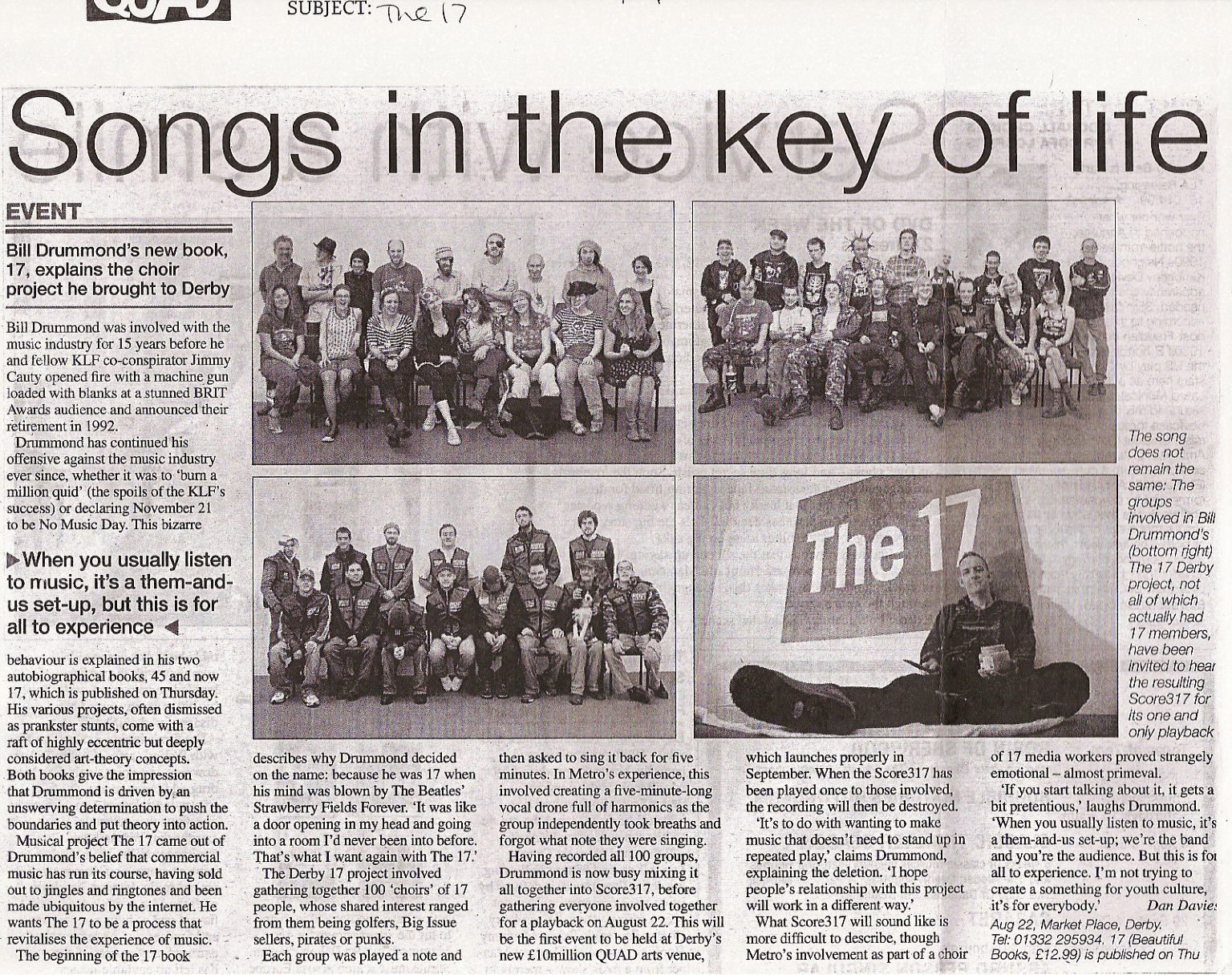

The17 performance in Derby Market Place
As part of the run up to the opening of QUAD, Derby’s new centre for art and film, a unique performance piece entitled ‘The17’ will take place on Derby’s’ Market Place on 22 August 2008. The performance involves 1,700 people from Derby and the local region, and has been created with QUAD by renowned artist and musician Bill Drummond.
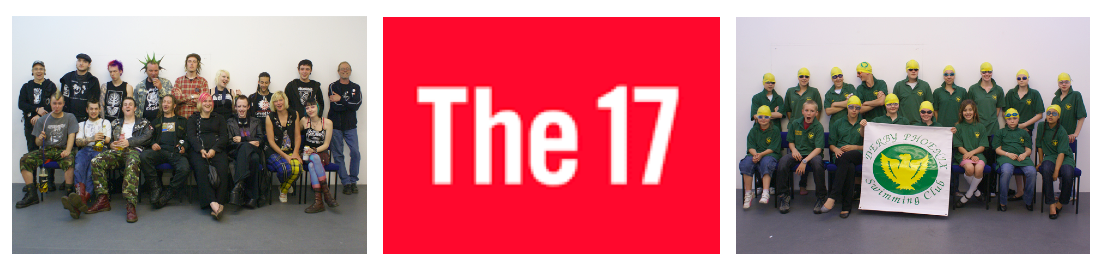
During six weeks over the summer, Bill Drummond and QUAD assembled 100 groups of 17 people from members of the community, and included groups of photographers, punks, pirates, hairdressers, Bach Choristers, Media Workers and MacDonald’s Staff.
Each of the groups attended a recording session, making one note with their voices for five minutes, and these 100 separate recordings will be mixed together to create one huge piece of choral music. All 1,700 participants have been invited to the Market Place for the evening of the 22 August 2008, to hear the one and only play back of this recording, before it is deleted forever. The only audience to The17 will be the singers themselves, so to hear The17 you have to have been part of it!
The17 participants also had a group photograph and group video portrait taken when they attended the recording session. The17 photographs will be included in the first exhibition inside QUAD, which will be open from Friday 26th September, and will also be published in a special The17 book, which available from QUAD. The17 videos will be shown in QUAD digital screens and on the BBC Big Screen.
What makes a business successful?
This is an article by Tracy Pepper you can find on the CIN website here (thanks Patrick for the kindness):
The question I am asked most often as a coach is what makes a business successful. Every business is of course different but for me the essentials are:
• Having a passion for what you do – if you love what you do your enthusiasm will come across when communicating to potential customers that will buy your product or service.
• Create a Vision – picture what your business will be like in 12 months time – create a collage or write down in detail describing the various areas, what you are selling – to whom- how much you are earning, where you are working etc. By creating this rich picture you are rehearsing in your mind your plan.
• Know how to communicate what it is you do/make/provide- when asked – “what is it that you do” don’t say I am an architect say I am an architect that specialises in modernist city centre designs, or I hand-make handbags with unique designs that appeal to most teenage girls.
• Know your customers – know who your product/ service will appeal to and target that market first. Do research if you can to confirm your view – sometimes you are wrong.
• Have a business plan – it is essential that you get what you want to achieve out of your head and down onto paper. Once it’s written down it takes you a step nearer to committing to do it. It also gives you the confidence and clarity of taking steps that move you forward. I will cover this area in more detail in future columns.
• Network and get as much help as you can – being part of networks like CIN give people working on their own and small companies the opportunity to hear from others the challenges and solutions they face. Mostly your challenges are similar to others. Networks are great places to explore funding opportunities and employment issues.
• Have patience and persistence – in business things can move slower than you would like and rarely happen first time of asking. Don’t give up at the first or even second delay.
Finally an old cliché – enjoy what you do – we spend far too much time working to not!
From one to many
This was posted here by Derby-based Graham Bennett. It’s food for thought in relation to organization management. Not that you have to be CEO of something to make sense of it. it works also if you work alone. especially in the creative sector. Thank you, Graham.
Changing organisational cultures
At a presentation given by Kevin Williams (at the time Chief Executive of YMCA England) we were shown a photograph of the people responsible for running YMCAs in the 1960s. They were all grey suited men.
Kevin then went on to explain that, currently, the majority of the larger YMCAs are now managed by women.
Clearly this cannot be the whole story – so what other changes have also taken place which might support such a change in leadership? And what might we learn from this?
I began by drawing a line down the middle of the page, putting “Male” at the top of the left hand side, and “Female” at the top of the right hand side. The following is a list of changes which seem to have happened in the world with which we work, during the same period of time:
Male to Female
Heavy Industry to Service Industries
Machines to Ideas/Knowledge
Strength to Nurturing
Specialisms to Multi-tasking
Power to Influence
Hierarchies to Networks
Control to Encourage
Command to Persuade / “sell”
Mono-culture to Valuing Diversity
Facts to Intuition
Books to Internet
Vote to Buy
Membership to Shareholder or User Group
Grants/Subsidies to Social Enterprise
Competition to Collaboration for mutual benefit
As with all caricatures, this needs some careful handling – but much of the world we work in is undoubtedly moving this way, and we all need to be able to respond. Even where organisations still need to work to the left side, some of their activities will need to work to the right side if success is to be achieved.
It seems likely that some of us are more comfortable when working in the way shown on the left side, others to the right. The solution to this must surely be:
* awareness of the issues;
* recognition of the inherent tensions between people, disciplines, organisations, and sectors; and
* having the right teams or partnerships in place to cover all bases.
If, from where you see the world, you feel that there are any other issues which should be considered, or added to the list, I would be delighted to hear of them.
Edgecraft
Ok, I got a crush on Seth Godin’s insights. This one you can find here. It’s about Edgecraft, which – according to him – is an iterative process that is much easier for an organization to embrace than brainstorming. Off we go:
It’s a mistake to try to champion much beyond your reach.
There are hundreds of available edges, things you can add to, subtract from or do to your product or service. Find an edge and go all the way to it. Going partway is time-consuming and expensive—and it doesn’t work very well. Going all the way to the edge is the only way to jolt the user into noticing what you’ve done. If they notice you, they’re one step closer to talking about you.
It’s all marketing now. The organizations that win will be the ones that realize that all they do is create things worth talking about.
And another little bit from the same book:
It’s not that people somehow lose their ability to be creative when they’re in an environment in which they feel safe. It’s that they ignore the creative ideas that naturally occur to them and fight the changes championed by others.
They like things the way they are, and they can’t resist the urge to defend the status quo. The challenge of the champion is to help people who are already creative to take advantage of their talent. By selling the dream and fighting the status quo, we can free people who have been lulled into a false sense of security.
And again:
You only have one boss, and if she doesn’t believe you can do it or that it’s worth doing, you’re stuck. If you can’t make the fulcrum work in the eyes of that key decision maker, your work is much more difficult. But there are hundreds of sources of capital in the outside world, and when you approach them as an entrepreneur, you’re more likely to have the posture of the champion. They want to believe that you’re the person who can do this, and thus you’re more likely to persuade them that you’re the guy.
That doesn’t necessarily mean the answer is to go outside and start something new. It means, instead, that you and your boss (or your co-workers, or your employees) should sit down together and figure out which parts of the fulcrum are out of whack.
Dramatic changes. Things that may very well be unattainable. Things that require not incremental improvements or changes, but significant quantum leaps in the way you organize, create and deliver what you do. If you can’t find a scary edge, then you haven’t found an edge, have you?
No use going to an edge that all your competition is going to as well. That’s not an edge. That’s the middle. Growth only comes from the leap to the remarkable.
But are you really serious about it?
Like the one that follow (and the one before), this is an article by Seth Godin; this time you can find it here. I almost bought his book…but before you rush off, here’s some interesting highlights:
I did a gig in New York today about the Dip and it went really well. Afterward, someone asked me a question about his new business.
I asked back, “if you accomplish that, will you be seen by your audience as the best in the world, or will you be seen as doing your best?”
He didn’t have to answer. He got it.
If you’re doing your best, only your AYSO soccer coach cares. If you’re the best in the world, the market cares. The secret, if you have limited resources (don’t we all) is to make ‘world’ small enough that you can actually accomplish that.
Obviously, this approach is applicable to just about any idea-based product, whether it’s consulting or clothes:
1. Find the core market
2. Obviously the otaku (Seth’s name for the ‘surplus’ in things)
3. make it easy to sample
4. Make it easy to share. And hope it hits the critical mass.
That seems common sense, but it’s common sense that’s not so common. Designing anything for the masses is silly. why? because the masses don’t buy stuff any more. The edges do.
Short. No attention left
Advise and Consent won the Pulitzer Prize in 1960. It’s 640 pages long. On Bullshit was a bestseller in 2005; it’s 68 pages long.
Commercials used to be a minute long, sometimes two. Then someone came up with the brilliant idea of running two per minute, then four. Now there are radio ads that are less than three seconds long.
It’s not an accident that things are moving faster and getting smaller. There’s just too much to choose from. With a million or more books available at a click, why should I invest the time to read all 640 pages of Advise and Consent when I can get the idea after 50 pages?
Audible.com offers more than 30,000 titles. If an audiobook isn’t spectacular, minute to minute, it’s easier to ditch it and get another one than it is to slog through it. After all, it’s just bits on my iPod.
Of course, this phenomenon isn’t limited to intellectual property. Craigslist.org is a free classified-ad listing service. A glance at their San Francisco listings shows more than 33,000 ads for housing. That means that if an apartment doesn’t sound perfect after just a sentence or two, it’s easy to glance down at the next ad.
The end.
Time management. In 5 steps
I’m talking here about Time. With capital T, since it’s the thing we mostly miss in life.
Especially if you’re self-employed, or you’re under pressure in your organization and/or familiar situation, Time is more than an essential idea in our life. Although is a convention, it’s felt like no other things.
So it’s worth to find a simple way to manage it, the most we can. it doesn’t mean being hyper-organized and hyper-anxious about organizing yours and other people’s life, but rather being aware how we spend our time.
I’m drawing some considerations from Mark McGuiness, a coach who’s running the insightful blog whishful thinking; boiling down and presenting them according to my experience. I hope that Mark won’t mind 😉
Ok, off we go:
1. Prioritise important things, but not urgent.
The trick is not allowing anything important become urgent. Do it with a schedule, prepare a timetable for what is going to come, try to spread important things over a week, or a month.
2. Ring-fence a bit of time, every day, for important goals and dreams in your life.
30 minutes in daytime (during your break, your lunch, or within your working hours); and 30 minutes in the evening (when you come home, after dinner, or before going to bed). Do not demand lots from this short sessions; adopt an easy attitude, like “I’m not going to work on that letter/application/project; I’ll just open the file and have a look at it…”
3. Reply only to yesterday’s e-mails.
Set an ‘_action’ folder in your inbox; put them all the email you receive during today’s work, and don’t reply to any of them. Deal only with one day (yesterday) bunch of e-mails, and it becomes manageable, because it’s limited, and you know in advance it’s limited.
4. Sort everything you have to do (job, family, interests, passions, volunteer work) in 5 folders/buckets/trays.
– the ‘_action’ folder of your e-mail inbox
– family and house
– job commitments
– passions and interests
– friends and volunteer commitments
This ‘buckets’ allow yourself to get off your head the seemingly infinite number of things you have to do. You’ll get through them day-by-day, finishing them and changing them over time, and keeping them in the right place at the right moment: you’ll never feel again that overwhelming sensation of not being able to keep the pace. Review the ‘trays’ every week, like 30 minutes on Saturday morning.
5. (and last) There so inspiration to wait for: only a lot of perspiration to do.
That means, you don’t wait for the right chance to do something; you create the conditions for that something to happen. You do what you ought to do (to yourself and to others); then let happen what might happen.
Coaching your career
Excerpt of article appeared on the Guardian, written by Lynsey Mellows:
If you are contemplating a change in career or feeling stagnant in your job, employing a professional career coach maybe just what you need to help you make an informed decision about your future.
Career coaching has experienced an explosive growth in recent years. Not to be mistaken for life coaching, which concentrates on personal development, career coaching is all about equipping individuals with practical guidance on how to move up, across or into a completely new field altogether.
Traditionally an employee’s career path has been left in the hands of a human resources department, but with more and more individuals taking control of their careers the role of the coach is becoming paramount […]
“Some clients want to move on from where they are now, but are unclear about what is the right move for them. Others know exactly what they want, but need help in convincing employers to hire them and some clients want help in managing a challenging situation at work,” said Corinne [Mills, managing director of Personal Career Management]
“We aim to help people understand what we call their ‘career capital’ – in other words, their transferable skills, knowledge, abilities and personal strengths. People massively underestimate their abilities. We use this knowledge to help them explore and decide on their options and then market themselves effectively to employers.”


 Curatorview [Alfredo Cramerotti]
1 comment