… the tragedy bloomed. And deceit became knwoledge. Exhibition by Michele Manzini
English:

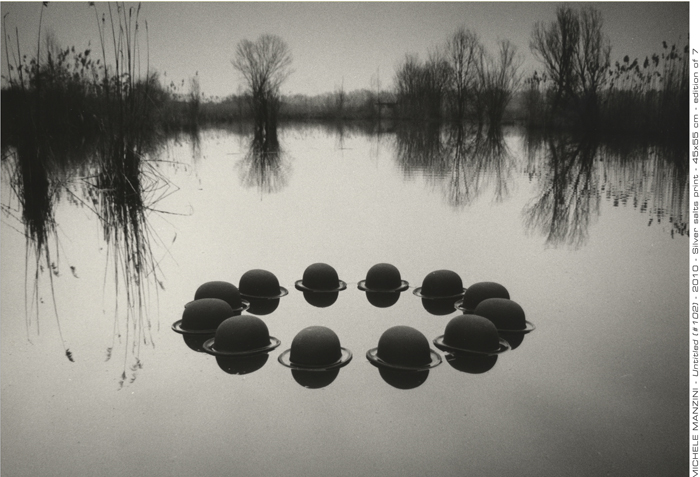
“When we recognize the cultural rather than political or physical traits of a context we can call it cultural geography.
“For example, this is what happens when the relationship between artists and the public is based equally on the two sides in order to generate, first knowledge (the ‘what’), and then meaning (in what terms). An artist’s ability consist in pushing himself beyond this artist/viewer dichotomy to create a third space, a cultural geography, an attempt to communicate. And not just communication between artistic and historical disciplines, but above all between “other” undertakings: economy, industrial design, philosophy, agriculture, law, town planning or whatever is most relevant in a particular place at a particular moment. Artists relate together spheres of activity and knowledge through a set of disciplines – and at every step they question themselves about what, how, and why. At least at this point.
“Every event linked to a cultural geography sets off a new challenge for the next action: new formats, new physical and mental spaces, new kinds of relationships, new times. Artists do not invent but simply transform existing infrastructures as the public slowly becomes receptive to them. They might start from museums of natural history and books about the economy to arrive at YouTube and the San Remo festival. They can incorporate buses, advertising hoardings, and scientific measurements. Art comes about when knowledge comes into conflict with the imagination, and this is a healthy, productive, and relevant conflict. “The work of an artist is a centre for possible studies. Not surefire but imaginable ones. And thus doable for the very fact that we can conceive of them.”
Alfredo Cramerotti, 2011
The show by this Veronese artist, who for years has been involved with the theme of landscape, will therefore be characterized by a kind of dissemination of the exhibition across various interpretative planes and levels. A curatorial approach consisting of semantic shifts, the dismantling of conceptual apparatuses, anomalous choices of exhibiting, iterations, invasions of other fields, talks, and the production of texts that describe aims which, at times, are divergent with respect to the artist’s figurative interests and his solid theoretical underpinning.
—
Italiano:

” Possiamo definirla geografia culturale, quando riconosciamo tratti culturali anziche’ politici o fisici di un contesto.
” Per esempio succede quando la relazione tra artista e pubblico si poggia equamente su ambedue le parti per generare prima conoscenza (che cosa), e poi significato (in che termini). L’abilita’ di un artista sta nello spingersi oltre questa dicotomia artista/spettatore, creando uno spazio terzo, una geografia culturale, un tentativo di comunicazione. Non solo tra discipline artistiche o storiche, ma soprattutto tra pratiche ‘altre’: economia, design industriale, filosofia, agricoltura, legge, urbanistica o quello che e’ piu’ rilevante in un determinato posto e un dato momento. L’artista mette in relazione sfere di attivita’ e conoscenza attraverso un ‘set’ di discipline – e a ogni passo si interroga sul cosa, come e perche’. O almeno a questo punta.Ogni evento legato a una geografia culturale fa scattare una nuova sfida per la prossima azione; nuovi formati, nuovi spazi fisici e mentali, nuovi tipi di relazioni, nuovi tempi. L’artista non inventa, semplicemente trasforma le infrastrutture esistenti man mano che il pubblico si apre a queste. Puo’ partire dai musei di storia naturale e dai libri di economia e arrivare a YouTube e al Festival di Sanremo. Puo’ incorporare autobus, tabelloni pubblicitari e misurazioni scientifiche. L’arte succede dove la conoscenza entra in conflitto con l’immaginazione, ed e’ un conflitto sano, produttivo, rilevante. ll lavoro di un artista e’ un centro per studi possibili. Non certi, immaginabili. E percio’ fattibili, proprio perche’ riusciamo a concepirli.”
Alfredo Cramerotti, 2011
La mostra dell’artista veronese, da anni impegnato sul tema del paesaggio, sarà quindi caratterizzata da una sorta di disseminazione dell’evento espositivo su più piani e livelli interpretativi. Un approccio curatoriale fatto di slittamenti semantici, smontaggio degli apparati concettuali, anomale scelte espositive, iterazioni, intersezioni, invasioni di campo, talk, produzione di testi che descriveranno traiettorie talvolta divergenti rispetto alla ricerca figurativa dell’artista e al suo solido corpus teorico.
Alfredo Cramerotti: Aesthetic Journalism. Public talk at Villa delle Rose, Bologna
Alfredo Cramerotti: Aesthetic Journalism
Public talk at Villa delle Rose
Via Saragozza 228-230, 40135 Bologna, Italy
Thursday 7 July 2011, 7 pm
As part of the Studio of Ælia Media, a project by Pablo Helguera, winner of the International Award for Participatory Art, Alfredo Cramerotti will present his research about aesthetic journalism and the consequences for artistic practices.

Alfredo Cramerotti’s curatorial approach does not consist in creating (new) “knowledge” about something, but in sharpening the existing ways of production and circulation of knowledge. That means he encourages artists to create relations of mutual influence with other systems that govern or facilitate our life, like mass media, science, law, architecture and other activities and planning methods. It means to constantly change the perception of society with artistic means. In one of his recent projects, the European biennial of contemporary art Manifest 8 that took place in the Region Murcia in Spain, Alfredo opened a space for information exchange for the participating artists, a suspicious and spiteful terrain compared with the “certainties” of art.
During his conversation at Villa delle Rose, Alfredo will cast light on this kind of approach, from the concept to the realization, and he will invite the audience to discuss the modalities of hybrid practices which – like bio-politics, development of sustainability, virtual reality and other processes that sum up various disciplines – recreate individual and society on an everyday base.
Alfredo Cramerotti is Senior Curator at QUAD art, film and media centre in Derby, UK and is Editor of Critical Photography at Intellect Books. Among his recent research and curatorial activity: Manifesta 8 European Biennial of contemporary art, Region of Murcia, Spain; FORMAT International Photography Festival’s Conference Derby, UK; Fellowship Art Theory and Criticism Künstlerhaus Büchsenhausen Innsbruck, Austria; CPS Chamber of Public Secrets, art & media production unit; AGM Culture, roaming curatorial agency.
Cramerotti has curated more than sixty international exhibitions and multimedia projects, working on major shows of, among others, Ian Breakwell, Dinu Li, Daphne Wright, Bill Drummond and Jane & Louise Wilson. He has published in Brumaria, Nolens Volens, Manifesta Journal, MOLE, Esse Arts+Opinions, Altyazi, Journal of Media Cultural Politics, Transmission, Pages Magazine, and authored the books ‘Aesthetic Journalism: How to Inform without Informing’ (2009) and ‘Unmapping the City: Perspectives of Flatness’ (2010). Visiting Lecturer in numerous European Universities such as NTU Nottingham Trent University, University of Westminster London, Sotheby’s Institute of Art and ArtEZ/DAI Dutch Art Institute Arnhem.
International Award for Participatory Art
An initiative of the Legislative Assembly of the Region Emilia-Romagna, Italy
In collaboration with LaRete Art Projects and goodwill.
http://www.artepartecipativa.it
Ælia Media. A project by Pablo Helguera.
Realized together with: Emanuela Ascari, Katia Baraldi, Fedra Boscaro, Lorena Colantuono, Giorgia Dolfini, Vincenzo Estremo, Federica Falancia, Matteo Ferrari. Emanuele Girotti, Eléonore Grassi, Nathaniel Katz, Tihana Maravic, Marianna Mendozza, Stefano Miniato, Stefano Pasquini, Cinzia Pietribiasi, Linda Rigotti, Francesca Pizzo, Ennio Ruffolo, Anna Santomauro, Alessandra Saviotti, Daniela Spagna Musso, Annamaria Tina.
Curated by Julia Draganovic and Claudia Löffelholz.
Organization and coordination: Alice Militello and Federica Patti.
Press and communication: goodwillcom
All That Fits: The Aesthetics of Journalism on N_P Networked Performance
ll That Fits: The Aesthetics of Journalism [ Derby]
Networked Performance Blog
 [Image: Insurance.AES256 by Michael Takeo Magruder. See video below.]
All That Fits: The Aesthetics of Journalism — Curated by Alfredo Cramerotti & Simon Sheikh :: until July 31, 2011 :: QUAD Gallery, Market Place, Cathedral Quarter, Derby, DE1 3AS.
The exhibition All that Fits: The Aesthetics of Journalism presents the provocative idea that art and journalism are two sides of a unique activity; the production and distribution of images and information. The exhibition brings to the surface how images and information are communicated, and the aesthetic principles used in the act of transmission.
Whereas journalism provides a view on the world, as it ‘really’ is, art often presents a view on the view, as an act of reflection. All that Fits: The Aesthetics of Journalism will examine both as systems of information that define truth in terms of the visible but also what can be imagined.
In the course of two months, the exhibition will be presented in three chapters: The Speaker, The Image and The Militant. The three separate displays of artwork refer to the rotation of the news cycle, while each responding to the overall theme.
The Speaker (May 28 – June 19) concerns a specific figure, the speaking subject or author, also in terms of editorial processes and camera angles. What can enable a subject to appear as authentic, authoritative and truthful?
The Image (June 22 – July 10) examines how images are produced, through framing and positioning, but also how counter-images are created. Despite the claim of neutrality and pragmatism, this chapter proposes an ‘aesthetics of journalism’.
The Militant (July13 – 31) continues the strand of counter-images, but by using journalistic means such as exposé and research. These methods often work to uncover what a corporate media industry does not, and thus return to some of reportage’s initial claims.
Sammy Baloji (DR Congo), Yael Bartana (Holland/ Israel), Eric Baudelaire (France), Ursula Biemann (Switzerland), Ross Birrell (UK), Michael Blum (Canada /Israel), Broomberg and Chanarin (UK/South Africa), Abraham Cruzvillegas (Germany/ Mexico), Anita Di Bianco (Germany/USA), Marcelo Exposito (Argentina/ Spain), Douglas Fishbone (UK/USA), Zachary Formwalt (Holland/ USA), Wynne Greenwood and K8 Hardy (USA), Tamar Guimaraes (Brazil/ Denmark), Lamia Joreige (Lebanon), Graziela Kunsch (Brazil), Michael Takeo Magruder (UK/USA), Renzo Martens (Holland), Oliver Ressler (Austria), Katya Sander (Denmark), Slum-TV (Kenya), Hito Steyerl (Germany), Walid Raad/ The Atlas Group (USA/ Lebanon) and Alejandro Vidal (Spain).
All That Fits – video introduction of Michael Takeo Magruder’s work from Alfredo Cramerotti on Vimeo.
All That Fits: The Aesthetics of Journalism is supported by the Danish Art Council, Mondriaan Foundation, Autograph ABP, The Jack Kirkland Collection, the Embassy of Brazil in London and Centre National des Arts Plastiques (France).
Also see The Production of Truth: The Aesthetics of Journalism by Alfredo Cramerotti and Simon Sheikh, Digimag.
The Production of Truth. The Aesthetics of Journalism
DigiMag 65
Txt: Alfredo Cramerotti e Simon Sheikh
June 2011
http://www.digicult.it/digimag/article.asp?id=2099


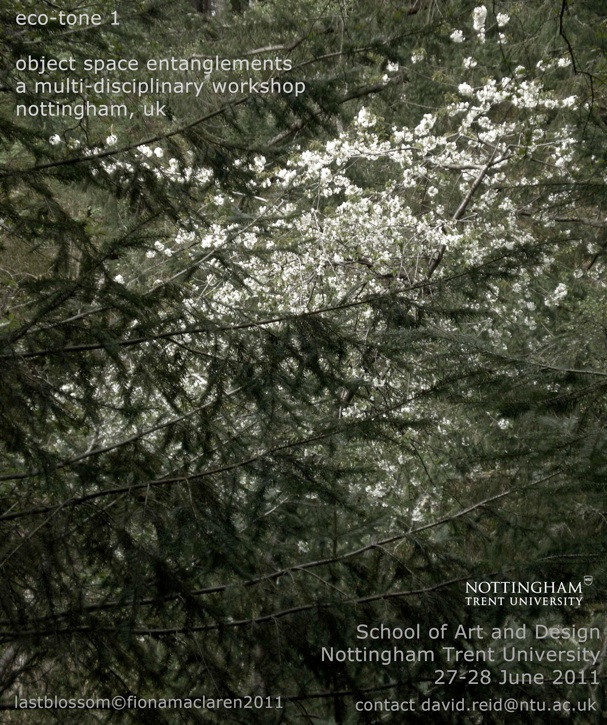
Eco-tone 1 – Object Space Entanglements
Interdisciplinary workshop supported by Nottingham Trent University School of Art and Design research fund
Nottingham Trent University, Nottingham, UK
27-28 June 2011
Eco-tone brings into proximity creative and academic practice to juxtapose modes of awareness associated with specific activities so that they are experienced beyond usual boundaries. Participants are invited to respond to the relationship of environment, ecology and ecology of practice; to form spatial relations from within which we can expect to witness resonances that enhance how practice operates.
Eco-tome aims to enhance understanding of our relationship with environment and ecology.
Participants
Jean Baird [Art and Design, Nottingham Trent University] – Why objects?
Professor Kathleen Coessens [Kathleen Coessens, pianist and philosopher of Vrije Universiteit Brussel and Senior Research Fellow of Orpheus Research Centre in Music] – Responsive Space
Mary Conlan [Shinnors Curatorial Fellow, Limerick City Gallery of Art] – Six Memos Calvino project, Smog, Knowledge as Dust-cloud and the unfinished lecture on Consistency; Eco-tone ‘curator in action’
Alfredo Cramerotti [QUAD, Derby, and Intellect Books] – The Essence of Things; Eco-tone ‘curator in action’
Rhodri Davies [Harp] – Occam 1 [Elaine Radigue]; Harp as Filter [Jean-Luc Guionnet]
John Ellis [Nottingham Trent University] tbc – Latour and the Social
Paul J. Ennis [Department of Philosophy, University College, Dublin] – Melancholic Coexistence amongst Objects.
Chrissie Harrington [Head of School of Arts and Humanities, University College Suffolk] tbc – The Space Between
Robert Jackson [School of Art and Media, University of Plymouth] – The Agency of Waste: Purification and Procedure.
Dr Kevin Love [Senior Lecturer in Philosophy and Social Theory School of Social Sciences] Nottingham Trent University – Dispositions: ecologies of philosophy.
Dr David Reid [School of Art & Design, Nottingham Trent University] – Eco-tone: Ecology of Practice
Jonathan P Watts [Critical Writing for Art & Design, Royal College of Art] – England and the Octopus
Undergraduate research project – Photography, Environment, Ecology. Oliver Seamarks and Ben Gore.
—
Abstracts available on request
All welcome
If you wish to attend please respond to ensure adequate catering and room space is available.
Contact: david.reid@ntu.ac.uk
object space entanglements blog
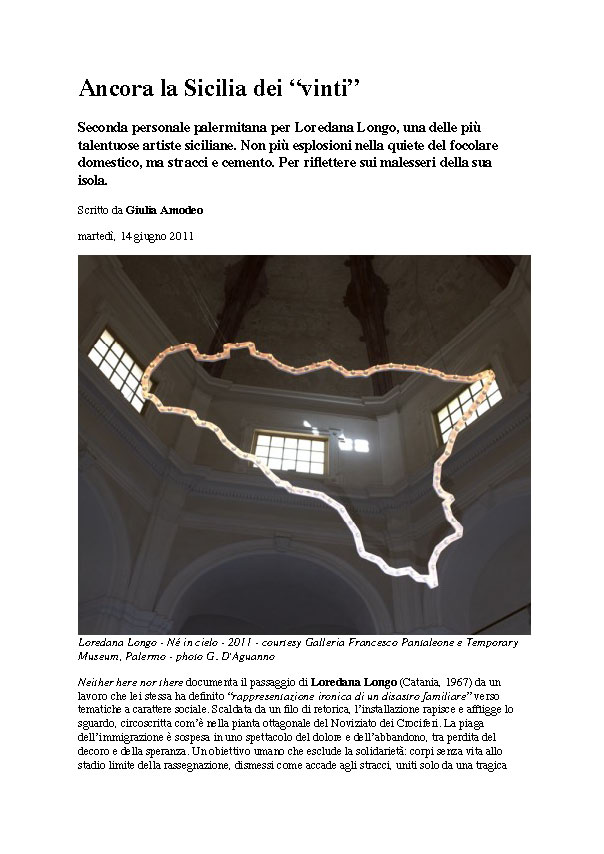
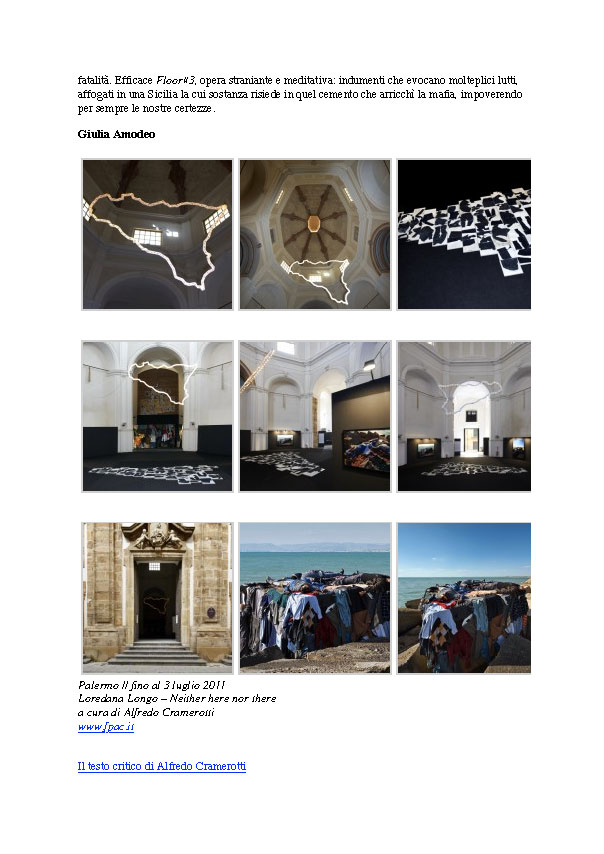
Ancora la Sicilia dei “vinti” Seconda personale palermitana per Loredana Longo
Artribune.com
by Giulia Amodeo
martedì, 14 giugno 2011
[italian]
‘All That Fits’ exhibition – video introduction of Michael Takeo Magruder’s work
All That Fits: the Aesthetics of Journalism, curated by Alfredo Cramerotti and Simon Sheikh, includes the work ‘Insurance AES256 by Michael Takeo Magruder.
This is his video introduction to the work.
The Guardian Guide: ‘All That Fits’ exhibition review
The Guardian Guide
by Robert Clark
28 May 2011

‘All That Fits’ exhibition – video introduction by Alfredo Cramerotti
All That Fits: the Aesthetics of Journalism is an exhibition curated by Alfredo Cramerotti and Simon Sheikh, exploring the complements and conflicts between art practice and journalism.
Exhibitions open at Derby QUAD from 28 May to 31 July 2011.
NEWS! New Event World Spectacular – Introduction by Lauren Mele
Exploring the dialogue between art and journalism.
An interview with Lauren Mele, co-curator of NEWS! partner exhibition to All That Fits: The Aesthetics of Journalism.
Exhibitions open at Derby QUAD from 28 May to 31 July 2011.


 Curatorview [Alfredo Cramerotti]
leave a comment