AZART PHOTO: FORMAT11 International Photography Festival
Issue Jan-Feb-Mar 2011
(French)


Manifesta 8 – In Dialogue with Northern Africa VAGA Tour 6-8 October 2010
VAGA Visual Arts and Galleries Association Newsletter
13 August 2010
Manifesta 8 takes place in the Spanish cities of Murcia and Cartagena. It is being curated by Alexandria Contemporary Arts Forum, Chamber of Public Secrets and Tranzit.org and explores the idea of Europe in the 21st century, focussing on the
boundaries of the continent and engaging with Europe’s present-day frontiers and its interrelation with the Maghreb region. The South of Spain, specifically Al-Andalus, has been a historical blend of Islamic, Judaic and Christian cultural influences co-existing together.
Wednesday 6th October 2010
MURCIA
6.00pm
Introductory Talk with Alfredo Cramerotti, Co-Curator of Manifesta 8, part of the
Chamber of Public Secrets curatorial collective and Curator at QUAD in Derby.
Media Lounge Espacio Molinos del Rio-Caballerizas C/Molinos 1
No Such Place: A Partial History of Imaginary Maps

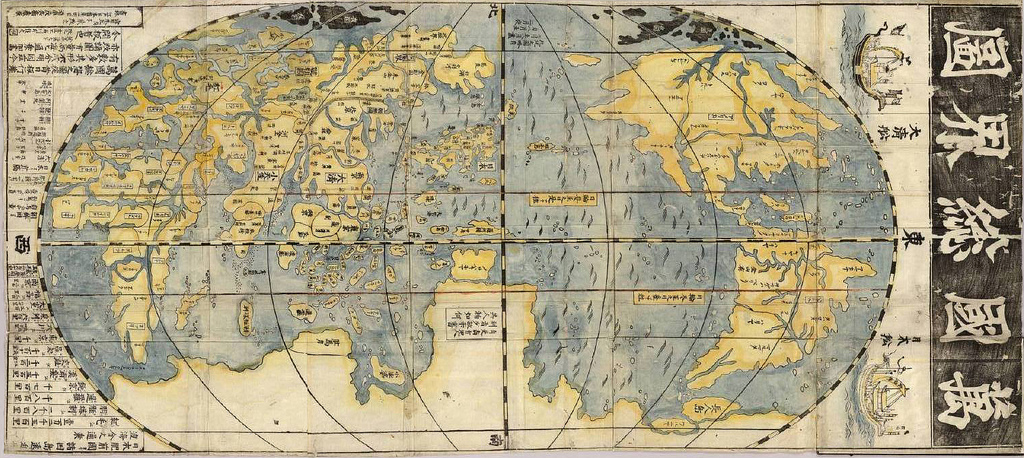
To tie in with Ground Level, QUAD commissioned Artist Cathy Haynes to curate an exhibition on the theme of imaginary maps. In a ‘residency of maps’ she journeyed utopias and fantasy lands with a list of questions such as: Did we really believe the earth was flat before Columbus? How have map-makers filled gaps in known territory? Can a map ever be perfectly true? What counts as an imaginary map? Can a map shape reality? Can it even alter our sense of identity?
To find the answers, she looked at maps from the Age of Discovery that combine new scientific thinking with mythical beasts and puzzled over secret codes and private jokes inscribed in official land surveys. She complemented this with research of Ocean charts, peppered with phantom landforms, including one respected scientist’s theory that the earth is hollow, plus a blueprint for straightening the Thames through central London.
Through the findings of her research process, she has made a collection of extraordinary maps and map-making stories from the history of cartography, engineering, philosophy, literary fiction, interwoven with pop culture, propaganda, contemporary art and feature films.
Image: The Carta Marina by Olaus Magnus, 1539: the most accurate map at the time of the Nordic countries.
Ground Level


Hayward Touring Curatorial Open II
QUAD Gallery 18th September – 31st October 2010
Ground Level explores how contemporary art practice, mapping and cartography collide. Traditionally the role of the cartographer has been to provide a geographically precise description of the landscape. However, rarely has it been a wholly objective enterprise. While technology increasingly grants access to the precision of satellite imagery, the cartographer’s work has moved further from the ground into more contested areas such as ownership, rights to land, and the flows of people.
This exhibition brings together international artists who perform their own personal forms of cartography. The resulting works suggest maps and surveys, but rather than portraying a singular worldview they put forward idiosyncratic readings of language, peoples and signs, as well as geography.
The exhibition is curated by Kit Hammonds, winner of the 2010 Hayward Curatorial Open, a platform for innovative curatorship in the UK.
Artists include: Maria Thereza Alves; The Atlas Group; Ricardo Basbaum; Heath Bunting and Kayle Brandon; Center for Land Use Interpretation; Simon Evans; Yolande Harris; Christian Philipp Müller; Eyal Weizman; Stephen Willats. Ground Level is a Hayward Touring exhibition selected and developed in partnership with John Hansard Gallery; QUAD, Derby; Oriel Mostyn, Llandudno and Leamington Spa Art Gallery & Museum.
Click here to see a video interview with Curator Kit Hammonds.
Publication
Ground Level accompanies the second Hayward Touring Curatorial Open exhibition devised by writer and curator Kit Hammonds. This limited edition publication features work by Maria Thereza Alves, The Atlas Group, Ricardo Basbaum, Heath Bunting with Kayle Brandon, Center For Land Use Interpretation, Simon Evans, Yolande Harris, Christian-Philipp Müller, Eyal Weizman and Stephen Willats.
It also includes an illustrated essay by Hammonds exploring the way in which mapping relates to contemporary visual art as an experiential process that requires a direct relationship with the landscape, geography and people.
Exhibition copies feature a specially produced Risograph facsimile of Island Time by Simon Evans. Ground Level is published by Hayward Publishing and is available in all good art bookshops and at QUAD during the exhibition.
Images:
Maria Thereza Alves, Seeds of Change (Bristol), 2007 © the artist, 2010
Heath Bunting with Kayle Brandon, Borderxing, 2004 © the artist, 2010
Center For Land Use Interpretation, The Hydraulic Models of The Army Corps of Engineers, 2010. ©the artist, 2010
Ian Breakwell: The Elusive State of Happiness on Derby Evening Telegraph
Derby Evening Telegraph
12th February 2010

The new Photographer
From 19 to 21 June I have participated – in representation of QUAD Derby and Intellect Books Bristol, at the first UK National Photography Symposium in Manchester, organized by Redeye – The Photography Network, in collaboration with the University of Bolton and Arts Council England.
Paul Herrman, the Director of Redeye who brainchild the symposium, held an interesting session in relation to the figure of the ‘contemporary photographer’. First, he highlighted the big changes in relation to photography occurred in the last decade:
– camera ownership – digital imaging
– internet
– education
– photography in the art world
Along these changes, a transition happened also in terms of old photographer / new photographer:
The old practitioner: The new practitioner:
– primacy of technique – primacy of ideas
– specialization – complementary range of works
– selected audience/circles of admirers – international audience/virtual circles
Today’s ‘top photographers’ present therefore the following features:
1. Interest, knowledge and reading in relation of the photographic economy and the world at large: ‘if your picture are not good enough, you don’t read enough.’
2. Marketing, talking and writing
3. Development of ‘the voice’, that is, differentiate oneself (the famous line ‘I can/can’t see you in these pictures…’ often heard in portfolio reviews)
4. Building relationships in time with curators, buyers and other professionals
5. Work ethic and good business (with the right balance of copyright and free licence use)
6. Long terms commitment (minimum of five-six years of practice before ‘getting’ anywhere), and motivation: both clients and professionals need to know that a photographer is going to be there in ten years time
7. Craft and ideas – research opportunities and deliver results.
Furthermore, Herrman listed ’twenty things one can do to get closer to be a top photographer’ (besides talent and commitment, I guess):
1. Going to openings – where people want to hear your ideas
2. Going to festivals (only three or four in the UK, but many abroad)
3. Business link (GVA – Great Value Added is not the only criteria)
4. Gettting some trading (agencies, galleries, etc)
5. Social media (internet at large helps to know people)
6. Metadata, absolute crucial to caption and keyword the work
7. Project making: a strong enough project to get teeth onto, something that resonates with people
8. Partnerships/collectives such as getting together with a writer, or a musician, etc. to realize a project
9. Website/blog, using to get ideas out and update regularly
10. Slideshow; collaborating with someone else, like sound people and through a narrative structure, to create a slideshow and show in programmes and venues such as BBC Big Screens around the UK (desperate to get good content)
11. Preparing portfolio
12. Marketing material such cards, etc.
13. Writing, important aspect
14. Giving a talk; it helps to get your ideas together
15. Applying for a grant; criteria to assess proposal are published on the Arts Council website; core matter is the audience development and which bits of work will accomplish that. Writing a good grant application is part of the job as photographers
16. Print sales
17. Exhibiting wherever one can (not whenever, I’d say…); getting used to the idea of exhibit
18. Entry and checking competition
19. Email/newsletter every 6 months, to let the network know what one has been done, etc.
20. ‘You have to be burning and you have to have your shit together’
In photography, but possibly in all arts disciplines (and non-disciplines), if one has to say something, it’s got to be said in a manner that is a) accessible b) that matters and c) that adds something to what have been said before. Question, transform, exchange. To be interested in photography, one has to be interested in the world.


 Curatorview [Alfredo Cramerotti]
leave a comment