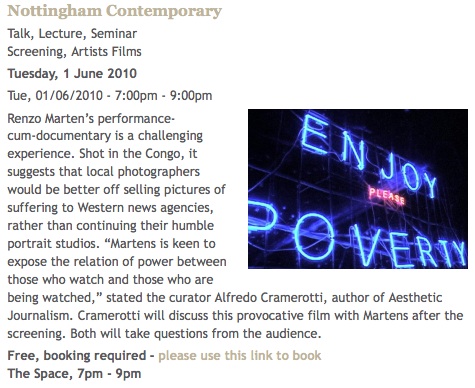
Presentation of Manifesta 8 in Rome / Alfredo Cramerotti’s interview
29 May 2010
Interview to Alfredo Cramerotti, co-curator Manifesta 8, in occasion of the presentation of the biennial in Rome

At the historic Belle Époque cafe, Bar della Pace in Via Santa Maria della Pace, one-minute walk from Piazza Navona, from 11.00am to 12.30pm
The event will see the participation of Hedwig Fijen (Director Manifesta Foundation, Amsterdam), Alfredo Cramerotti (curator M8, from the curatorial group Chamber of Public Secrets, Copenhagen), Lisa Mazza (Manifesta Foundation, Amsterdam), Esther Regueira (the new general co-coordinator of M8 in Murcia) and Jonathan Turner (M8 editor, Rome).
The presentation will take place in concurrence with the art fair Roma – The Road to Contemporary Art, and with the press launch and official opening of the new MAXXI – Museum of 21st Century Art in Rome, designed by Zaha Hadid.
Alfredo Cramerotti: Aesthetic Journalism at Autograph ABP / Rivington Place, London
Autograph ABP London Newsletter
Thu, 25 Mar 2010
Alfredo Cramerotti: Aesthetic Journalism
13 April 2010, 6:30-8:00, Rivington Place, London

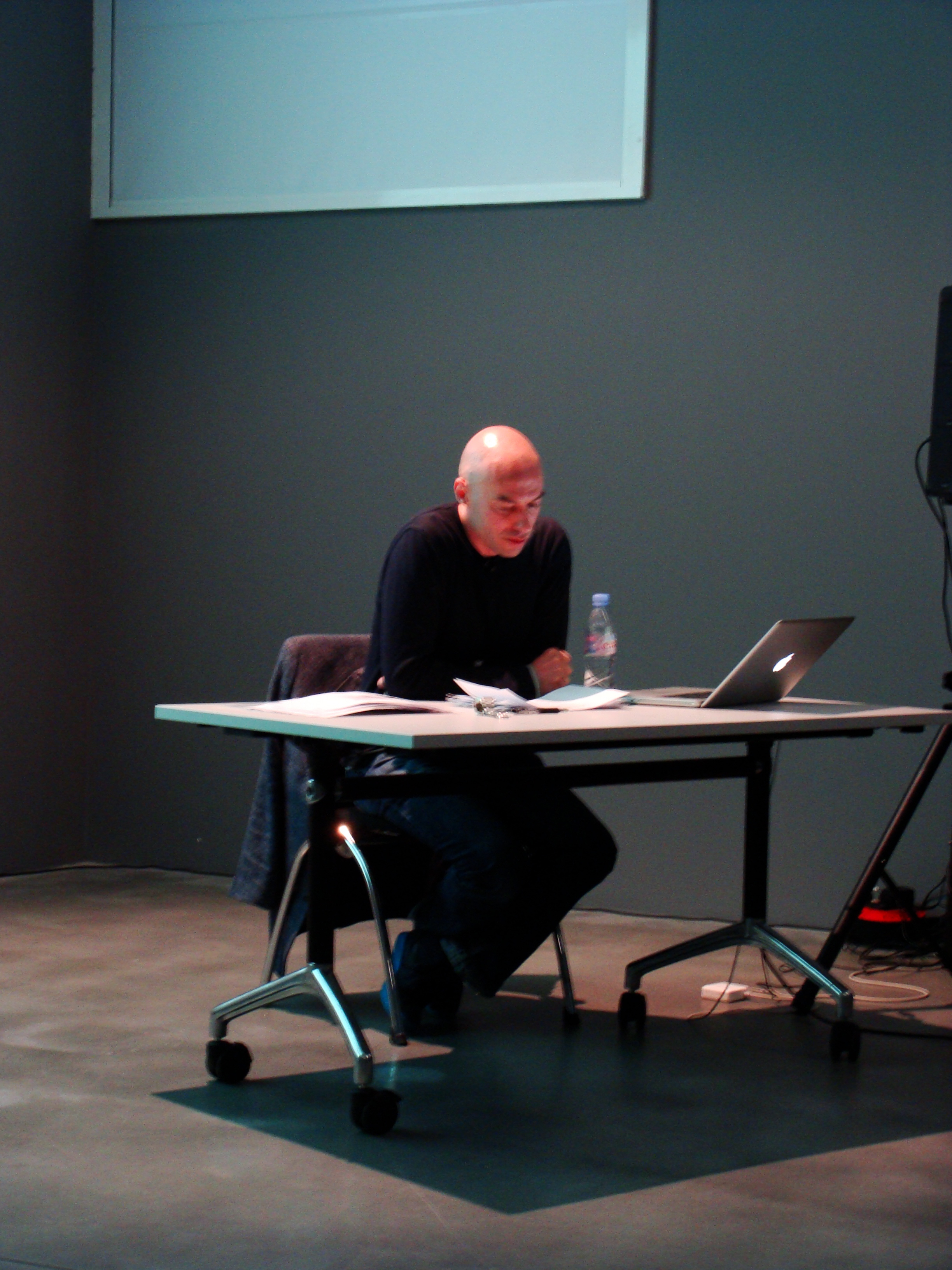
Autograph ABP is proud to present a talk at Rivington Place with writer, curator and artist Alfredo Cramerotti. Addressing a growing area of focus in contemporary art, Aesthetic Journalism investigates why contemporary art exhibitions often consist of interviews, documentaries and reportage.
Art theorist and curator Alfredo Cramerotti traces the shift in the production of truth from the domain of the news media to that of art and aestheticism – a change that questions the very foundations of journalism and the nature of art. The book probes the current merge of art with the sphere of investigative journalism and explores how this new mode of information is appropriating more and more space in modern culture. Aesthetic Journalism suggests future developments for this new relationship between art and documentary journalism, offering itself as a useful tool to audiences, scholars, producers and critics alike.
Cramerotti probes the current merging of art with the sphere of investigative journalism. The attempt to map this field, here defined as ‘Aesthetic Journalism’, challenges, with clear language, the definitions of both art and journalism, and addresses a new mode of information from the point of view of the reader and viewer.
Audio of the talk available from: OPEN-i (Open Photojournalism Edu
Ian Breakwell: The Elusive State of Happiness on Art Monthly
David Briers / Art Monthly
Issue 5 April 2010
(excerpts)
[…] This exhibition, in Breakwell’s home town, is the first retrospective survey of the artist’s work since his death in 2005.
[…] Selecting a representative but not unwieldy group of works cannot have been an easy task, but one which the exhibition’s curators have achieved with perfectly judged restraint – this is the best exhibition of Breakwell’s work that I have seen […]
DAVID BRIERS is an independent writer and curator based in West Yorkshire.

Ian Breakwell: The Elusive State of Happiness on Art World
Paul Carey-Kent / Art World
4 April 2010
Hi Louise / Alfredo
I just thought I’d congratulate you on The Elusive State of Happiness, which I thought was a fabulously put together show, as good as anything in the country at present. I did already like Ian Breakwell’s work (see eg my blog review for March 8 on the recent Anthony Reynolds show) but I didn’t expect such a comprehensive and effectively-installed presentation of his virtues.
Best wishes,
Paul Carey-Kent
(Editor at Large, Art World – currently suspended)
Recommended London shows @ blog: http://paulsartworld.blogspot.com
IMAGES FESTIVAL Toronto: Alfredo Cramerotti on Chamber of Public Secrets
29 Mar 2010
CPS Chamber of Public Secrets, Co-curated by Khaled Ramadan and Alfredo Cramerotti


Chamber of Public Secrets works as a network of artists, curators and thinkers who have been collaborating since 2004 on the organization, production and circulation of film and video festivals, exhibitions, TV and radio programs, political fictions and documentaries. CPS members have also established forums for debate and published books and articles on issues like media representation, migration, mobility, colonialism, gender and difference. CPS helps to debate the position of artistic and media narratives and the function and responsibility of both in relation to society.
The CPS Archive was established in Copenhagen 2007 as an independent, non-profit art project focusing on the latest developments in visual art culture. The archive collects, preserves, and provides photographs, video films and documentaries about a variety of issues, thereby exploring, exposing and exemplifying the way contemporary art interacts with society through the use of new media.
The archive functions as an information and research centre and is open to the public. It consists of an electronic image, video and film database, which forms the basis for exhibitions, debates, symposiums, artist presentations, performances and screenings. The CPS Archive is open for cooperation with individuals and institutions that share the interest in exploring, examining and informing the contemporary artistic usage of visual elements – with the aim of enhancing communication between people of different societies.
For this screening, Alfredo Cramerotti will be presenting recent works from the archive by artists including Mounira Al Solh, Dalia Alkoury and Raed Yaseen that will serve as an introduction to a curatorial project he and Khaled Ramadan have worked on for Manifesta 8 called The Rest Is History?
Through operating as a roving Biennial, Manifesta must each time address and negotiate a different context with specific geographical, historical, aesthetical and political structures. In this way, its curators are offered the opportunity, and the challenge, to engage with local, global and networked communities using a variety of platforms and methodologies.
In the vision of CPS, Manifesta 8 is a series of ‘transmissions’ that critically use artistic, relational and media(ted) strategies to explore ideas of what Spain / Europe is today and focus on its boundaries and relationship with Northern Africa, encouraging viewers to ask questions.
CPS’s approach to curating encompasses (mass) media platforms such as television, internet, radio and newspapers, alongside other exhibition formats. Broadcast airtime, online streaming, printed matter, human relations and physical venues are all ‘channels’ in which we present different types of constructions. These media(ted) channels are an extremely interesting place to situate a series of projects for Manifesta 8. By challenging artists and contributors to explore new terrains beyond their usual practice, we question what is the media’s relationship to the construction of a local reality, how does it relate to ideas of truth, fact and history, and what are its possibilities for engaging with new audiences? And why do we need to expand the existing boundaries of art by introducing the notion of media?”
Khaled Ramadan is an artist and curator currently based in Helsinki. His fields of specialty include the culture and history of broadcast aesthetics, with interests in the fields of aesthetic journalism and documentary film research. He has produced several documentary films, theoretical texts and books on broadcast aesthetics, journalism and documentary filmmaking. Ramadan also has extensive experience curating video exhibitions and film festivals. He is the founder of the MidEast Cut festival, the Made in Video festival, the Coding-Decoding documentary festival, the video festival Not on Satellite, and the Video File. He is member of the International Association of Curators of Contemporary Art, IKT and is currently co-curator of Manifesta 8.
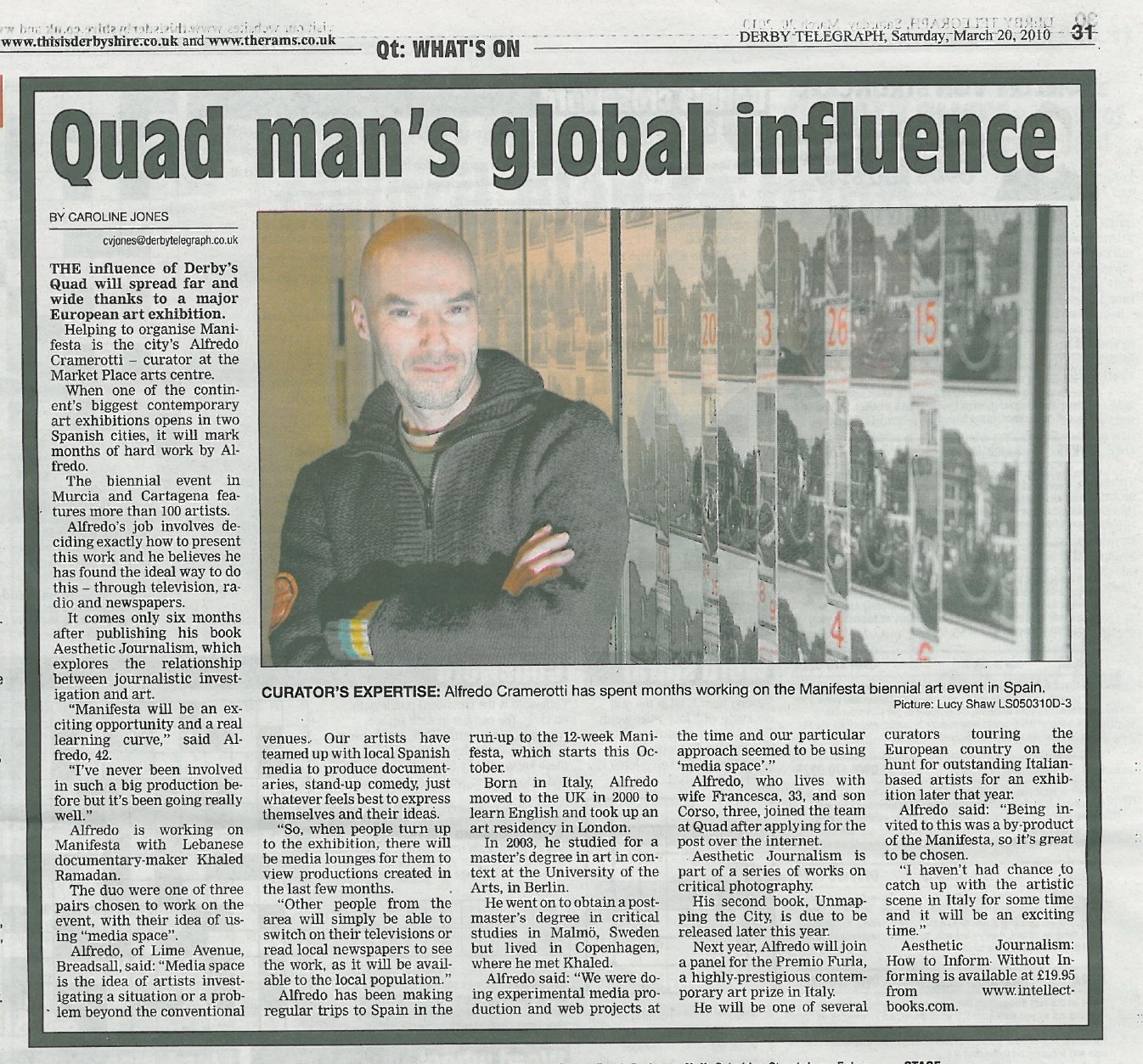
Alfredo Cramerotti is a writer, curator and artist. His work explores the relationship between reality and representation across a variety of media. He is co-curator of the forthcoming Manifesta 8, a European biennial of contemporary art in Murcia and Cartagena, Spain, and curator of QUAD, an art, film and media centre in Derby, UK. He co-runs the collective art and media projects Annual General Meeting and Chamber of Public Secrets. Recent publications include Aesthetic Journalism: How to Inform without Informing (2009).
Presentation Zen Reloaded
Hello
this is a post by Mark McGuinness about the book ‘Presentation Zen’ orginallty posted here
How many of us can honestly say we look forward to another PowerPoint presentation? ‘Death by PowerPoint’ is so common it’s become a cliche, conjuring up images of endless slides full of bullet points in a font just too small to read – so the presenter spends eternity 30 minutes with his head craned backwards over his shoulder, reading the text to us in a monotone.
It doesn’t have to be like this.
Would you believe me if I told you PowerPoint can be a very creative medium to work in? Or that I look forward using PowerPoint (or Keynote on my Mac) whenever I have a new presentation to put together?
How would you like to not only overcome any nervousness about presenting, but to enjoy using PowerPoint as an expression of your creativity — and an opportunity to wow your audience?
Here’s a book that will help you do just that.
Presentation Zen by Garr Reynolds
As the name suggests, Presentation Zen
The book and the fabulous Presentation Zen blog grew out of Garr Reynolds’ frustration with the ‘death by PowerPoint’ approach. Presentation Zen offers its solution in three stages:
- Preparation
- Design
- Presentation
1. Preparation
 Photo by Amir K
Garr makes the often-overlooked point that there is more to a presentation than PowerPoint slides — and we may not need them at all. The main reason most presentations are so mediocre is that we don’t stop to consider what we really want to say, and how we can best communicate it to our audience.
So instead of rushing to fire up PowerPoint and start typing bullets, Garr encourages us to leave the computer alone and start by Planning Analog – asking ourselves important questions and scribbling down the answers on paper or a whiteboard:
Who is the audience?
What’s their background?
Why was I asked to speak?
What do I want them to do?
What visual medium is most appropriate for this particular situation and audience?
What’s the story here?
What is my absolutely central point?
Once you have the answers to these questions, time to start Crafting the Story. Why is storytelling important?
Good presentations include stories. The best presenters today illustrate the points with stories, often personal ones. The easiest way to explain complicated ideas is through examples or by sharing a story that underscores the point. Stories are easier to recall for your audience.
I know exactly what Garr means. When I first started giving presentations, about 10 years ago, I realised pretty quickly that what my audience responded to most strongly was the stories I told. And it was no coincidence that as soon as I became immersed in telling a story, I became animated and full of enthusiasm.
Stories are engaging and memorable because they present ideas via a human situation — usually involving some kind of drama or struggle and its resolution. They arouse powerful emotions in the presenter and audience — which makes them motivating as well as memorable.
If I could only offer one piece of advice while coaching someone to be a better presenter, it would be: tell a story that means something to you. It could be from your own experience, but it doesn’t have to be. If a story resonates for you personally, that will come across when you tell it for your audience.
2. Design
If — and it’s a big ‘if’ — you’re going to use slides to accompany your presentation, you can stand out from the vast majority of presenters by adopting Garr’s radically simple approach to slide design.
Here’s a slide I made a few years ago:

I trust that makes it clear I’m not a graphic designer. 
In my defence, the slide isn’t covered with an overwhelming amount of text – but Garr made me realise that slides like this were of more value to me than they were to my audience.
Here’s what I did with that slide when I talked about the same subject in a recent presentation:
 Photo by aleksey.const
It’s not perfect, but there’s no question which slide will make a bigger impression on an audience.
Notice how the words on the second slide have been reduced to the bare minimum. The image is the most important element – it should illustrate the presenter’s words in an engaging and memorable way. The second slide has more impact because of Garr’s principle of Amplification through Simplification. (My note: this brings us back to the Simplicity post earleier in this blog)
As I say, I’m not a graphic designer but I’ve learned a huge amount about slide design from Garr, including:
- why you should include as little text as possible
- how to avoid using bullet points (on slides, not blog posts )
- the importance of empty space
- enhancing design using contrast, alignment, repetition, and proximity
Since adopting these principles, I regularly see the words ‘Great slides!’ on feedback forms after my seminars. A trained graphic designer would obviously be able to improve on my efforts, but Garr and Seth Godin have shown me that producing attractive slides is within my reach. And if a wordsmith like me can do it, so can you.
Where can you find images to use in your presentations? Garr recommends iStockphoto.com, a website where you can license high-quality images for a few dollars/pounds each. I use iStockphoto a lot and second his recommendation — it offers a wide range of clean and clear images of just about anything you can imagine.
My only criticism of iStockphoto is that the images can be a bit corporate and antiseptic — if you want something a little edgier (and free) then read Skellie’s fantastic tutorial on using Creative Commons images from Flickr. Once you’ve got the hang of that, I recommend Compfight, an excellent way to search for Creative Commons licensed images.
3. Delivery

Counterintuitively, the section on presentation delivery is the shortest in Presentation Zen — with good reason. If you’ve done a good job of preparing a presentation on designing your slides, most of the problems associated with presenting will have melted away.
The principles that will make your presentation memorable to an audience will also make it easy for you to remember it — so you won’t need the crutch of having all your notes crammed onto your slides in bullet points. As soon as you see the image on each slide, it will trigger the stories and ideas associated with it. And if you’ve chosen good stories to tell, you’ll be brimming with enthusiasm and ready to share them with your audience — transforming your stage nerves into excited anticipation.
So Garr focuses on the two things that are absolutely essential when you take the stage:
- Being in the Moment. It doesn’t matter if you fluff your lines or forget one of your examples. It doesn’t matter if the slides down look quite right on the projector, or your video doesn’t work. But it does matter if you spend your precious time on stage worrying about these things instead of being present in the moment. When you are present, easy to be yourself, to be relaxed and spontaneous — and if necessary, to improvise. Presence is what brings the real magic into your performance.
- Connecting with the Audience. You are not there to transfer information to your audience. You could do that via e-mail. You are there to connect with them on an emotional level and inspire them with the importance of what you are telling them. More than that — to prompt them to go away and do something about it. Otherwise why bother turning up?
I’ve screwed up all kinds of things during presentations — forgetting key points, tripping over cables, pressing the wrong button and causing the slideshow to vanish. I’ve even turned up to discover that the topic I’d been briefed on and had diligently prepared was completely irrelevant to the people in front of me. My experience is that an audience will forgive all of these things as long as you are fully present and sincerely committed to giving them something of value.
So prepare thoroughly — but be prepared to tear up your scripts and improvise a completely new presentation from scratch. I’ve done this, and it was surprisingly well-received — not because it was a perfect presentation (far from it) but because the audience could see me making an effort to help them with their real needs. They joined in and helped me out — and I found I wasn’t giving a presentation to an audience, it was something we were creating together.
Follow the principles in Presentation Zen, and you can expect to make a similar connection with your audience. The best part? You’ll all be having a lot more fun while you learn.
Thanks Mark, Thanks Garr. Grateful for this. A
Ian Breakwell: The Elusive State of Happiness on Arts Council England
Arts Council England
2 March 2010
by Kate Stoddart
Arts Council England Assessor
(excerpt)
The exhibition celebrated this Derby artist with a national and international reputation by showing several bodies of work dating from the 1960’s to 2005. Not presented as a retrospective, the exhibition gave a vivid impression of his life’s work and his main preoccupations – finding the extraordinary in the ordinary, the Diaries (diary making across several formats, sometimes fusing fiction and fact). He worked with the media that best expressed the idea – photography, film, drawing and text, and collage. The exhibition was curated by QUAD, in partnership with the artists widow and gallery .
[…]
Unlike some conceptual artists, there is a close attention to the viewer, a desire to communicate clearly. There was a melancholy dark humour that was communicated via this work, part of the artists personality and presence.
50 Reasons for Getting out of Bed 2005 – a poem presented in large format vinyl letters on the wall, was very moving – a list of the ordinary things the artist loved seeing, doing, feeling, eating ending with a give away line abut the nausea accompanying the treatment for his cancer, the reason for the poem. Yes, I felt the artist’s’ voice’ (as stated in the introduction panel and in the companion book) was well explored, as was his way of working. The work will leave an impression with me.
[…]
The publication was a strong addition to his current published works however. One of the best publications accompanying an exhibition in that it will help give a comprehensive recall of the works in the show but also gave a strong feel of what it felt like being in the show.


 Curatorview [Alfredo Cramerotti]
Enter your password to view comments.