Alfredo Cramerotti: Aesthetic Journalism at Autograph ABP / Rivington Place, London
Autograph ABP London Newsletter
Thu, 25 Mar 2010
Alfredo Cramerotti: Aesthetic Journalism
13 April 2010, 6:30-8:00, Rivington Place, London

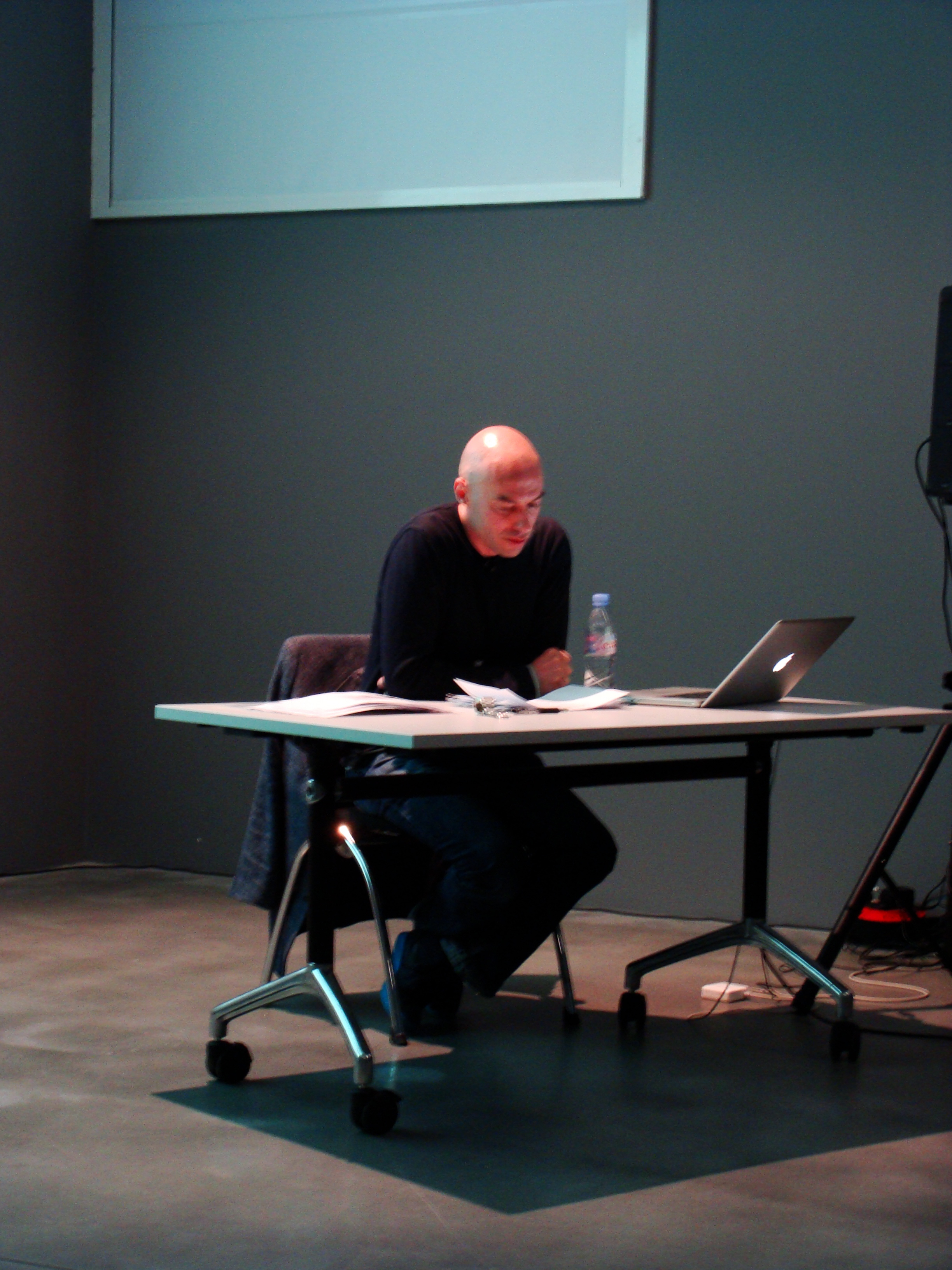
Autograph ABP is proud to present a talk at Rivington Place with writer, curator and artist Alfredo Cramerotti. Addressing a growing area of focus in contemporary art, Aesthetic Journalism investigates why contemporary art exhibitions often consist of interviews, documentaries and reportage.
Art theorist and curator Alfredo Cramerotti traces the shift in the production of truth from the domain of the news media to that of art and aestheticism – a change that questions the very foundations of journalism and the nature of art. The book probes the current merge of art with the sphere of investigative journalism and explores how this new mode of information is appropriating more and more space in modern culture. Aesthetic Journalism suggests future developments for this new relationship between art and documentary journalism, offering itself as a useful tool to audiences, scholars, producers and critics alike.
Cramerotti probes the current merging of art with the sphere of investigative journalism. The attempt to map this field, here defined as ‘Aesthetic Journalism’, challenges, with clear language, the definitions of both art and journalism, and addresses a new mode of information from the point of view of the reader and viewer.
Audio of the talk available from: OPEN-i (Open Photojournalism Edu
IMAGES FESTIVAL Toronto: Alfredo Cramerotti on Chamber of Public Secrets
29 Mar 2010
CPS Chamber of Public Secrets, Co-curated by Khaled Ramadan and Alfredo Cramerotti

Chamber of Public Secrets works as a network of artists, curators and thinkers who have been collaborating since 2004 on the organization, production and circulation of film and video festivals, exhibitions, TV and radio programs, political fictions and documentaries. CPS members have also established forums for debate and published books and articles on issues like media representation, migration, mobility, colonialism, gender and difference. CPS helps to debate the position of artistic and media narratives and the function and responsibility of both in relation to society.
The CPS Archive was established in Copenhagen 2007 as an independent, non-profit art project focusing on the latest developments in visual art culture. The archive collects, preserves, and provides photographs, video films and documentaries about a variety of issues, thereby exploring, exposing and exemplifying the way contemporary art interacts with society through the use of new media.
The archive functions as an information and research centre and is open to the public. It consists of an electronic image, video and film database, which forms the basis for exhibitions, debates, symposiums, artist presentations, performances and screenings. The CPS Archive is open for cooperation with individuals and institutions that share the interest in exploring, examining and informing the contemporary artistic usage of visual elements – with the aim of enhancing communication between people of different societies.
For this screening, Alfredo Cramerotti will be presenting recent works from the archive by artists including Mounira Al Solh, Dalia Alkoury and Raed Yaseen that will serve as an introduction to a curatorial project he and Khaled Ramadan have worked on for Manifesta 8 called The Rest Is History?
Through operating as a roving Biennial, Manifesta must each time address and negotiate a different context with specific geographical, historical, aesthetical and political structures. In this way, its curators are offered the opportunity, and the challenge, to engage with local, global and networked communities using a variety of platforms and methodologies.
In the vision of CPS, Manifesta 8 is a series of ‘transmissions’ that critically use artistic, relational and media(ted) strategies to explore ideas of what Spain / Europe is today and focus on its boundaries and relationship with Northern Africa, encouraging viewers to ask questions.
CPS’s approach to curating encompasses (mass) media platforms such as television, internet, radio and newspapers, alongside other exhibition formats. Broadcast airtime, online streaming, printed matter, human relations and physical venues are all ‘channels’ in which we present different types of constructions. These media(ted) channels are an extremely interesting place to situate a series of projects for Manifesta 8. By challenging artists and contributors to explore new terrains beyond their usual practice, we question what is the media’s relationship to the construction of a local reality, how does it relate to ideas of truth, fact and history, and what are its possibilities for engaging with new audiences? And why do we need to expand the existing boundaries of art by introducing the notion of media?”
Khaled Ramadan is an artist and curator currently based in Helsinki. His fields of specialty include the culture and history of broadcast aesthetics, with interests in the fields of aesthetic journalism and documentary film research. He has produced several documentary films, theoretical texts and books on broadcast aesthetics, journalism and documentary filmmaking. Ramadan also has extensive experience curating video exhibitions and film festivals. He is the founder of the MidEast Cut festival, the Made in Video festival, the Coding-Decoding documentary festival, the video festival Not on Satellite, and the Video File. He is member of the International Association of Curators of Contemporary Art, IKT and is currently co-curator of Manifesta 8.
Alfredo Cramerotti is a writer, curator and artist. His work explores the relationship between reality and representation across a variety of media. He is co-curator of the forthcoming Manifesta 8, a European biennial of contemporary art in Murcia and Cartagena, Spain, and curator of QUAD, an art, film and media centre in Derby, UK. He co-runs the collective art and media projects Annual General Meeting and Chamber of Public Secrets. Recent publications include Aesthetic Journalism: How to Inform without Informing (2009).
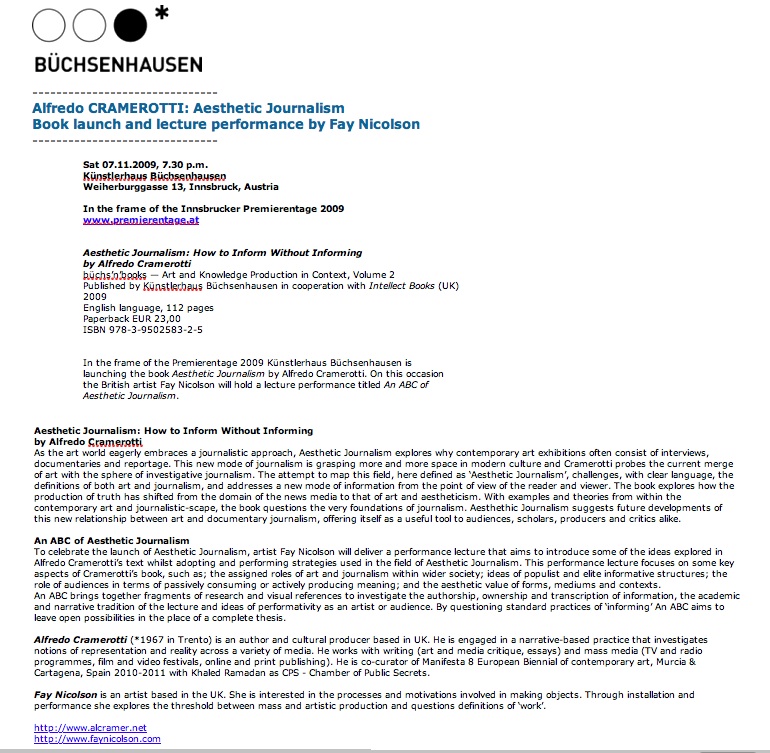
Alfredo Cramerotti: Aesthetic Journalism book launch and lecture performance by Fay Nicolson
Sat 07.11.2009, 7.30 p.m.
Künstlerhaus Büchsenhausen
Weiherburggasse 13, Innsbruck, Austria
Redeye Network Meeting
Tuesday 19 May 2009, 7.30pm
Speaker: Alfredo Cramerotti
Alfredo Cramerotti will present his recent project Faulty Lines. Shot in various cities around the world, the project explores the relationship between the two-dimensional photographic image and a three-dimensional built environment. Alfredo Cramerotti is an artist, curator and writer based in Derby. His work as an artist is primarily concerned with questions of narrative in photography, installation, video, performance and text. Organised in collaboration with Open Eye Gallery, Redeye’s Liverpool Network meetings take place every couple of months. They offer photographers of all kinds the chance to meet, catch up on news and gossip, meet members of the Redeye and Open Eye Gallery teams and see short talks and presentations of work.
ARTIST TURNS AUTHOR
Derby Evening Telegraph
Wednesday, April 01, 2009
A STAFF member at Derby’s Quad arts centre has published his first book.
Exhibitions officer Alfredo Cramerotti’s book, called Aesthetic Journalism: How to Inform Without Informing, looks at how writing about art has become more journalistic in recent times.
Alfredo Cramerotti is an international artist, curator and writer and has worked in radio, TV and publishing.
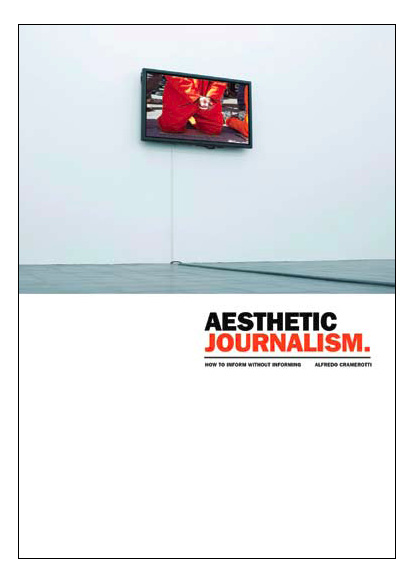
Aesthetic Journalism: How to Inform without Informing
Intellect Books
In print from September 2009
Aesthetic Journalism
How to Inform Without Informing
By Alfredo Cramerotti
ISBN 9781841502687
Paperback 112 pages 230x174mm
Published September 2009
Price £19.95
As the art world eagerly embraces a journalistic approach, Aesthetic Journalism explores why contemporary art exhibitions often consist of interviews, documentaries and reportage. This new mode of journalism is grasping more and more space in modern culture and Cramerotti probes the current merge of art with the sphere of investigative journalism. The attempt to map this field, here defined as ‘Aesthetic Journalism’, challenges, with clear language, the definitions of both art and journalism, and addresses a new mode of information from the point of view of the reader and viewer. The book explores how the production of truth has shifted from the domain of the news media to that of art and aestheticism. With examples and theories from within the contemporary art and journalistic-scape, the book questions the very foundations of journalism. Aesthetic Journalism suggests future developments of this new relationship between art and documentary journalism, offering itself as a useful tool to audiences, scholars, producers and critics alike.
Knowledge
Is it really true that knowledge is something superior to other ‘goods’ of life? That is – by far – the most desirable of things? Having the access to an item may represent an advantage; even if is not a goal per se, but rather a tool. The ultimate aim of mankind is happiness, not goods: on this we might all agree. Now, what about knowledge? It seems that is the only good which don’t bring, along with its satisfaction, some disadvantages.
Let’s make two examples: in medicine, for instance: the fact that humans can cure themselves from flu, it’s definitely an advantage. But it also bring the need to cure themselves from any other type of illnesses, even those that once where not contemplated, those that we didn’t care about, because they could not be considered in terms of advantage/disadvantage, but as facts of life. Now, the fact that we can save our life from flu brings also the need to save ourselves from all other types of illness. If we cannot satisfy this need, we perceived it as a disadvantage. The threshold of happiness has been moved forward.
Same thing with transportation: when cars didn’t exist, they couldn’t solve all the problems, which they solve today. But now a car has become the base, without which one has a disadvantage. A car is, so to say, the base to be happy (take it not literally), and once achieved this basic need, we will look forward to ‘step up’ to the next one, maybe a bigger car, or maybe two cars in the family, and so on. This is valid for all the items and services of technical progress: from the satisfaction of a need, springs up immediately other needs to satisfy that we didn’t have before.
The degree of happiness doesn’t depend on which step of the social ladder we are: everyone can feel happy or sad at whatever social level. We cannot say that humanity in the past was happier or sadder than today. Reading, for instance, the ancient texts, it seems that the level of happiness was more or less the same, even with far less items and technological progress.
The fact is that happiness is achievable only in the brief moment of acquisition of an item, or a service: when one was ill, and is cured; when one needed a car, and got it. The only brief lapse of happiness is attainable in the passage from one state to the other, and not from the fact of being in one state. After that, we immediately start to perceive the need of going further onto the next level. That means, the satisfaction of a need brings always the disadvantage of creating another need.
Regarding our first concern, knowledge, it seems that it is immune from such a thing: to know something is a linear process, it doesn’t bring to us the t unbearable feeling of having to progress to the next level. But it does something else. If it’s true that the less one knows, the better s/he lives (because the more one knows, the more s/he perceives the bad things of life), it’s also true that knowledge is something that once achieved, it cannot be undone. To put it in simple terms: we cannot go back to a previous state of ignorance, because we don’t want to. Knowledge is an irreversible (linear) process: who knows, wants not to know less. Nobody wants to decrease his or her level of knowledge, even if it would bring a major happiness. We can try for ourselves: let’s think about a happy person with less knowledge, less acculturated than we are, and then let’s ask ourselves if we would exchange with him or her: we wouldn’t. We are not able to renounce to our knowledge.
No matter its relationship with happiness, knowledge is a progressive entity, it’s ‘oriented’, so to say: it’s not neutral; humans don’t want to renounce to it, whatever it brings along with, even unhappiness. The good thing, on the other hand, is that it doesn’t originate other needs: it’s a type of acquisition, which is more stable. But as soon as we know more, we would never accept not to have it.
 ::
::  ::
::  ::
::  ::
::  ::
::  ::
::  ::
::  ::
::  ::
::  ::
:: 
Failure
Since it makes uncomfortable, failure among our contemporaries has no space. No room for development. No room for address. Failure –in other words– should not exist, according to the present society. Do we feel the same? We shouldn’t, of course. Theoretically each of us allows a margin of failure in life. But maybe not this time, we tell ourselves…
We feel that if we fail here (and now), we could jeopardize our future credibility. For instance, from where I stand it’s impossible to talk about failure in a positive sense, nor develop a notion of failure, without suspicion for whom is reading and/or approaching me.
We set our expectations on a high level, and we don’t even consider the possibility of not achieving them: and this works also for the expectation in the others. If I say to you than this space about coaching creative people could be a failure in pursuing its goal, you get immediately on-guard.
Hence, what is important in any activity, professional or personal, for duty or leisure, for ourselves and the others, is to attempt to dispense with the error-phobia that envelop us in a perennial mist. Not only we are scared of failing, in physical and mental terms, sometimes we even set up mechanisms of self-censorship. We don’t even allow ourselves to think we could fail, and things could go wrong. What does exactly mean things could go wrong?
When we expect something from someone else or some situation, we want to enjoy the most of it. We get ideas; we plan them, put to work and enjoy the results. Still, the possibility to fail is not harming anything. Failure is a precious space where we can stretch our boundaries and experiment with another dimension of living. In this sense, failure is a vital component of our experience of life.
I bet most of you feel now the urge to ask why should we fail? It’s not that we should fail in order to live better. We should simply allow ourselves the space, the mental dimension, of failure. We live in a win-win society, where one cannot afford to step into something wrong. For instance, we cannot bear the thought to lose our time following someone or something, which in the end disappears and leave us alone. This can happen in love as well as business.
In our deeds we invest feelings, time, money, and precisely because it’s an ‘investment’ we expect something back. A return, some results. We cannot conceive an action freed from expected effects, freed from the obligation to avoid errors. It hurts us to see and to think about our failure. We can bear only someone else’s failure. And we don’t want to be that someone else.
There’s a school of thought arguing that there’s no right to fail, but a duty to experiment. Fine. Does it mean that an experiment cannot fail? Why do we take away the word ‘fail’? We fail in studies, jobs, loves. We fail permanently, as well as succeeding. In writing these lines, I’m probably failing to communicate exactly my thoughts to you, completely or to some extent.
I fail a lot, as well as not. And I fail sometimes because I’m overly generating, and couldn’t fit everything in place and in time. Other times because I wasn’t able to carry out a commitment, or didn’t feel like, and my project, or task, collapsed on itself for obvious lack of will, time and resources. Other times again, I fail because I initiated something already doubtful, and it went worse and worse.
And in some occasions I managed to successfully complete something totally different from what I started. Is that a failure?
Trust
It’s true that life sometimes is both painful and simultaneously rewarding, especially in moments where you feel lost, or stuck, or somehow put in a corner. Painful for the experience (a loss, a feeling of inconclusiveness); rewarding because, in the end, is what pushes us towards some choices (even the non-choice is a choice). I’m not sure, as I have read in an online forum (nettime.org, precisely), that this has to be realized at the expenses of trust. Trust in ourselves, and in the other.
A life centered on the trust in the self, would be challenging, difficult and fascinating at the same time, but how far could we go in this sense? What would be a human without the environment around, which include her/his similar? Isn’t the idea of only first-hand experience a bit too privileged?
Everyone of us has the possibility to choose among a range of solutions, for work and life: not only in the professional approach (the way one can ‘sell’ her/himself in life, or not) but also regarding information (what you want to become, through reflection, info-gathering and coaching, for instance), and distribution of this information (the context, restricted or enlarged, in which you want to act). True, I’m probably talking for the Western society, with all the ups and downs – not so sure if the majority of the world population can do the same.
In doing the above, trust in the other is simpler, and more human. I doubt all the time in my work practice and personal life, but at the same time I do trust people I have chosen to have around, or I share a life with. If I have to distrust everyone and everything, I would get stuck in my own thoughts. Is it really something wrong in trusting? I don’t want to get too transcendental (I know the term itself might rise some eyebrows), but isn’t all this also a matter of love? Do we have to confront each other and everything around us all the time to claim we are ‘free’?


 Curatorview [Alfredo Cramerotti]
leave a comment