Manifesta 8 Curators
Announced September 2009
Manifesta 8, the European Biennial of Contemporary Art
Manifesta 8, the European Biennial of Contemporary Art, will take place in 2010 in the Region of Murcia, Spain, in dialogue with Northern Africa.
The curatorial team of Manifesta 8 is composed of:
ALEXANDRIA CONTEMPORARY ARTS FORUM
CHAMBER OF PUBLIC SECRETS
TRANZIT.ORG
Manifesta 8 taking place in the Spanish cities of Murcia and Cartagena in 2010, will be curated by Alexandria Contemporary Arts Forum, Chamber of Public Secrets and Tranzit.org as the three collectives, who will together form the curatorial team of the next edition.
In keeping with Manifesta’s aim to experiment with innovative curatorial models and methodologies, no individual art professionals were considered for the position of curator of Manifesta 8. Instead, curatorial groups, artistic and interdisciplinary collectives and/or existing institutions were invited by the Board and the Director of the International Foundation Manifesta to propose a new working model for Manifesta 8. In doing so, the Board wishes to initiate a transcontinental collaborative strategy, connecting regions and institutions located around the Mediterranean.
Opening on October, 2010, and continuing through the autumn in the Region of Murcia (Spain) in dialogue with Northern Africa, Manifesta 8 will explore the idea of Europe in the 21st century, focussing on the boundaries of the continent, and thus strengthening its international and intercontinental character. More specifically, the aim of Manifesta 8 will be to engage with Europe’s present-day frontiers and its interrelation with the Maghreb region.
As with each edition, the newly appointed curatorial team will develop Manifesta 8 in close collaboration with the permanent team of the Amsterdam based home offices of Manifesta together with local producers in Murcia and Cartagena.
Inherent to Manifesta’s nomadic character is the desire to explore the psychological and geographical territory of Europe, referring both to border-lines and the notion of nationality. This process aims to establish closer dialogue between particular cultural and artistic situations and the broader, international fields of contemporary art, theory and politics in a changing society.
ALEXANDRIA CONTEMPORARY ARTS FORUM
Curator/Team Executive: Bassam El Baroni
Associate Curator: Jeremy Beaudry
Alexandria Contemporary Arts Forum (ACAF), founded in Alexandria (Egypt) in December 2005, focuses on contemporary art, new media and discursive practice, cultivating a deeper awareness of art in relation to all aspects of contemporary life and culture. Central to its mission is an ongoing engagement with projects that bring together established and emerging artists, university students, and diverse practitioners, in contexts that recognize the value of an informal, non-hierarchical, open-ended circulation of information and experience. The ACAF is in a constant state of flux and incorporates innovative activities, guided by its socio-cultural compass.
CHAMBER OF PUBLIC SECRETS
Curators/Team Executives: Khaled Ramadan / Alfredo Cramerotti
Chamber of Public Secrets (CPS), based in Copenhagen (Denmark) and the Middle East, works as a network of artists, curators and thinkers who have been collaborating since 2004 in the organization, production and circulation of film and video festivals, art exhibitions, TV and radio programs, political fictions and documentaries. CPS also develops forums for debate and publishes books and articles about socio-political and cultural issues such as migration, mobility, representation, colonialism, gender and difference. CPS wishes to stimulate the role of debate, while reconstructing the role of art, its responsibility and its relation to society.
TRANZIT.ORG
Team executive: Vít Havránek
Team assembly: Zbyněk Baladrán, Dóra Hegyi, Boris Ondreička, Georg Schöllhammer
tranzit.org is a network of autonomous art associations, existing since 2002 in Austria, Czech Republic, Hungary, Slovakia, who cooperate working across borders – between nations, languages and histories. Each tranzit group operates independently from each other, using different formats and methods – such as discursive platforms, exhibitions, publications and research initiatives – but always aiming to generate a deep involvement in the local artistic and intellectual context. At the same time each tranzit group carries out a re-assessment of contemporary history, challenging the canons, geography and master-narratives of post-war European (art) histories. The aim of tranzit is to act trans-locally, in constant dialogue with cultural narratives on a local and global scale.
In the next few months the three selected collectives will define a mutual working methodology which will culminate in the concept and realization of Manifesta 8, the European Biennial of Contemporary Art.
Manifesta 8 is an initiative of the International Foundation Manifesta in collaboration with the Comunidad Autónoma de la Región de Murcia (CARM) and Murcia Cultural.
The International Foundation Manifesta is supported by the European Commission Culture Framework program, The Ministry of Education, Culture and Science of The Netherlands.
Sponsors and Collaborators
Government of the Autonomous Region of Murcia · City Council Murcia · City Council Cartagena
Hedwig Fijen, Director
International Foundation Manifesta, Amsterdam

The new Photographer
From 19 to 21 June I have participated – in representation of QUAD Derby and Intellect Books Bristol, at the first UK National Photography Symposium in Manchester, organized by Redeye – The Photography Network, in collaboration with the University of Bolton and Arts Council England.
Paul Herrman, the Director of Redeye who brainchild the symposium, held an interesting session in relation to the figure of the ‘contemporary photographer’. First, he highlighted the big changes in relation to photography occurred in the last decade:
– camera ownership – digital imaging
– internet
– education
– photography in the art world
Along these changes, a transition happened also in terms of old photographer / new photographer:
The old practitioner: The new practitioner:
– primacy of technique – primacy of ideas
– specialization – complementary range of works
– selected audience/circles of admirers – international audience/virtual circles
Today’s ‘top photographers’ present therefore the following features:
1. Interest, knowledge and reading in relation of the photographic economy and the world at large: ‘if your picture are not good enough, you don’t read enough.’
2. Marketing, talking and writing
3. Development of ‘the voice’, that is, differentiate oneself (the famous line ‘I can/can’t see you in these pictures…’ often heard in portfolio reviews)
4. Building relationships in time with curators, buyers and other professionals
5. Work ethic and good business (with the right balance of copyright and free licence use)
6. Long terms commitment (minimum of five-six years of practice before ‘getting’ anywhere), and motivation: both clients and professionals need to know that a photographer is going to be there in ten years time
7. Craft and ideas – research opportunities and deliver results.
Furthermore, Herrman listed ’twenty things one can do to get closer to be a top photographer’ (besides talent and commitment, I guess):
1. Going to openings – where people want to hear your ideas
2. Going to festivals (only three or four in the UK, but many abroad)
3. Business link (GVA – Great Value Added is not the only criteria)
4. Gettting some trading (agencies, galleries, etc)
5. Social media (internet at large helps to know people)
6. Metadata, absolute crucial to caption and keyword the work
7. Project making: a strong enough project to get teeth onto, something that resonates with people
8. Partnerships/collectives such as getting together with a writer, or a musician, etc. to realize a project
9. Website/blog, using to get ideas out and update regularly
10. Slideshow; collaborating with someone else, like sound people and through a narrative structure, to create a slideshow and show in programmes and venues such as BBC Big Screens around the UK (desperate to get good content)
11. Preparing portfolio
12. Marketing material such cards, etc.
13. Writing, important aspect
14. Giving a talk; it helps to get your ideas together
15. Applying for a grant; criteria to assess proposal are published on the Arts Council website; core matter is the audience development and which bits of work will accomplish that. Writing a good grant application is part of the job as photographers
16. Print sales
17. Exhibiting wherever one can (not whenever, I’d say…); getting used to the idea of exhibit
18. Entry and checking competition
19. Email/newsletter every 6 months, to let the network know what one has been done, etc.
20. ‘You have to be burning and you have to have your shit together’
In photography, but possibly in all arts disciplines (and non-disciplines), if one has to say something, it’s got to be said in a manner that is a) accessible b) that matters and c) that adds something to what have been said before. Question, transform, exchange. To be interested in photography, one has to be interested in the world.

Redeye Network Meeting
Tuesday 19 May 2009, 7.30pm
Speaker: Alfredo Cramerotti
Alfredo Cramerotti will present his recent project Faulty Lines. Shot in various cities around the world, the project explores the relationship between the two-dimensional photographic image and a three-dimensional built environment. Alfredo Cramerotti is an artist, curator and writer based in Derby. His work as an artist is primarily concerned with questions of narrative in photography, installation, video, performance and text. Organised in collaboration with Open Eye Gallery, Redeye’s Liverpool Network meetings take place every couple of months. They offer photographers of all kinds the chance to meet, catch up on news and gossip, meet members of the Redeye and Open Eye Gallery teams and see short talks and presentations of work.
Cats and creatives
David Parrish posted recently an interesting compariso between creative people and cats, the sort of things makes you smile but then – in the end – has some strategic potential.
You can find the complete post here; what below is an excerpt. Enjoy.
In an article in the Harvard Business Review on ‘Leading Clever People’ (details below). The researchers make several interesting points about leading creative people (and other clever people including scientists and academics). Before my own presentation I was musing on the conclusions of the article and the analogy of ‘herding cats’. I couldn’t help thinking of some similarities between the article’s conclusions about leading creatives and managing a pet cat.
1. ‘Creatives’ do not want to be led. Neither do cats. Try putting a lead on a cat.
2. ‘Creatives’ like to do their own thing. So do cats. Some companies allow their employees to use 20% of their time to pursue personal projects. I call this the ‘80% loyalty’ philosophy. Some cat owners accept that their cats sometimes disappear for days to do their own thing. They probably have another human who also feeds them.
3. ‘Creatives’ have a low boredom threshold. Cats soon get bored with you.
4. ‘Creatives’ expect instant access. Even if they want you to keep away from them most of the time, when they want you, they expect to get to see you. Similarly with cats. You can’t find them but they can always find you when they want you.
5. ‘Creatives’ won’t thank you and will be unwilling to recognise your leadership. Cats might get friendly when they want something, but after they get fed they just walk away.
6. Even though they don’t acknowledge it, ‘creatives’ need you and the organisation as much as you need them. Despite cats’ aloofness, like ‘creatives’ they do depend on the shelter and food you provide.
I won’t try to push the comparisons further but it does seem that there are some amusing similarities!
Let me know what you think – I’d like to hear your views.
The HBR article is ‘Leading Clever People’ by Rob Goffee from London Business School and Gareth Jones from INSEAD, who have studied leadership for 20 years. Their article was published in March 2007 and is available online from Harvard Business Review.
ARTIST TURNS AUTHOR
Derby Evening Telegraph
Wednesday, April 01, 2009
A STAFF member at Derby’s Quad arts centre has published his first book.
Exhibitions officer Alfredo Cramerotti’s book, called Aesthetic Journalism: How to Inform Without Informing, looks at how writing about art has become more journalistic in recent times.
Alfredo Cramerotti is an international artist, curator and writer and has worked in radio, TV and publishing.
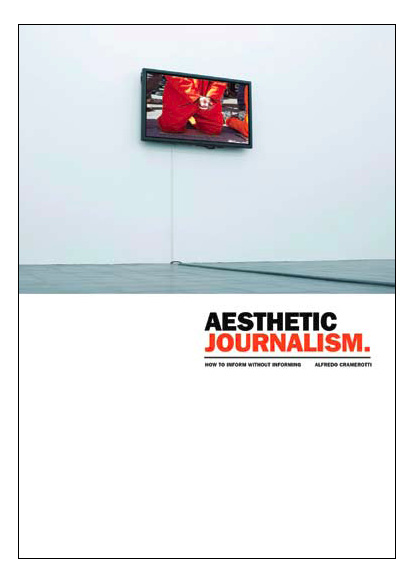
Aesthetic Journalism: How to Inform without Informing
Intellect Books
In print from September 2009
Aesthetic Journalism
How to Inform Without Informing
By Alfredo Cramerotti
ISBN 9781841502687
Paperback 112 pages 230x174mm
Published September 2009
Price £19.95
As the art world eagerly embraces a journalistic approach, Aesthetic Journalism explores why contemporary art exhibitions often consist of interviews, documentaries and reportage. This new mode of journalism is grasping more and more space in modern culture and Cramerotti probes the current merge of art with the sphere of investigative journalism. The attempt to map this field, here defined as ‘Aesthetic Journalism’, challenges, with clear language, the definitions of both art and journalism, and addresses a new mode of information from the point of view of the reader and viewer. The book explores how the production of truth has shifted from the domain of the news media to that of art and aestheticism. With examples and theories from within the contemporary art and journalistic-scape, the book questions the very foundations of journalism. Aesthetic Journalism suggests future developments of this new relationship between art and documentary journalism, offering itself as a useful tool to audiences, scholars, producers and critics alike.
Art and Design Industrial Liaison Committee
University of Derby
Faculty of Arts, Design and Technology
27 February 2009
Dear Alfredo
Out of respect and in recognition of your contribution to the creative industries you have been nominated by University of Derby, Art and Design academic staff for membership on the newly formed Art and Design Industrial Liaison Committee.
The committee is to be understood as a positive and dynamic link between the creative industries and respective subject areas of Art and Design education at the University; it will operate in an advisory capacity for future programme design, delivery and curriculum development; enabling us to maintain a relevant and pertinent portfolio of programmes which are in tune with the needs of industry and providing our students a more critical and creative edge when preparing themselves for future employment.
Scott Green
Head of Subject: ART
University of Derby
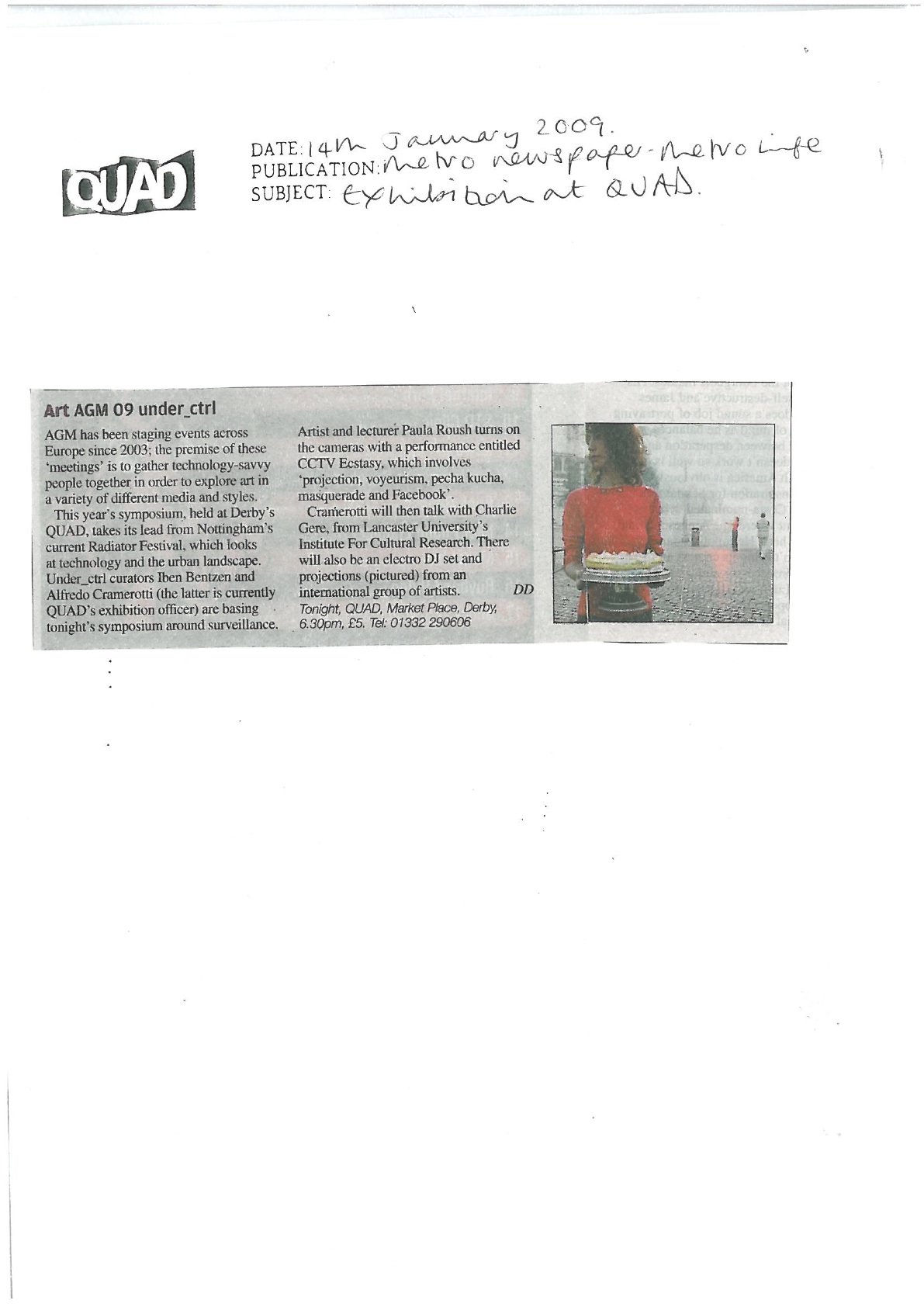
AGM 09 under_ctrl Exhibition and Performance
AGM 09 under.ctrl
QUAD Derby, UK & Radiator Biennial Festival of New Media Art Nottingham, UK
The 7th edition of the media/art project AGM (www.agmculture.org) is this year part of the Radiator Biennial Festival and Symposium (www.radiator-festival.org) and includes an exhibition, video installation, performance, music and talk; exploring our behaviour with technologies of surveillance and counter-surveillance in QUAD. From 15th to 25th January 2009, eight international artists, designers, writers and performers respond to the cultural environment generated by CCTV and (self) recording.
On screens throughout QUAD, 15th – 25th January 2009
Artworks by plankton (media collective, Austria), Chris Oakley (videomaker, UK), Miska Knapek (new media designer, Denmark/Sweden), Scott Jon Siegel (game designer, USA), and ZimmerFrei (art collective, Italy).
AGM is an art/media project that happens once a year and changes its form, content and location every time. Previous editions were held in Italy (performance event, 2003), the Netherlands (radio programme, 2004), Canada (sound installations, 2005), Denmark (public screenings, 2006), Austria (symposium, 2007), and the Internet (2008).For previous editions please visit www.agmculture.org. Curated by Iben Bentzen and Alfredo Cramerotti, QUAD Exhibitions Officer.
The fourth Radiator Biennial Festival and Symposium brings together artists with academics, geographers, urban theorists, scientists, sociologists and fellow citizens in the discovery of a new topography of the city, based on the understanding that digital networks are transforming our notion of public and private space. The symposium “Exploits in the Wireless City” at Broadway in Nottingham (http://www.broadway.org.uk) features theorists, architects, journalists, urban planners, and artists’ works. The symposium aims to instigate discussion, debate and new interdisciplinary research networks. Curated by Anette Schäfer and Miles Chalcraft.
METRO Newspaper
14th January 2009
Derby Evening Telegraph Newspaper
9th January 2009
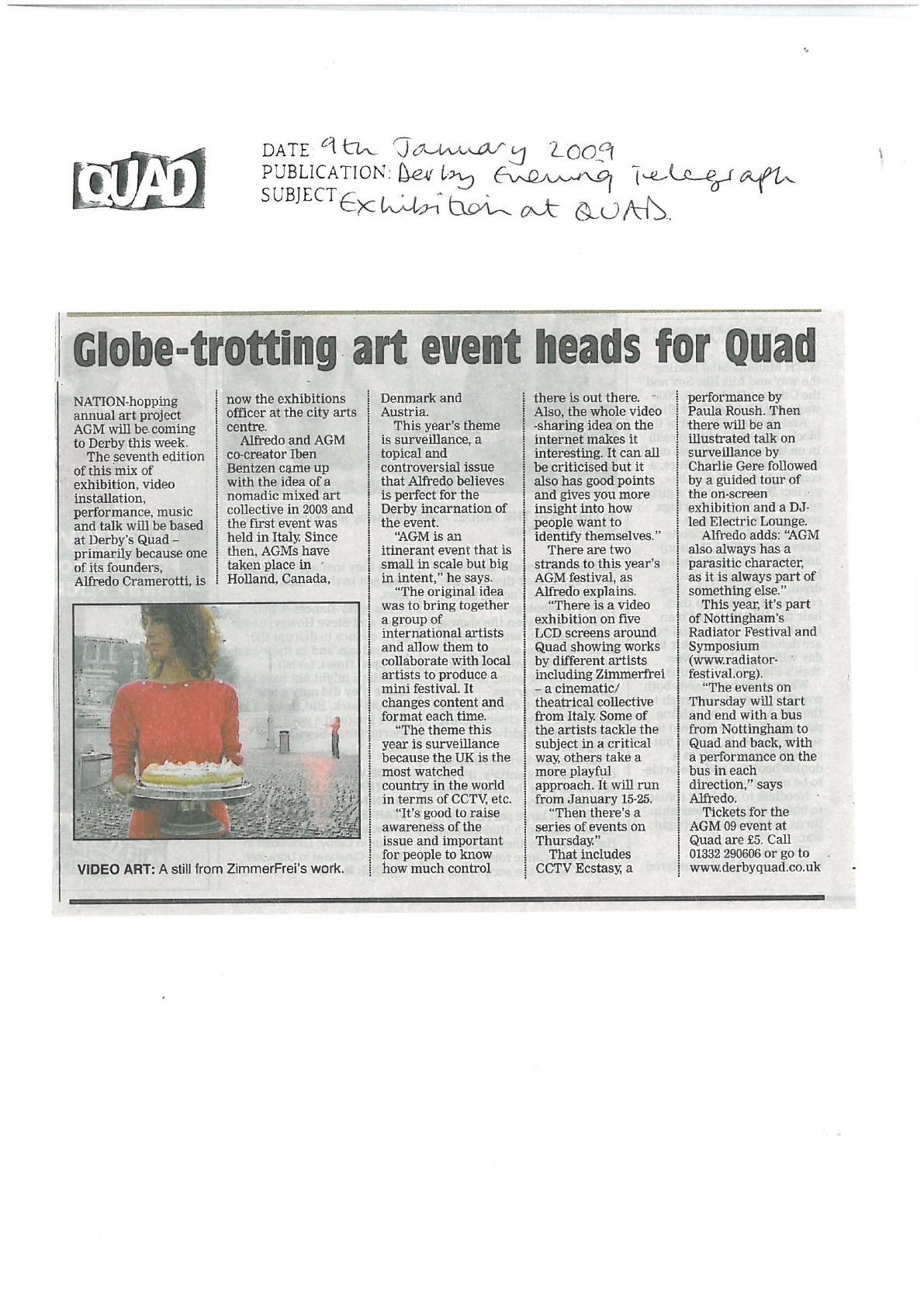
QUAD Latest News
12th December 2008

Other Motivations/2
Values
This is a further article in the “Motivations’ series published by Mark McGuiness; you can find it here.
Manager: “I just don’t understand it. I’ve tried everything, but he still doesn’t get it. He just carries on doing the opposite of what he’s supposed to do.”
Coach: “Well I’ve heard a lot about why you want him to do it, and a lot of reasons why he ’should’ do it. But the question I haven’t heard the answer to is ‘What’s in it for him?’”
(Long silence.)
Manager: “That’s a very good question.”
The basic problem is one of empathy. It is partly down to the situation – because the manager sees the big picture clearly and is under so much pressure to deliver results, it’s easy to forget that others may not have the same understanding or urgency. But it’s also down to a fundamental blindspot of human beings – it’s so easy for each of us to assume that everyone has the same values and priorities that we do.
Because we all have different personal motivations – otherwise known as values. Or rather, we may well share many of the same values, but may not rank them in quite the same way. Recognising and respecting other people’s values is often the key to happiness in relationships. And it’s critical to success if your job involves managing or influencing people.
Each person – continues Mark – has made a fundamental decision about what is most important in life, and acts accordingly. And the weird thing is, other people have made different decisions to you. This is why they don’t always ‘get it’, no matter how many times you tell them. Once you realise this, a lot of the apparent weirdness about other people disappears. It becomes a lot easier to get on with them.
Get to know people
Look at them (without staring). Listen to them (without interrupting). Notice what brings them alive – when they become enthusiastic, animated, productive. What does this tell you about their personal values? And what about the times when they shut down, withdraw, give you lip service or start complaining? What does that tell you about their motivation?
Assume that everything they do and say makes complete sense
This frees you to look at them as they are, instead of as you think they should be. And once you do that, you can start to notice all kinds of things you didn’t see before.
Don’t stick labels on them
We’ve all been there. You wouldn’t be human if you didn’t find yourself labelling people, especially when problems arise. It’s easy to see others as ‘difficult’, ‘lazy’, ‘obstructive’ and so on. The trouble is, this makes life more difficult for you. If someone is just plain ‘difficult’ then there’s nothing you can do to influence them, short of rebuilding their personality. But if you take the label off and ask yourself ‘what are they motivated by?’ Then you have an opportunity to use their personal motivations to influence them.
Trade in their currency
Think of personal values the same way as monetary currency. Why bother praising somebody who just wants to work on an interesting challenge? A pay rise won’t compensate someone for having their ideas blocked at every turn.
Try ‘trading in their currency’ by speaking to their personal values.
Experiment
Treat people the way you’ve always treated them and they will respond the way they’ve always responded. If you get stuck, ask yourself ‘What does this person least expect me to do?’. Try doing something new – and notice the results. Be creative.


 Curatorview [Alfredo Cramerotti]
leave a comment