2012 blog in review
The WordPress.com stats helper monkeys prepared a 2012 annual report for this blog.

Here’s an excerpt:
600 people reached the top of Mt. Everest in 2012. This blog got about 5,300 views in 2012. If every person who reached the top of Mt. Everest viewed this blog, it would have taken 9 years to get that many views.
FIRST FIVE website playlist: Alfredo Cramerotti
First Five asks artists, academics and theorists the first five websites that they visit each day. Do the websites we read shape, describe and identify who we are? How do we choose to visit these sites?

First Five is not a musical playlist, but a website playlist. It asks various thinkers, creative types, culturally important people, academics, and even Open CuRate It’s Boo Chapple to list their top browsing habits. It’s an interesting reflection of our changing culture, and a great place to find fantastic websites.
Alfredo Cramerotti is a writer, curator, editor and artist working across a variety of media such as TV, radio, publishing, internet, media festivals, photography, writing and exhibition curating. He directs Mostyn, Wales’ largest and leading contemporary art centre, co-directs AGM Culture, roaming curatorial agency and CPS Chamber of Public Secrets, media & art production unit (co-curator of Manifesta 8, the European Biennial of Contemporary Art, Region of Murcia, Spain, 2010). He is Research Scholar at the European Centre for Photography Research, University of Wales, Newport, Visiting Lecturer in various European Universities among others NTU Nottingham Trent University, University of Westminster, HEAD Geneva and DAI Dutch Arts Institute, and Editor of the Critical Photography book series by Intellect Books. His own publications include the book Aesthetic Journalism: How to inform without informing (2009) and Unmapping the City: Perspectives of Flatness (2010).
Here are Alfredo’s first five…

“Visually relevant”
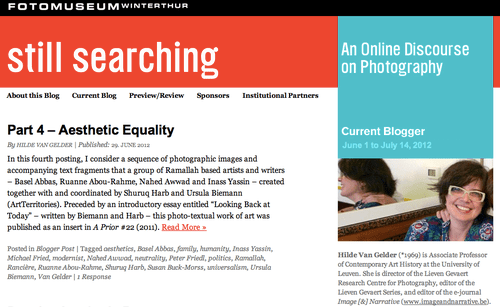
“Critically valuable”
3. http://www.foam.org/whatsnext
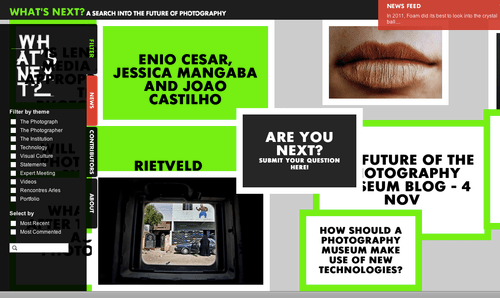
“Theoretically challenging”
4. http://alcramer.tumblr.com/
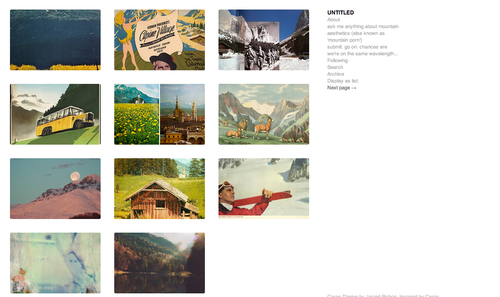
“Curatorially intriguing (there are a number of people contributing to the blog, not only me)”
“Relationally oblique”
P.S. You can click on the images to go to the site…
TVE Metropolis – Manifesta 8: AGM 10 feat. Comrade Alfredo Neri (excerpt)
(Spanish below)
Special Metropolis TV format from TVE Spain about Manifesta 8 / CPS Chamber of Public Secrets / AGM 10 feat. Comrade Alfredo Neri (2006).
A ‘performative documentary’ about Alfredo Neri, the spokesman of the Italian neo-nazi movement Skinheads. The work was presented in Manifesta 8 by AGM 10 which selected a number of archive pieces from CPS archive.
A powerful analysis of the media construction, representation and mediation of facts, identities and historical narratives through the documentary language.
(Spanish)
Una de las piezas más impactantes de la emisión será el fragmento del trabajo de AGM 10: CPS (Italia), titulado: Camarada Alfredo Neri (2006-2010) Un documental de corte ficticio para hacernos reflexionar sobre la construcción de los relatos y del lenguaje documental.
The new Photographer
From 19 to 21 June I have participated – in representation of QUAD Derby and Intellect Books Bristol, at the first UK National Photography Symposium in Manchester, organized by Redeye – The Photography Network, in collaboration with the University of Bolton and Arts Council England.
Paul Herrman, the Director of Redeye who brainchild the symposium, held an interesting session in relation to the figure of the ‘contemporary photographer’. First, he highlighted the big changes in relation to photography occurred in the last decade:
– camera ownership – digital imaging
– internet
– education
– photography in the art world
Along these changes, a transition happened also in terms of old photographer / new photographer:
The old practitioner: The new practitioner:
– primacy of technique – primacy of ideas
– specialization – complementary range of works
– selected audience/circles of admirers – international audience/virtual circles
Today’s ‘top photographers’ present therefore the following features:
1. Interest, knowledge and reading in relation of the photographic economy and the world at large: ‘if your picture are not good enough, you don’t read enough.’
2. Marketing, talking and writing
3. Development of ‘the voice’, that is, differentiate oneself (the famous line ‘I can/can’t see you in these pictures…’ often heard in portfolio reviews)
4. Building relationships in time with curators, buyers and other professionals
5. Work ethic and good business (with the right balance of copyright and free licence use)
6. Long terms commitment (minimum of five-six years of practice before ‘getting’ anywhere), and motivation: both clients and professionals need to know that a photographer is going to be there in ten years time
7. Craft and ideas – research opportunities and deliver results.
Furthermore, Herrman listed ’twenty things one can do to get closer to be a top photographer’ (besides talent and commitment, I guess):
1. Going to openings – where people want to hear your ideas
2. Going to festivals (only three or four in the UK, but many abroad)
3. Business link (GVA – Great Value Added is not the only criteria)
4. Gettting some trading (agencies, galleries, etc)
5. Social media (internet at large helps to know people)
6. Metadata, absolute crucial to caption and keyword the work
7. Project making: a strong enough project to get teeth onto, something that resonates with people
8. Partnerships/collectives such as getting together with a writer, or a musician, etc. to realize a project
9. Website/blog, using to get ideas out and update regularly
10. Slideshow; collaborating with someone else, like sound people and through a narrative structure, to create a slideshow and show in programmes and venues such as BBC Big Screens around the UK (desperate to get good content)
11. Preparing portfolio
12. Marketing material such cards, etc.
13. Writing, important aspect
14. Giving a talk; it helps to get your ideas together
15. Applying for a grant; criteria to assess proposal are published on the Arts Council website; core matter is the audience development and which bits of work will accomplish that. Writing a good grant application is part of the job as photographers
16. Print sales
17. Exhibiting wherever one can (not whenever, I’d say…); getting used to the idea of exhibit
18. Entry and checking competition
19. Email/newsletter every 6 months, to let the network know what one has been done, etc.
20. ‘You have to be burning and you have to have your shit together’
In photography, but possibly in all arts disciplines (and non-disciplines), if one has to say something, it’s got to be said in a manner that is a) accessible b) that matters and c) that adds something to what have been said before. Question, transform, exchange. To be interested in photography, one has to be interested in the world.


 Curatorview [Alfredo Cramerotti]
leave a comment