Talk at ARTIUM Vitoria-Gasteiz: The Aesthetics of Journalism
El Correos newspaper, 25 January 2011
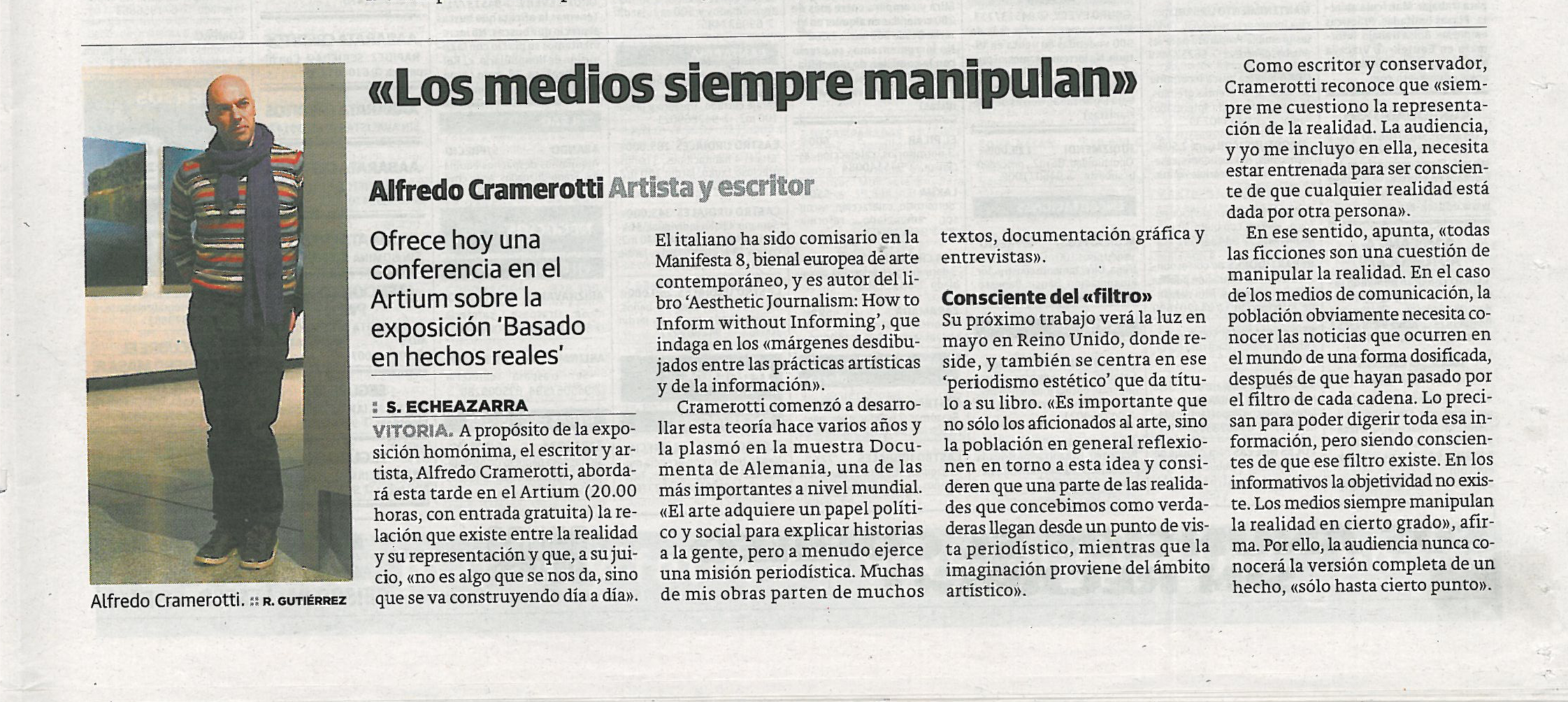
Over the past six years Alfredo Cramerotti has written about the aesthetic merger of contemporary art and the news media. Drawing from his book Aesthetic Journalism: How to inform without informing (2009, Intellect), Cramerotti provocatively advances the idea that art and journalism are not separate forms of communication, but rather two sides of a unique activity , the production and distribution of images and information.
As aesthetic regimes, both journalism and artistic makes claims for the truth, albeit of a different kind. One is a coded system that speaks for the truth (or so it claims), the other a set of activities that questions itself at every step (or so it claims), thus making truth. Whereas journalism provides a view on the world ‘out there,’ as it ‘really’ is, art often presents a view on the view, truth posited as acts of (self)reflection. Cramerotti will examine both as a types of truth production, as systems of information that defines truth in terms of the visible: producing not only what can be seen, but also what can be imagined, and thus imaged. As such, we start to get closer to the core of reality itself when we make our reality not a given, irreversible fact, but a possibility among many others.
The talk generated a principal question: is it possible to work with aesthetics and informatics, to be both reflective and precise? To both employ documentary techniques and journalistic methods while remaining self-reflecting and critical on those means? Ultimately, the artist’s work is not about delivering information but questioning it, reversing the tradition of both fields (art and journalism), to highlight both the aesthetic workings and trappings of reportage and the informational turn within current aesthetic production.
TVE Metropolis – Manifesta 8: Abed Anouti
(Spanish below)
Special Metropolis TV format from TVE Spain about Manifesta 8 / CPS Chamber of Public Secrets / Abed Anouti
También rescatando la historia olvidada de los edificios, y de las gentes que los habitaron, ABED ANOUTI (Líbano) en La sombra de San Antón (2010) realiza una investigación desde distintos ángulos, para cercarnos a la historia y la memoria de la cárcel de Cartagena.
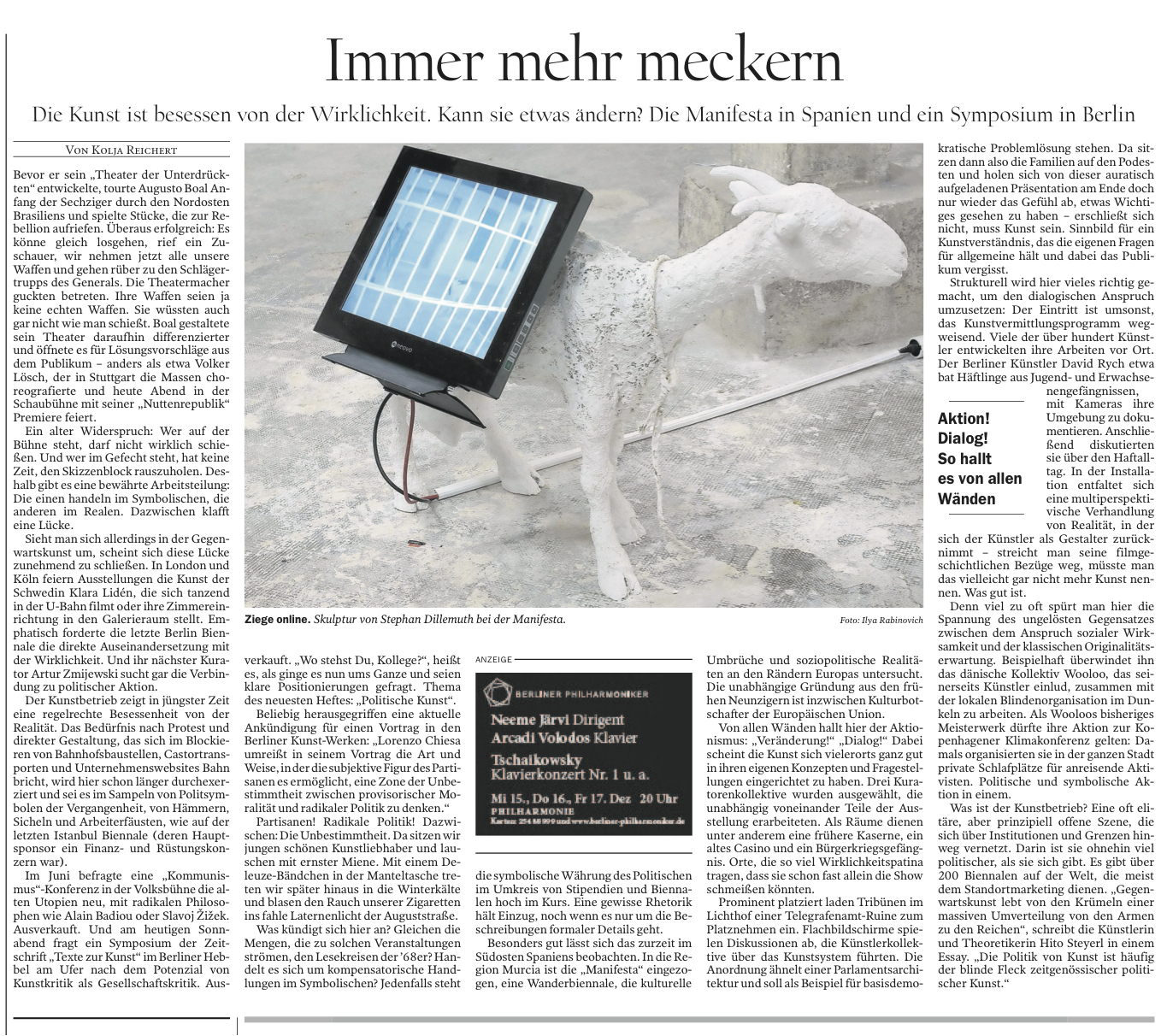
TVE Metropolis – Manifesta 8: Thierry Geoffroy / Colonel
Special Metropolis TV format from TVE Spain about Manifesta 8 / CPS Chamber of Public Secrets / Thierry Geoffroy a.k.a. Colonel
” Empezamos la emisión con un fragmento del video de entrevistas de THIERRY GEOFFROY/COLONEL (Francia), en el que bajo un formato de reportaje televisivo, el personaje del inspector Colombo investiga si realmente existe diálogo entre Europa y el Norte de África, haciendo suyo el tema fundamental de la bienal: averiguar el estado de las relaciones entre ambas culturas. “
8th Furla Prize 2011
(Italian below)

The 8. Furla Prize 2011 evolved over its eight editions and is now recognised as the ultimate Italian prize in support of young Italian contemporary artists, with a format focusing on education and the production of new works.
The patron artist of the 8. Furla Prize 2011 is Christian Boltanski, who created the image and motto of this edition, Pleure qui peut, rit qui vet, a sort of oxymoron for the 5 finalists.
The artists are: Alis/Filliol – Andrea Respino (Cuneo, 1976) and Davide Gennarino (Torino, 1979), nominated by Simone Menegoi and Marianne Lanavère; Francesco Arena (Brindisi, 1978), nominated by Vincenzo De Bellis and Philippe Pirotte; Rossella Biscotti (Bari, 1978), nominated by Cecilia Canziani and Vincent Honoré; Matteo Rubbi (Bergamo, 1980), nominated by Lorenzo Bruni and Carson Chan; Marinella Senatore (Salerno, 1977), nominated by Alfredo Cramerotti and Emily Pethick.
The 5 finalists projects and a selection of artists’ works will be presented in Bologna at Palazzo Pepoli, in the exhibition Pleur qui peut, rit qui veut – a collaboration with Fondazione Furla and Fondazione Carisbo (29 January – 6 February 2011).
An international jury consisting of Christian Boltanski, Stefano Chiodi (art historian and critic), Vít Havránek (curator), Jörg Heiser (co-editor of frieze magazine), Miguel Von Hafe Pérez (director of the CGAC Centro Galego de Arte Contemporáneo in Santiago de Compostela, Spain) will choose the winner, to be announced on January 28, 2011 in Bologna, during the opening of the exhibition.
In addition to the opportunity to study and work abroad in an artist’s residency program (at Arizona State University Art Museum) the winner will also be invited to create a work financed by the Fondazione Furla and intended to be showing for a public exhibition thanks to a special agreement with the MAMbo – Museum of Modern Art of Bologna. The work of the winning project will premiere at the Fondazione Querini Stampalia in Venice in June 2011, during the 54 Biennale of Visual Arts.
The Furla Prize, created by Chiara Bertola, is today organised and promoted by Fondazione Furla, Fondazione Carisbo, Fondazione Querini Stampalia, and MAMbo – Museum of Modern Art of Bologna, with the support of Carisbo S.p.A. and with the collaboration of Viafarini and Arte Fiera.
Pleure qui peut, rit qui veut, shortlist exhibition
Alis/Filliol, Francesco Arena, Rossella Biscotti, Matteo Rubbi, Marinella Senatore.
Curated by Lorenzo Bruni, Cecilia Canziani, Alfredo Cramerotti, Vincenzo de Bellis, Simone Menegoi
29 January – 6 February 2011
Palazzo Pepoli, Via Castiglione 8/10 Bologna
Hours: 30 January – 6 February, 10 am – 7 pm | Saturday 29 January, 10 am – 24
Free Entry
27 – 28 January 2011 | 10 am – 12 noon| preview Arte Fiera press and professionals
28 January 2011 | opening 7pm – 9pm | by invitation only
Round Table “8th Furla Prize 2011”:
Friday, 28 January 2011, 11:30am – 1.30pm
as part of Arte Fiera 2011 Art Talks | Piazza Costituzione, Bologna, Italy
—
PREMIO FURLA
Il Premio Furla giunge all’ottava edizione con un padrino di eccezione Christian Boltanski, ideatore dell’ immagine guida e del motto di questa edizione Pleur qui peut, rit qui veut.
I cinque artisti finalisti sono: Alis/Filliol – Andrea Respino e Davide Gennarino, nominati da Simone Menegoi e Marianne Lanavère; Francesco Arena, nominato da Vincenzo De Bellis e Philippe Pirotte; Rossella Biscotti, nominata da Cecilia Canziani e Vincent Honoré; Matteo Rubbi, nominato da Lorenzo Bruni e Carson Chan; Marinella Senatore, nominata da Alfredo Cramerotti ed Emily Pethick.
Il vincitore sara’ annunciato durante l’inaugurazione della mostra Pleure qui peut, rit qui veut – una collaborazione tra Fondazione Carisbo e Fondazione Furla: esposti nella splendida cornice di Palazzo Pepoli i progetti dei finalisti e una selezione delle loro opere dal 29 gennaio al 6 febbraio 2011.
Ad Arte Fiera Spazio Art Talks venerdi 28 gennaio ore 11.30 – 13.30 una tavola rotonda con i curatori e gli artisti.
Arte Fiera e il MAMbo daranno inoltre visibilità ai progetti in un’area dedicata all’interno dei loro spazi.
Il premio consiste in una residenza d’artista all’estero organizzata in collaborazione con Arizona State University Art Museum (Tempe, USA) e nella realizzazione del progetto presentato. L’opera sarà esposta in anteprima alla Fondazione Querini Stampalia a Venezia a giugno 2011, durante la 54. Biennale di Arti Visive, e concessa poi in comodato al MAMbo – Museo d’Arte Moderna di Bologna.
Il Premio Furla ideato nel 2000 da Chiara Bertola a Venezia alla Fondazione Querini Stampalia, è oggi organizzato e promosso da Fondazione Furla, Fondazione Carisbo, Fondazione Querini Stampalia, MAMbo – Museo d’Arte Moderna di Bologna, con il supporto di Carisbo S.p.A e con la collaborazione di Viafarini e Arte Fiera.
Pleure qui peut, rit qui veut. Mostra degli artisti finalisti
Alis/Filliol, Francesco Arena, Rossella Biscotti, Matteo Rubbi, Marinella Senatore.
A cura di Lorenzo Bruni, Cecilia Canziani, Alfredo Cramerotti, Vincenzo de Bellis, Simone Menegoi.
29 gennaio – 6 febbraio 2011
Bologna, Palazzo Pepoli Via Castiglione 8/10
Orario: 30 gennaio – 6 febbraio ore 10-19; Sabato 29 gennaio ore 10-24
Ingresso libero
Giovedì 27 e venerdì 28 gennaio ore 10 -12, Press Preview
Venerdì 28 gennaio 2011 dalle 19.00 proclamazione del vincitore e inaugurazione mostra | su invito
Venerdì 28 gennaio 2011 ore 11.30 – 13.30
Tavola rotonda
8. Premio Furla 2011 con artisti e curatori
Spazio Art Talks – Arte Fiera Art First 2011
Piazza Costituzione, Bologna
info@fondazionefurla.org
http://www.fondazionefurla.org
Immagine: Christian Boltanski per 8.Premio Furla 2011
AGM – Call for host organisations
AGM
agmculture.org
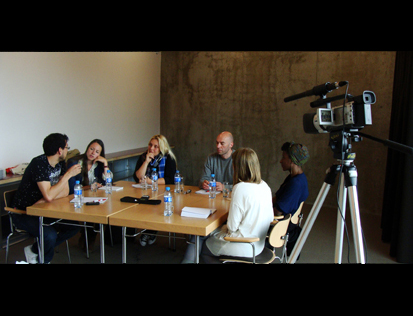
Image credit: AGM Conversation ‘On Translation’ saw the participation of Michael Takeo Magruder, Fay Nicolson,
Nada Prlja, Alfredo Cramerotti, Yesomi Umolu, Hannah Conroy, Jeffery Baker.
Contact
agm@agmculture.org
Hannah Conroy
Phone: 0044 (0) 7943639832
Fax: n/a
Address
agmculture.org
AGM
1 Thoresby Street
Nottingham, NG1 1AJ
England
Ongoing call for project partners
AGM accepts now proposals for future editions of its annual, international symposium, an itinerant and ‘expanded’ form of gathering that may include debate, exhibition, screening, performance and other formats.
Proposals from host organisations or project partners can be sent to agm@agmculture.org
Please include contact details, and an outline or relevance for collaboration. Further information can be seen on our website: http://www.agmculture.org
—
AGM is a curatorial project with some of the inbuilt features of a parasite. Each time, by changing partner, location, form and content, its primary focus is to explore the peculiarity of the hosting body – be it a site, an institution or a theme.
Through the creation of encounters and cultural exchange, AGM promotes the development of a network of cultural centres working around Europe. Our goal is to create and consolidate international collaboration, foster knowledge exchange and support international mobility of cultural workers, theorists and artists.
AGM is orchestrated by Hannah Conroy (UK), Iben Bentzen (Denmark), Yesomi Umolu (UK) and Alfredo Cramerotti (UK/Italy). Recent projects included the ongoing Conversation Series symposia, which provide an open forum for sharing and exchange with no underlying pretext but to consider the current state of affairs at various moments in the lead up to the exhibition or research process. Also, the collective presented AGM 10:Collectivus CPS, at Manifesta 8, Spain (2010) which sought to explore the collective process as emphasised in the selection of three collectives to curate the biennale this time around.
This year sees the beginning of a three year project AGM_Loci, which will facilitate public events that seek to encourage international collaboration and foster knowledge exchange between artist and theorists across Europe. Starting in 2011, curators and artists from Manifatture Knos, Lecce, Italy; One Thoresby Street, Nottingham, UK; Walden Affairs, Den Haag, Holland; Künstlerhaus Büchsenhausen, Innsbruck, Austria will initiate a dialogue to generate a public agenda and ignite discussions on the issue of shared memory of urban spaces.
Every AGM Culture edition poses a series of questions challenging pre-conceived ideas of the hosting body and the relative cultural productions taking place in/through that environment.
One Thoresby Street, 1 Thoresby Street, Nottingham, UK, NG1 1AJ
+44 (0)7941 470145 (Alfredo) or +44 (0)7943 639832 (Hannah)
Periodismo estético
Periodismo estético
Posted By Pedro Medina on 8 Enero 2011 (18:55) in Publicaciones
Published on http://www.abreelojo.com
[Spanish]

Periodismo, poder, sistema del arte y cómo se transmite la información hoy día son varios de los temas que aborda Alfredo Cramerotti al reflexionar sobre “periodismo estético” en su Aesthetic journalism. How to inform without informing.
La discusión sobre los formatos periodísticos y su papel en la construcción de una imagen del mundo está muy viva, como atestiguan las reflexiones de autores como Pierre Bourdieu, Ulrich Beck o Noam Chomsky, recuperando la noción de periodismo como servicio a una comunidad, al margen de la fáctica creación de poder a través de la influencia ejercida desde los medios de comunicación.
El libro de Alfredo Cramerotti, realizado desde la experiencia artística, sigue esta línea aportando una reflexión interesante ante lo que denomina “periodismo estético”, con la que pretende reivindicar un ámbito específico de las prácticas artísticas «en forma de investigación de la situación política, social y cultural». El análisis se centra pues en la información que se produce, si bien todos (autor y receptor) deberíamos preguntarnos desde dónde estamos considerando cada una de estas prácticas, e incluso conceptos muy cuestionados hoy día como el de “verdad”.
Se deben analizar las dimensiones de poder y autoridad que conllevan las imágenes y textos. Como dice Zizek, lo real se identifica con una forma de contar las cosas, y en esta práctica se reclama una responsabilidad del “artista-investigador” acorde con la autoridad e influencia que se puede ejercer, máxime en un tiempo donde el periodismo de investigación está francamente amenazado.
Lo más destacado es su interés por exponer la interacción entre las prácticas artísticas y periodísticas, labor que se revela especialmente en el estudio de obras del periodismo estético. En definitiva, cabe reconocer una cuidada investigación que nos lleva a pensar de nuevo la sociedad en términos culturales (y también estéticos), con el objetivo no tanto de transformar directamente nuestro entorno, sino los procesos que nos llevan a confeccionar el significado que tenemos del mundo.
Aesthetic journalism
How to inform without informing
Alfredo Cramerotti
Intellect, Bristol, Chicago, 2009, 135 páginas, 35 $
Interview: Ariel Reichman at Manifesta 8
Ariel Reichman’s short interview about his project in San Anton old prison in Cartagena for Manifesta 8.
Footage and interview by Davis Berg and Henna Hyvärinen.
Produced by the Finnish Academy of Fine Arts and CPS Chamber of Public Secrets.
Unmapping the City: Perspectives of Flatness
Unmapping the City
Perspectives of Flatness

Paperback 128 pages
230x230mm
Published January 2011
Imprint: Intellect
Edited by Alfredo Cramerotti
Unmapping the City, the first title in the new Intellect series ‘Critical Photography’, features photographs shot between 2004 and 2008 in fourteen different cities around the world. The images are linked by their shared attempts to define a two-dimensional approach to a three-dimensional built reality, and to address spatial representation and urbanity through art. In representing the cityscape through a flat texture of lines and minimal colour tones, they draw the reader into a conversation about the interplay between reality and its representation. This volume, by significantly challenging and expanding the discourse on photography and text and instigating a critical re-evaluation of the relationship between photography, perception and the city, will be of interest to artists, curators, photographers, architects, and critical theorists.
Introduction
Images by Alfredo Cramerotti and text by Jonathan Willett
Middleword by Inês Moreira


 Curatorview [Alfredo Cramerotti]
leave a comment