MOSTYN new exhibition season opening – Preview Friday 25 October 2013
MOSTYN, Wales’ foremost contemporary art gallery, is delighted to announce a new season of exhibitions.
Preview: Friday 25 October 6:30pm, all welcome
Women’s Art Society
26 October–5 January 2014
Nina Beier: Sweat no Sweat
26 October–5 January 2014
Dan Rees: Kelp
26 October–5 January 2014
Gallery 6: Uprisings – John Henry Newton
26 October–12 January 2014

Women’s Art Society
26 October–5 January 2014
Participating artists: Meriç Algün Ringborg, Sol Calero, Volker Eichelmann, Claire Fontaine, Tim Foxon, Guerrilla Girls, Jens Haaning, Catherine Opie, Martha Rosler, Danh Vo, Ai Weiwei
& a historical display of the Gwynedd Ladies’ Art Society
Women’s Art Society is the first exhibition in a series of exhibitions at MOSTYN taking place between 2013 and 2017. Each exhibition in the series will examine the history of MOSTYN and its building, and how that history is tied to events beyond its context locally, nationally and internationally.
This first exhibition reaches back to the inauguration of MOSTYN. Opened in 1902, the Mostyn Art Gallery was commissioned by Lady Augusta Mostyn and built to showcase the work of the Gwynedd Ladies’ Art Society, who were denied membership of male-dominated local art societies on the basis of their gender.
Women’s Art Society presents artefacts, documentation and artwork from the orginal Ladies Art Society, together with artworks by contemporary artists. These artworks are linked to the history of the original society by the way in which they examine the politics of gender, identity and regulation, and aspects of exclusion and prejudice—issues that confronted the Society and were vital in its formation.
Updating the spirit of the original Ladies’ Art Society and looking at it anew, the intent is to present and discuss the history of MOSTYN and its building, while bridging the divide between past and present.
The exhibition is displayed in galleries 2 & 3 and is curated by MOSTYN’s Visual Arts Programme Curator Adam Carr and organised and produced by MOSTYN.
Nina Beier
Sweat no Sweat
26 October–5 January 2014
This exhibition is the first for Nina Beier in a UK public institution, and one of the most comprehensive exhibitions dedicated to her work to date. Beier’s practice is perhaps best characterised by its conceptual orientation and its rigorous investigation of the object and exhibition of art itself as well as its attention to form and context. Aspects of art production and ideas of display, value and ownership, and the manner in which these are perceived and received, are amplified and subverted in many of her diverse works. The performance of objects and materials, how they change through time or alter according to context and presentation and their potential to appear contradictory are crucial and recurring themes in Beier’s work. This exhibition, in MOSTYN galleries 4 & 5, brings together both existing works and new commissions.
The exhibition is supported by the Danish Arts Council Committee for International Visual Arts.
Dan Rees
Kelp
26 October–5 January 2014
Rees’ starting point for Kelp is his own love of laverbread, which he regularly has sent from Wales to his studio in Berlin. This approach to national identity and Wales’ heritage is entirely characteristic of Rees’ other works, which have regularly drawn from the particularities of his upbringing, his background and his place of birth.
Through a number of different approaches—among them packaging design, photography, sculpture and satirical cartoons—Kelp sees Wales’ trade of seaweed and laverbread rethought and reconsidered, and appealing to the modern-day consumer. This exhibition is displayed in Gallery 1.
This exhibition is organised in partnership with Amgueddfa Cymru – National Museum Wales and supported by the Colwinston Charitable Trust.
Gallery 6: Uprisings – John Henry Newton
26 October 2013–12 January 2014
Gallery 6 is a new initiative at MOSTYN housed in its upper level. It is dedicated to presenting the work of young and emerging artists, all of whom are yet to have a solo exhibition in an institutional setting—nationally or internationally. The Gallery 6 space and its associated programme, titled Uprisings, provide the opportunity for an artist to work under professional conditions, and to present their work to a larger audience. It will bring to MOSTYN a diverse range of artists, at the very forefront of contemporary art practice, from both home and away.
Four Uprisings will occur each year. This, the third of 2013, is by John Henry Newton.
Gallery 6 would not be possible without the generous support of Esmée Fairbairn Foundation.
—
MOSTYN | Cymru | Wales12 Vaughan Street
Llandudno LL30 1AB
Wales, UK
http://www.mostyn.org
MOSTYN in Llandudno, North Wales (UK) is the leading, publicly funded, contemporary art gallery in Wales and serves as a forum for the presentation and discussion of contemporary life through international contemporary art and curatorial practice.
Through exhibitions, learning programme, lectures, symposia and publications, MOSTYN plays an active role in discussing contemporary culture in Wales, the UK and beyond.
To be kept up to date with MOSTYN’s new programme, please subscribe to our mailing list by emailing lin@mostyn.org.
Contact: T +44(0) 1492 879 201 / post@mostyn.org
Aesthetic Journalism: How to Inform Without Informing @ Corner College, Zurich, Switzerland

Lecture
Aesthetic Journalism
How to Inform Without Informing
Alfredo Cramerotti
04.05.2012
20,00 Uhr
Italian writer, curator and artist Alfredo Cramerotti will give an introduction in his book “Aesthetic Journalism: How to Inform Without Informing”. Recognising the “blurring of margins between artistic and information practices” as a main feature in contemporary culture, Cramerotti sets out the Who, What, Where, When and How, and Why of Aesthetic Journalism.

Cramerotti identifies this “’investigative approach” in contemporary art and photography as the use of fieldwork, reportage, interviews, document analysis, graphic mapping and information distribution. He cites a number of artists who employ these strategies: Hans Haacke, Martha Rosler, Lukas Einsele, Laura Horelli, Renzo Martens, Alfredo Jaar, Renée Green, The Atlas Group/Walid Raad and Bruno Serralongue. For Cramerotti, Aesthetic Journalism implies the critical use of documentary techniques and journalistic methods where the medium itself undergoes questioning. He posits that aesthetics, understood as a “process in which we open up our sensibility to the diversity of the forms of nature (and manmade environment)” can open up the mechanisms of art and media to expose the limitations of photojournalism, documentation and the ethics of representation. In doing so, Aesthetic Journalism renders productive readings of reality, information, fact, fiction and objectivity.
The concepts outlined in the book have been a key tool in the development of the Chamber of Public Secrets’ curatorial approach for the 8th edition of Manifesta, the European Biennial of Contemporary Art: Manifesta 8 taking place in the region of Murcia, Spain.
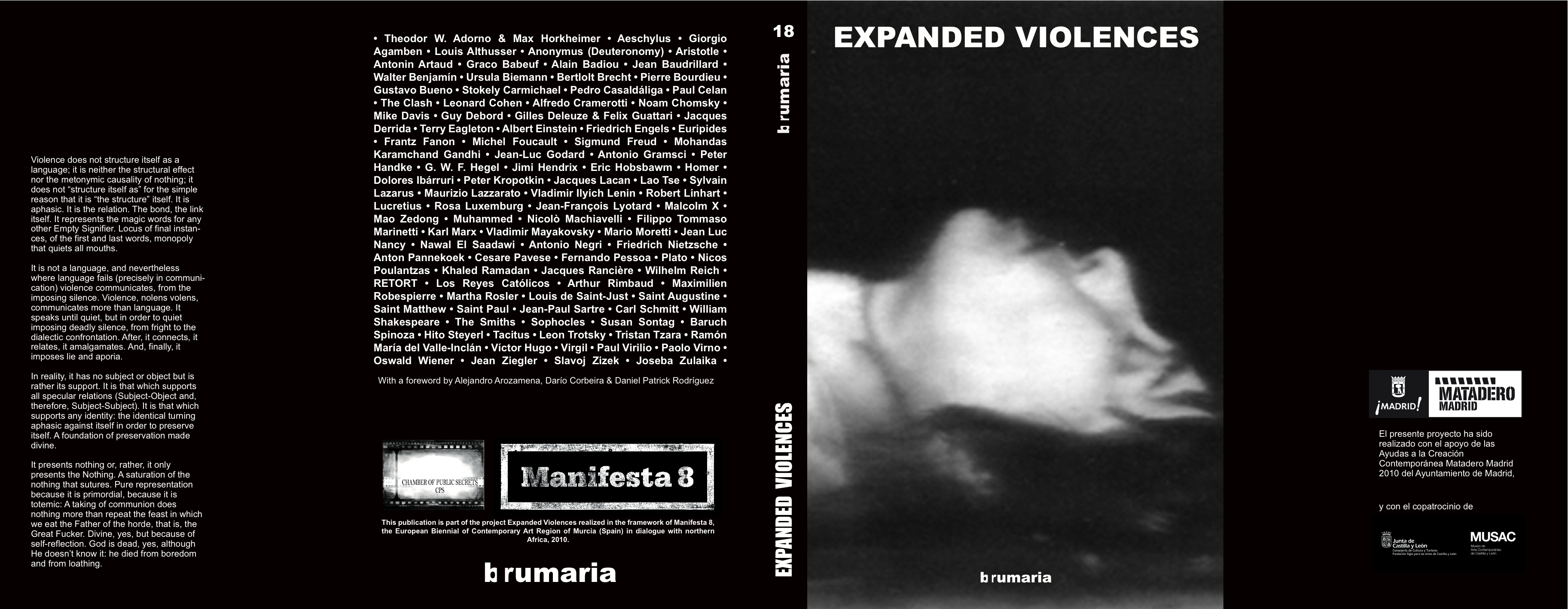
Expanded Violences by Brumaria
Expanded Violences is a project realized in the framework of Manifesta 8, The European Biennial of Contemporary Art.

IS VIOLENCE
THE ONLY MEANS TO CHANGE THIS
DEADLY WORLD?
Expanded Violences
Throughout the past two years in Brumaria, we have been working on and over multifocal-terrorism art-war relations. A product of this has been a series of forays— Art and Terrorism, Iconoclasm-Iconolatry, and now Expanded Violences— which, by means of different formats—research projects, exhibition projects, artistic work, seminars and publications—have permitted us to affirm the amplitude of these topics and the conceptual, thematic, and discursive gaps that today persist in the art institution both in the Spanish region and in the world of global art.
We understand that we neither want nor are able to isolate contemporary art from the world in which it is produced, commercialized, or museumized, especially if we keep in mind the present characteristics of armed conflict and if we affirm that we live in a state of permanent war. Although in the past war (the institutionalized phase of violence) defined itself as a conflict among sovereign nation-states, given that in the last few decades this sovereign authority of the nation-state has been decaying in favour of the emergency of a supranational sovereignty, the nature and the conditions of both war and political violence in our present times have necessarily and considerably changed, leaving behind the memory of the defeated, the humiliated, the offended…the murdered. In our current environment war is a global phenomenon. We live in a state of ubiquitous, brutal, and permanent “civil war”: a new and monstrous state of exception.
Expanded Violences focuses its attention on a triangulation between violence as representation strategically administered by power, the operation by which mass media and the use of art form a critical vertex of this multiple dialectic. If it seems obvious that there exists interdependence between political and economic power and the strategic operations used in mass media, the role of art is not so clear in this context.
• Theodor W. Adorno & Max Horkheimer • Aeschylus • Giorgio Agamben • Louis Althusser • Anonymus (Deuteronomy) • Aristotle • Antonin Artaud • Graco Babeuf • Alain Badiou • Jean Baudrillard • Walter Benjamín • Ursula Biemann • Bertlolt Brecht • Pierre Bourdieu • Gustavo Bueno • Stokely Carmichael • Pedro Casaldáliga • Paul Celan • The Clash • Leonard Cohen • Alfredo Cramerotti • Noam Chomsky • Mike Davis • Guy Debord • Gilles Deleuze & Felix Guattari • Jacques Derrida • Terry Eagleton • Albert Einstein • Friedrich Engels • Euripides • Frantz Fanon • Michel Foucault • Sigmund Freud • Mohandas Karamchand Gandhi • Jean-Luc Godard • Antonio Gramsci • Peter Handke • G. W. F. Hegel • Jimi Hendrix • Eric Hobsbawm • Homer • Dolores Ibárruri • Peter Kropotkin • Jacques Lacan • Lao Tse • Sylvain Lazarus • Maurizio Lazzarato • Vladimir Ilyich Lenin • Robert Linhart • Lucretius • Rosa Luxemburg • Jean-François Lyotard • Malcolm X • Mao Zedong • Nicolò Machiavelli • Filippo Tommaso Marinetti • Karl Marx • Vladimir Mayakovsky • Mario Moretti • Muhammed • Jean Luc Nancy • Nawal El Saadawi • Antonio Negri • Friedrich Nietzsche • Anton Pannekoek • Cesare Pavese • Fernando Pessoa • Plato • Nicos Poulantzas • Khaled Ramadan • Jacques Rancière • Wilhelm Reich • RETORT • Los Reyes Católicos • Arthur Rimbaud • Maximilien Robespierre • Martha Rosler • Louis de Saint-Just • Saint Augustine • Saint Matthew • Saint Paul • Jean-Paul Sartre • Carl Schmitt • William Shakespeare • The Smiths • Sophocles • Susan Sontag • Baruch Spinoza • Hito Steyerl • Tacitus • Leon Trotsky • Tristan Tzara • Ramón María del Valle-Inclán • Víctor Hugo • Virgil • Paul Virilio • Paolo Virno • Oswald Wiener • Jean Ziegler • Slavoj Zizek • Joseba Zulaika •
With a foreword by Alejandro Arozamena, Darío Corbeira & Daniel Patrick Rodríguez
Brumaria works #1
– Double installation with moving images, sound and temperature.
– Two publications in English and Spanish.
– A seminar.


 Curatorview [Alfredo Cramerotti]
leave a comment