STANDPOINT FUTURES at Chisenhale Studios London – Call for artists is open!
|
STANDPOINT FUTURES at Chisenhale Studios
Standpoint Futures is a residency programme for visual artists, providing high calibre, tailored opportunities for discussion and interaction with the London art world. Applications are invited for the 2017 programme. Each residency is 6 weeks long, working at new residency partners Chisenhale Studios in Bow, London E3. Standpoint Futures awards artists a free studio and accommodation during their residency, all advisor and mentoring meetings, plus a contribution to expenses of £100 per week. The residencies will run from mid January – July 2017. The submission portal will go live on Monday 1 August. Selectors: For more information please follow the link to the website here |

|

|
Above: Studio 4 at Chisenhale Studios, where Futures artists will be based in 2017. Credit: Tessa Whitehead, Studio4 Installation, 2015 |
|
Studio visitors to our residency artists in 2015 included Jonathan P Watts, Morgan Quaintance, Anthea Hamilton, Katie Guggenheim (Chisenhale Gallery), Marianne Forrest (Auto Italia), Milovan Farronato (Fiorucci Arts Trust), Dr Katherine Angel (Historian/Writer), Dr Betti Marenko (Central Saint Martins), Eddie Peake, Francesca Gavin, Andrea Francke, Amy Budd (Raven Row), Beatrice Gibson (LUX), Lindsay Seers, Nick Crowe, Ruth Ewan, Colin Perry (Writer), David Hoyland (Seventeen Gallery), Rachel Anderson (Artangel), and Anna Gritz (South London Gallery). |
|

‘697 MADRI’ by Stefano Cagol presents a lecture by Alfredo Cramerotti
In the frame of the solo project ‘697 MADRI’ by Stefano Cagol, Alfredo Cramerotti holds the lecture ‘The expanded image. The mutation of the role of contemporary photography’
 |
‘The expanded image. The mutation of the role of contemporary photography’Lecture: August 6, 2016, 18.00 hrshttp://www.697madri.eu |
THE PROJECT
697 MADRI (697 mothers) refers to the 697 young soldiers died in the First World War in this border area of Trentino South Tyrol and buried by the Austro-Hungarian Monumental Military Cemetery in Bondo.
On July 2nd, 2016 the artist Stefano Cagol called all the women to come to the small village of Bondo (700 inhabitants) in the middle of the Alps and the Dolomites for a participatory performance. Hundreds of women came from all the region and outside and walked and staid on the monumental granite stairs recalling the personal and family suffering beyond flags, troops and belongings. They became part of a new monument to life and this action has been fixed by video and photographic images by the artist.
Now the artworks are on view till September 17th, 2016 by the Antica Chiesa di San Barnaba – Ancient Church of Saint Barnaba in Bondo, together with an installation (aluminum and sound) that recall, with sharp edges, the extreme conditions of the soldiers waging war on the top of these mountains that actually appear as a natural paradise.
THE LECTURE
In this border region, in a small village in the middle of the Alps, in a symbolic place recalling the continue conflicts and the human consequences of wars, it is extremely relevant the presence of Alfredo Cramerotti for a lecture about the role of images nowadays. Lecture: August 6, 2016, 18.00 hrs
Alfredo Cramerotti is the Director of MOSTYN, the main art center in Wales; he was born in Trentino and this is the first time he comes back for an art event. Cramerotti and Stefano Cagol had the chance to collaborate for the Maldives National Pavilion at 55th Venice Biennale: Cagol as participating artist and Alfredo Cramerotti as part of the curatorial collective CPS-Chamber of Public Secrets.
The lecture ‘The expanded image. The mutation of the role of contemporary photography’ by Alfredo Cramerotti is realized with the participation of Franco Marzatico, Superintendent for Cultural Heritage of the Autonomous Province of Trento.
THE PROMOTING INSTITUTION
The project and the collateral program are promoted by the Scuola Musicale Giudicarie: www.scuolamusicalegiudicarie.it
With the support of the municipality of Sella Giudicarie, BIM Valle del Chiese, BIM Sarca-Mincio-Garda, with the participation of Associazione Nazionale Alpini and Osterreichisches Schwarzes Kreuz.
The iconographic and historical research is curated by Giulia Robol.
#697madri
Festival of Journalism and Art: Panel Discussion

Image © Edmund Black
Festival of Journalism and Art: Panel Discussion
Press coverage for MOSTYN exhibitions: Diango Hernandez, Iwan Lewis and WAR II
Museum Morsbroich, Leverkusen
Diango Hernández in conversation with Alfredo Cramerotti
1 July 2016


Download PDF: Conversation
Planet Magazine Issue 221
by Jen Loffman
1 June 2016


Contemporary Art Daily
Diango Hernández at Mostyn
5 May 2016


Download PDF: CONTEMPORARY ART DAILY_Diango Hernandez
Link: Diango Hernández at MOSTYN
Daily News: What’s On / Q&A
15 April 2016
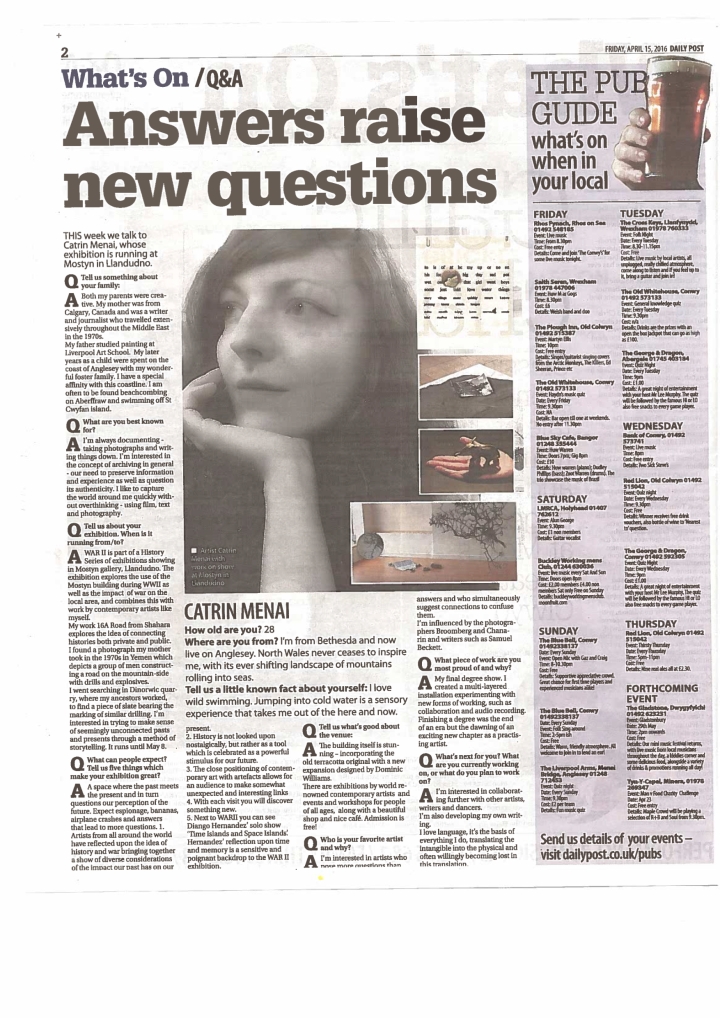
Daily News: What’s On / Q&A
1 April 2016

a-n Artist’s Information Company
21 March 2016
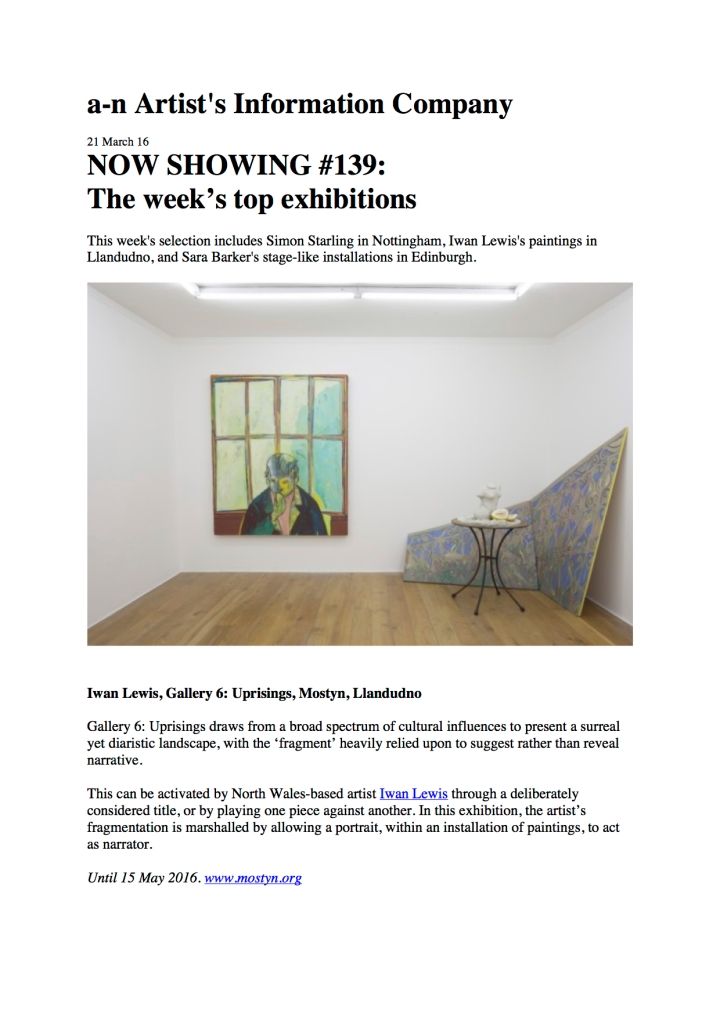
Daily News: What’s On / Q&A
18 March 2016

Arts Newsletter
by David Brown
March 2016
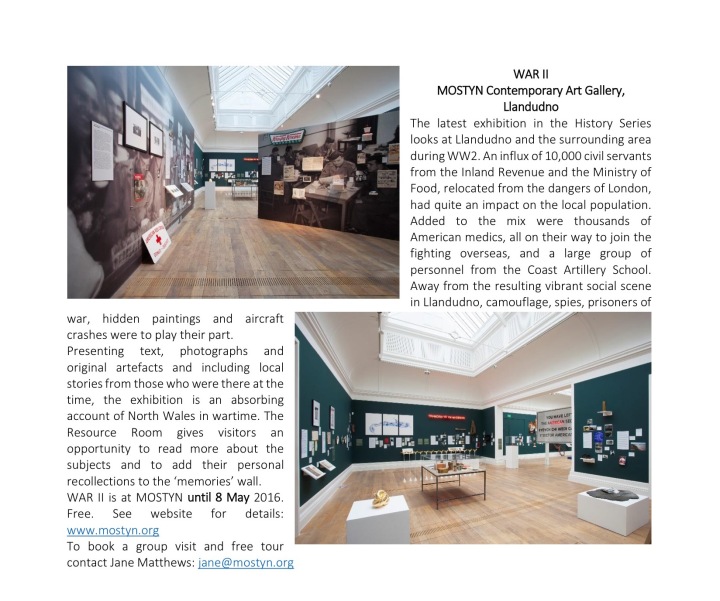
Weekly News
25 February 2016


Link: http://www.dailypost.co.uk/news/north-wales-news/llandudno-exhibition-tells-story-father-10930386
MOUSSE
9 February 2016


Link: http://moussemagazine.it/diego-hernandez-war-ii-mostyn-2016/
CURA Magazine
3 February 2016


Link: http://curamagazine.com/tips/war-ii/
Culture24
by Kate McNab
4 January 2016

ATP Diary – Interview with Adam Carr – WAR II, MOSTYN, Llandudno
by Matteo Mottin
30 December 2015


Link: http://atpdiary.com/adam-carr-war-ii-mostyn-exhibits/
Weekly News
9 December 2015


ITV News
by Ian Lang
7 December 2015

Llandudno gallery celebrates its American GI history
An exhibition’s being launched to celebrate the role of a north Wales resort in hosting thousands of American service personnel in the Second World War.
The Mostyn building – now an art gallery – provided food and recreation for American troops living in Llandudno, a complete contrast to the building’s use as a drill hall in the First World War.
Watch Ian Lang‘s report:
NW Pioneer & Welsh Coastal Life
11 November 2015


The Seen Journal No.1
TIME ISLANDS AND SPACE ISLANDS: Diango Hernández in conversation with Alfredo Cramerotti
01 October 2015


Download PDF: THE-SEEN-Issue-01-Diango-Hernandez-Alfredo-Cramerotti
Press coverage for MOSTYN exhibitions: Irma Blank and Laura Reeves
Roven n°12: Les Rituels du dessin: SUR LE RITUEL. CINQ QUESTIONS À IRMA BLANK
by Alfredo Cramerotti, Irma Blank, Joana Neves [Ed.]
15 March 2016


Daily Post: What’s On / Q&A
20 February 2015

MOSTYN exhibition, The School of Art, Science and Technical Classes: Jonathan Shanklin’s talk

Great news!
Jonathan Shanklin, who discovered the Antarctic ozone hole, will be speaking about this important scientific breakthrough and his family links to the current MOSTYN exhibition, The School of Art, Science and Technical Classes, on 30 July 2016, 2:00pm at The Imperial Hotel, Llandudno.
Tickets £8. Telephone 01492 868191 to book.
Newyddion gwych!
Bydd Jonathan Shanklin, a ddarganfu’r twll yn yr osôn yn yr Antarctig yn sgwrsio am y darganfyddiad gwyddonol, pwysig hwn a’i gysylltiadau teuluol ag arddangosfa gyfredol MOSTYN, Yr Ysgol Gelf, Gwyddoniaeth a Dosbarthiadau Technegol, 30 Gorffennaf 2016, 2.00yh yng Ngwesty’r Imperial, Llandudno
Tocynnau £8. Ffôn 01492 868191 i archebu lle.
The ozone hole is ‘healing’ according to new research published this week in the journal Science.
Jonathan Shanklin from BAS was one of the scientists who was part of the discovery in 1985. He says:
“It is very clear that the Montreal Protocol is working, that it is clearly leading to a reduction in the amount of ozone destroying chemicals in the atmosphere, and that this reduction is probably leading to a recovery of the Antarctic ozone layer. Nevertheless we will still have ozone holes for perhaps another half century.”
https://www.bas.ac.uk/…/first-signs-of-healing-in-the-anta…/
Press coverage for ULISSE II: Two sculptors in a timeless conversation on beauty
Makoto, Ulisse II
A project by Virtualgeo and Museo Archeologico Nazionale di Venezia, curated by Alfredo Cramerotti.
18 November 2015 to 31 January 2016
 The Venice Archaeological State Museum will host Ulysses II, a contemporary sculpture by Japanese artist Makoto to dialogue with the Ulysses one part of Grimani collection. The exhibition opens on November 18 at noon with Daniele Ferrara, Director of ‘Polo Museale del Veneto’.
Video trailer by Makoto
29 December 2015
Arte
11 November 2015
Undo.Net
11 November 2015
Undo 11 nov 2015_newsletter 18 nov
Fidest
13 November 2015
ArcheoMedia
14 November 2015
All Events
17 November 2015
La Repubblica
by Valentina Bernabei
17 November 2015
articolo repubblica 17 11 2015
Exibart
17 November 2015
TGCOM24
17 November 2015
Eliconie
17 November 2015
Artribune.com
by Arianna Testino
17 & 20 November 2015
Il Gazzettino
18 November 2015
gazzettino pag XXVII_18_11_2015
MIBACT – Ministero dei beni e delle attività culturali e del turismo
18 November 2015
Artisti Contemporanei
18 November 2015
artisti contemporanei 18 novembre 2015
Corriere della Sera
19 November 2015
Corsera ed Veneto 19 11 2015 pag 13
La Repubblica_Nuova Venezia
19 November 2015
Repubblica_Nuova Venezia 19 11 2015 pag 39
SKYARTE HD
21 November 2015
SKYARTE HD_21 dicembre 2015_21 gennaio 2016
Orient Express
by Giovanna Dal Magro
27 November 2015
Orient Express 27 Novembre 2015
ABCVENETO.COM
by Luigi Stefanelli
1 December 2015
Press coverage for EXPO VIDEO 2015, curated by Alfredo Cramerotti
EXPO VIDEO exhibition during EXPO CHICAGO (September 17 – 20, 2015)

Artspace Magazine
EXPO VIDEO Curator Alfredo Cramerotti on the Past, Present, and Future of Experimental Film
by Dylan Kerr
16 Sept 2015
Cultured Magazine
by Tali Jaffe, executive editor, and Sabrina Wirth
18 September 2015
 Jessica Stockholder’s Once Upon a Time, at IN/SITU 2014
EXPO Chicago, The International Exposition of Contemporary & Modern Art, showcases Chicago’s rich cultural history with a multi-sensory visual art event program with more than 140 art galleries. Visitors can experience temporary public art along the lakefront and throughout Chicago neighborhoods with EXPO IN/SITU Outside, curated by Louis Grachos and international films curated by Alfredo Cramerotti with EXPO VIDEO.
fair? Is that part of EXPO VIDEO’s purpose?
Alfredo Cramerotti: What I think is important is to not ‘forget’ that art implies a number of things – the thinking, the making, the displaying, the mediating, and yes, the collecting / selling / buying of it. In an art fair is crucial to understand where ‘value’ comes from. It’s wise to be aware where this value and potential growth comes from. It doesn’t start with money. Capital always follows action, as Iggy Pop brilliantly put it in his (so far, only) lecture, last year in London.
TJ: Is this the first program you’ve curated in a commercial setting? Does that affect your approach at all?
AC: It’s not the first time. I have curated solo shows for artists I know and appreciate since long in commercial galleries before, because I’ve been asked by them. I am also curating a group show in a commercial gallery in Vienna, just before EXPO VIDEO, because they invited me to put up a very interesting project about, you guess, art & capital. I’m writing the catalogue text now. They gave me carte blanche, and actually, none of the represented artists feature in the show and they were absolutely fine with that. I find the commercial context different, of course, but it depends a lot about your approach as curator, your vision for the project, your capability to negotiate the elements of the exhibition, and the relationship with both galleries and artists. I enjoy to ‘jump ship’ every now and then. It gives me a different perspective that might be useful in my institutional role too.
TJ: In speaking about the viewing experience, you say the viewer is at the center of the work. Can you elaborate on that please.
AC: I always try to put myself in the viewer’s shoes, when I plan a show. I take onboard the viewer’s experience in encountering the wall text, the colours on the galleries, the people along the spaces, sitting on a sofa or standing to watch a video (How long does it last? Do I have enough time? Do I want to see this one now or have a look at the rest of the exhibition first? Etc.), being able to read the information without struggling to understand them, and also being free to ignore them if I wanted. When I curate a show, I am the first audience. If something doesn’t ring true or right, it needs to change. Especially in a film & video show, it’s easy to forget that we put an enormous ask on the viewer; it’s possibly the most difficult exhibition to experience. That’s why I position the viewer at the centre of the work – in terms of content, interpretation, time, experience of viewing, possibility to come and go at leisure, and of choosing different times and modes of viewing.
TJ: There are a number of ways for viewers to experience the video program, including an app. Is that unusual, to be able to choose the format you experience an artwork?
AC: Yes, it might be unusual to some extent, but it goes back to what I was mentioning before – putting the viewer at the centre. If a work is conceived as an app, and that work is perfect for a curatorial concept and an idea for an exhibition, then why not include it? It is stretching the boundaries for what film & video can be, and how can be experienced. The same goes for the four viewing pods present in EXPO VIDEO. There are works which I haven’t included in the two screening rooms’ loops because I have a clear feeling they would work better on a digital screen, in the middle of an open area. It’s a matter of taking responsibilities for the choice of the work but also for the experience of that work.
TJ: Can you tell us about your concept “aesthetic journalism”?
AC: The scholarship about the theory and practice of “aesthetic journalism” refers to a concept I created, starting from my work as an artist, to investigate the relationship between contemporary exhibitions and elements of interview, documentary, fiction and reportage. In short, I speculate on the mutual convergence of art and media into a new cross discipline of “aesthetic journalism”. Turned out it has a strong resonance with many contemporary artists’ approaches and practices. The proof is that the book has been listed as recommended reading in many American and European universities, and I have constant lecture requests worldwide – even if the book was published in 2009. It’s a nice feeling being able to identify and unravel a cultural trope.
I am following up now with the idea of “expanded photography: the hyperimage”, which investigates digital culture’s impact on artistic and curatorial practices. I’m not there yet – still working on it.
TJ: There’s a great range in video lengths, from 1:32 to 30 minutes. Is it riskier or more challenging with the longer video works?
AC: Neither really. Depends of the work. Depends how it sits with the rest of the programme. Depends, also, on what narrative sequence one creates in the viewer’s mind, and how that mind actually makes that sequence work. Always an attempt, always changing.
TJ: I’m curious about the ages of the artists included. Can you tell us the youngest and eldest among them?
AC: I actually don’t know the age of the twenty artists or so, never researched an artist’s work based on her or his age. They probably go from 20 to 70 but that’s just a guess.
TJ: Are there any emerging artists you have your eye on at the moment?
AC: Yes, I have eyes and ears open all the time. That’s part of my job. Danilo Correale (based in NY) is one. Tamar Guimaraes (based in Copenhagen) another. Renhui Zhao (based in Singapore) a third. Marinella Senatore (based in Paris) a fourth. Marc Rees (based in Cardiff) a fifth. The list can go on, but I stop here.
/Dialogues: EXPO VIDEO | Alfredo Cramerotti In Conversation panel discussion, featuring Alfredo Cramerotti, Director | MOSTYN and 2015 EXPO VIDEO Curator; Malerie Marder, Artist; and Cauleen Smith, Artist. Moderated by Duncan MacKenzie, Bad at Sports.
by Stephanie Cristello
5 Oct 2015
Audio: http://badatsports.com/2015/episode-528-alfredo-cramerotti-malerie-marder-and-cauleen-smith/
Project G x 2
by George Gozmon + Guy-Vincent
17 October 2015
MOSTYN new exhibition season | Marinella Senatore: The School of Narrative Dance and Other Surprising Things / Camille Henrot, FORT, Meirion Ginsberg : The School of Art, Science & Technical Classes / GALLERY 6 Uprisings: Sïan Rees Astley
MOSTYN, Wales’ foremost contemporary visual arts centre, is delighted to announce a new season of exhibitions, May 21–September 17, 2016

Marinella Senatore
The School of Narrative Dance and Other Surprising Things
Galleries 2 & 3
MOSTYN, Wales UK proudly presents the first solo exhibition in a British institution by Marinella Senatore. The exhibition will present a selection of the artist’s work from 2009 to today, in a renewed form of installation which will enable visitor participation and active engagement.
A special focus will be dedicated to The School of Narrative Dance, an ongoing, touring project founded by the artist in 2013 which has received wide acclaim from the public in over ten countries around the world.
For the first time it will also present, in its original idea, RE:VERB—a multi-layered work consisting of seven videos intended for television broadcast, made with the people of Llandudno during the artist’s residency in North Wales in 2015. This work was commissioned by CALL, and made possible by the collaborative initiative and financial support of the Arts Council Wales Ideas:People:Places grant and Mostyn Estates Ltd.
The exhibition is accompanied by an Open Call for contributions to ESTMAN RADIO, an ongoing “self-service” online radio station which takes up residence in MOSTYN’s Gallery 2.
In addition, Marinella Senatore’s video piece The School of Narrative Dance will be showing concurrently on a media wall in Milan’s Corso Como 15 from May 20 until 31, as part of a joint partnership between MOSTYN and Poincaré Investment Ltd. The partnership also sees the presentation of a new video work by ciriaca + erre from May 1 until 19.
The exhibition, curated by Alfredo Cramerotti (Director, MOSTYN) and related public programme is supported by CALL and Poincaré Investments Ltd.
#MOSTYNnarrativedance
The School of Art, Science & Technical Classes
A school featuring solo exhibitions by Camille Henrot, FORT, Meirion Ginsberg and a historical presentation
Galleries 4, 5, Studio
The School of Art, Science & Technical Classes takes as its point of departure the use of MOSTYN’s building as an art gallery and educational establishment from 1903 to 1912. Some of the subjects on offer included life drawing, light & shade drawing, brushwork, geometrical drawing, woodcarving, metalwork, dressmaking, elocution, music, French and shorthand. The classes were supplemented by lectures on associated subjects.
Some 100 years on, new “classes” have been curated with solo exhibitions by Camille Henrot, FORT and Meirion Ginsberg. An additional room will survey the time of the original art school and its links to the present, along with a history of a number of local schools. The exhibition is part of the “History Series” at MOSTYN and is the seventh exhibition in the series.
The three artists have been chosen for their international relevance and mastery, or emergence and promise, in the respective disciplines of the classes, which are “brush drawing” (Camille Henrot), “metalwork” (FORT) and “light and shade” (Meirion Ginsberg). Arguably the original terms are outdated and have been replaced by new definitions, or have been co-opted by a more general term “Contemporary Art.” Paradoxically, however, they offer new ways of seeing and interpreting the work in display—in the same way that the “History Series” uses the past to establish new pathways for understanding society today.
This exhibition is curated by Adam Carr (Visual Arts Programme Curator, MOSTYN). The historical presentation is brought together in collaboration with Jane Matthews (Engagement Manager/Research MOSTYN) and Richard Cynan Jones (Operations and Facilities/Research, MOSTYN).
#MOSTYNSchool / #HistorySeries
GALLERY 6: Uprisings: Sïan Rees Astley
Gallery 6 is dedicated to presenting the work of young and emerging artists, all of whom are yet to have a solo exhibition in an institutional setting—nationally or internationally. The final exhibition of the programme is by Sïan Rees Astley, born 1992 and based on Anglesey, and a recent graduate from Coleg Menai in Bangor, North Wales.
Sïan Rees Astley’s work makes wide use of everyday materials, often those produced for the domestic space. Her work positions the process of its making at its core, and heightens the sense of time spent working with the materials. A key element of the work is repetition, used throughout, and which sometimes renders the materials used beyond recognition, only apparent by way of the work’s captions.
This exhibition, curated by Adam Carr (Visual Arts Programme Curator, MOSTYN), will present new work made in response to the space.
About MOSTYN | Cymru | Wales
Located in Llandudno, North Wales (UK), MOSTYN is the leading publicly funded contemporary visual art centre in Wales, serving as a forum for the presentation and discussion of contemporary life through international contemporary art and curatorial practice. Through exhibitions, learning programmes, lectures, symposia and publications, MOSTYN plays an active role in discussing contemporary culture in Wales, the UK, and beyond. To be kept up to date with MOSTYN’s new programme, please subscribe to our mailing list by emailing lin@mostyn.org.
MOSTYN
12 Vaughan Street
Llandudno LL30 1AB
United Kingdom


 Curatorview [Alfredo Cramerotti]
leave a comment