RFC Rapallo Fotografia Contemporanea – quinta edizione: RITORNO ALLA FOTOGRAFIA

15 gennaio – 13 febbraio 2011
Antico Castello sul Mare, Rapallo, Italy
opening day – sabato 15 gennaio
tavola rotonda
h 15.00 Villa Queirolo_Casa della Cultura, via Aurelia di Ponente, 1 Rapallo
“Ritorno alla Fotografia. Scelte e necessità nel dibattito contemporaneo”
partecipano Andrea Botto, Alfredo Cramerotti, Charlotte Dumas, Francesco Zanot

Manifesta 8 verrassingen in Murcia
Tableau Fine Art Magazine, The Netherlands.
MANIFESTA 8
by Jonathan Turner
A long-time collaborator with Manifesta since the mid-1990s, Tableau’s Rome correspondent Jonathan Turner gives an inside look into the current edition in Spain.
English text below
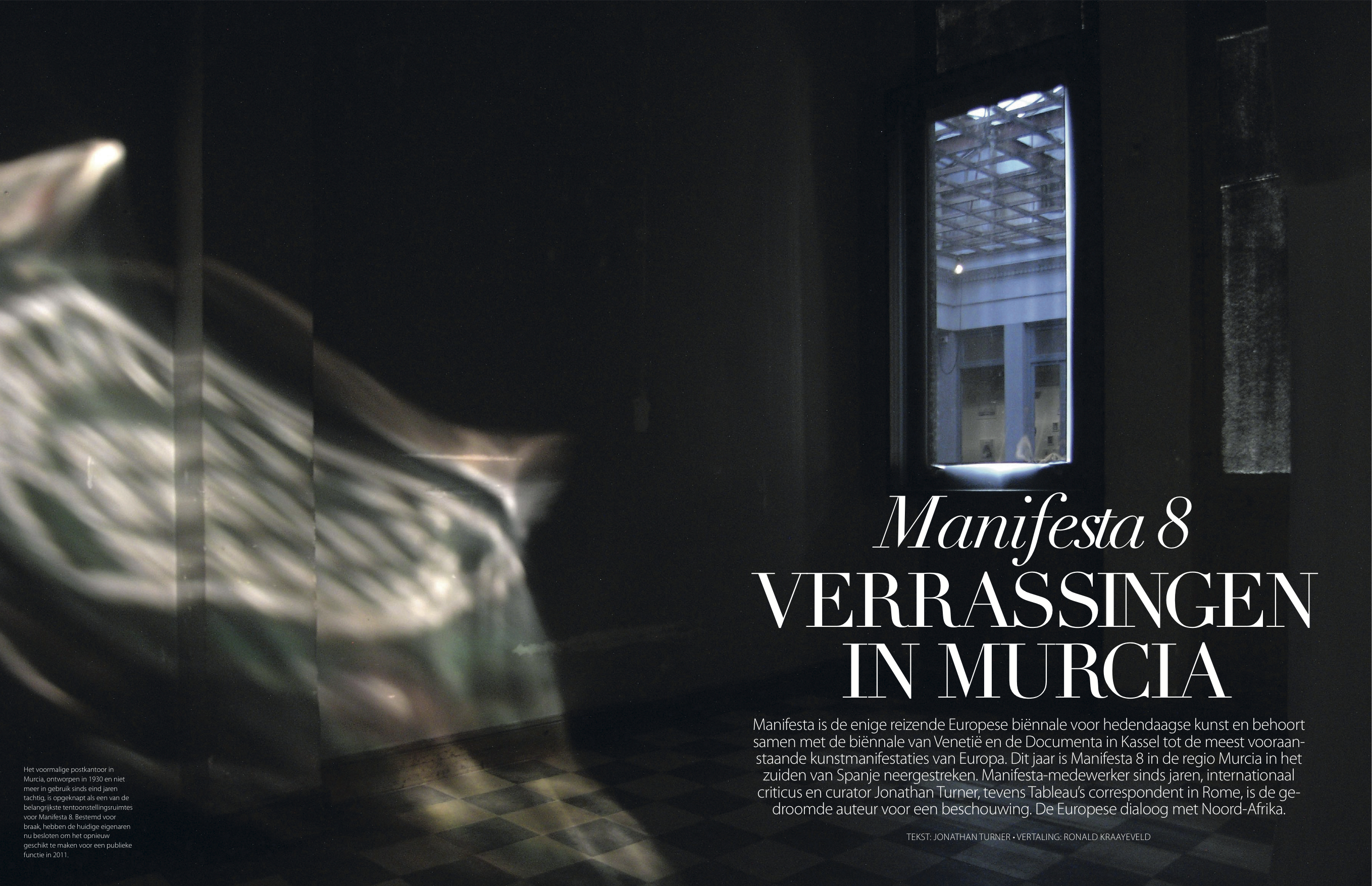
Il n’y a plus rien (There is nothing left) by Céline Condorelli, Installation shot.
INTRO
In this era of mega-biennials, huge art fairs and ever-expanding modern art museums, Manifesta 8 – the roving European Biennial of Contemporary Art currently taking place in Murcia and Cartagena in south-eastern Spain – can be seen in terms of being a cultural undertaking of grand proportions. Until January 9, Manifesta 8 takes place in two cities, organized by three curatorial groups, in 14 venues, with 65 parallel events, featuring more than 150 contributing artists, and accompanied by a 400-page book. However, it is also an event which focuses on intimacy and precise social themes, ranging from matters of surveillance, language, media interference, aspects of time, ethnic links, incarceration, blindness, and Europe’s present-day relationships to northern Africa, including such pressing issues as migration, refugee-status and integration. There are many surprises. Given the unusual context of Manifesta 8, set in a variety of buildings including museums, military barracks, a former post-office, a casino, an abandoned hospital building and even San Anton Prison, many of the artworks provided poignant echoes of the sites where they are installed. After all, what could be more evocative than works of art based on oppression or paying homage to political prisoners, exhibited inside cells in a building that until last June still housed inmates.
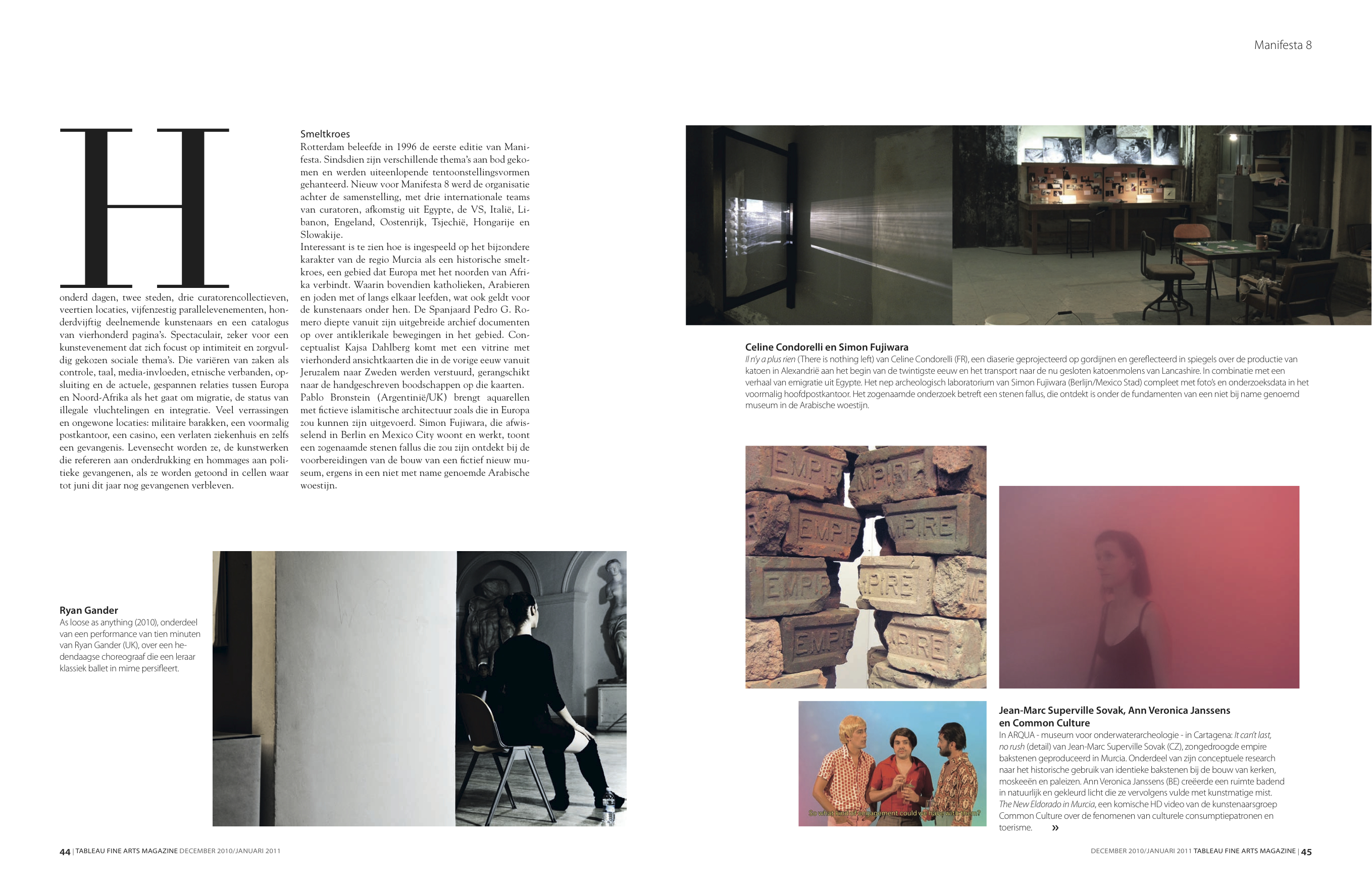
The first edition of Manifesta was held in Rotterdam in 1996, and each subsequent edition has focused on different themes and exhibition models. An innovation at Manifesta 8 has been its selection of a curatorial team composed of three international collectives – Alexandria Contemporary Arts Forum (Egypt and U.S.A), Chamber of Public Secrets (Italy, Lebanon, Scandinavia and U.K.) and tranzit.org (Austria, Czech Republic, Hungary and Slovakia). It also specifically set out to explore the particular nature of the region of Murcia as a historical melting pot and border zone linking Europe to northern Africa (Cartagena itself was established on the Spanish coast after the sacking of the ancient Roman city of Carthage in present-day Tunisia) with many artists tracing various Catholic, Arabic and Jewish links over time. Spain’s Pedro G. Romero presents documents from his vast archives focused on anti-clerical movements in his native Spain while Kajsa Dahlberg’s conceptual work comprises a mirrored showcase containing 400 postcards sent from Jerusalem to Sweden over the past century. They are displayed according to the content of the hand-written messages they contain.
Pablo Bronstein (Argentina/U.K.) makes watercolours “documenting” fictional Islamic architecture “built” in Europe, Simon Fujiwara (based in Berlin and Mexico City) recreates a make-believe archeological dig whereby an ancient stone phallus was “discovered” during excavations in preparation for a new museum building somewhere in an unspecified Arabian desert, while Parisian artist Neïl Beloufa defines his film shot in Mali as “a science fiction documentary”. Set in a staged reality, and viewed from within a theatrical setting of a roughly constructed auditorium made by the artist from cheap materials, Beloufa’s film is shot at night-time using street lighting to accentuate its own fakeness, with the protagonists talking in a dream-like way about their hopes and desires. Probably the clearest example of an artist tracing the links between Africa and the West is the mini-exhibition of black and white photographs by New York-based Lorraine O’Grady. In her series of diptyches, striking portraits of her female relatives are juxtaposed next to iconic images of ancient Egyptian sculptures.
Many projects have been developed by artists as acts of infiltration into the local community through the use of television and radio programs, the Internet, newspaper stories and special publications. This includes the invasive television reporting of Thierry Geoffroy (France/Denmark). Dressed like a colonial African explorer, he takes to the streets, interviewing residents of Murcia about their Muslim friends, accompanied by a camera crew. In an aligned project to Manifesta 8, Tiong Ang (Indonesia/The Netherlands) has filmed a tv soap opera called “As the Academy Turns”. It is an over-dramatic hoax set in an art academy, where the students, professors and other characters subvert popular views on higher art education.
Film and video featured strongly. Willie Doherty (Northern Ireland) has chosen the underside of a motorway bridge as the location for his video. It is a study of homelessness, shifting light and the ebb and flow of the Murcia’s Segura River. In the lush surroundings of the Casino in Cartagena, Stefanos Tsivopoulos (Athens/Amsterdam) projects his bleak film documenting the ravaged, Mars-like landscapes left behind by the mining industry of the region. Meanwhile, using flared exposure and grainy black-and-white, the artistic duo Igor & Ivan Buharov from Budapest present “Rudderless”. This is a mock socio-political documentary about a mythic, mystic man, a degraded romantic figure who ends up as a corpse on a conveyor belt.
But there is also comedy. In a room in the former central post office, painted as black as a prison cell, Michael Paul Britto (New York) studies the rhythms of aggression. In his double screen projection, the artist launches a litany of verbal abuse, attacking black politics, stereotypes and the viewer. The colourful language is sublime. The aggression and badmouthing reach a point of humour. Like in a movie by Quentin Tarantino, the violence is exaggerated to the point of satire. This work competes for attention with a video projection by Common Culture, an artist collective based in England. In this projection, three Spanish guys, dressed in loud clothes and cheap wigs like gigolos, stand in a disco under a mirror ball drinking cocktails complete with tiny umbrellas. They speak over the music. Their conversation is psycho-babble, discussing the “trans-national European hegemony” and attacking the contemporary art public by calling them “the mobile zombie nation”. Their criticism ends in farce.
In the same way that Manifesta sets out to utilise non-traditional spaces for its exhibitions, and to restore unused buildings for future cultural use after the biennial has moved on to its next location, many artists in Manifesta 8 also incorporate less traditional artistic processes. Ryan Gander (England) includes an almost invisible work in which he has modified a tiled floor to create a shallow puddle of water. Sometimes without knowing, visitors who pass through the exhibition leave wet footprints as ephemeral reminders of their presence. Czech artist Tomáš Vaněk inflates giant balloons, then explodes them. He then staples the rubber remains to the wall in abstract compositions. Vaněk regards this act as a demonstration of the concept: “Think round, act square”. Based in Amsterdam, Metahaven has created a project inspired by the fact that 13% of the volume of fruit and vegetables distributed in Europe is produced in the region of Murcia, often grown thanks to irrigation systems introduced by Islamic settlers many centuries ago. At various farms in the region, a series of different stickers designed by Metahaven are being applied to citrus fruits before they are marketed locally, nationally and throughout Europe. This is also a way to monitor the reality of European regulations. According to the artists, “Fruit labels have become fetish objects for collectors, although much of the romanticism has given way to bar-codes and other technocratic devices.” In an unexpected collaboration which also presents a fetish attitude, Turkish artist Banu Cennetoğlu has created a sculpture together with London-based Shiri Zinn, an artist known for her customized erotic objects. Zinn’s glass piece has become a cremation urn carrying a sample of dust collected from its exhibition site in the former artillery barracks in Murcia. This glass object now exists as a monument to the historic function of the site, reflecting on the dual aspects of potency and power. It is an ode to impotence versus authority.
Unusual for any art event, Manifesta 8 also pays close attention to the theme of blindness. Working in Copenhagen and New York, the duo Wooloo is running the world’s first non-visual residency program for artists. One event is an exhibition consisting of a blacked-out space where the visitor holds on to a rope, and follows a circuit distinguished by the aromas and spices of different local cuisines. In another project, an artist takes her blind assistant through a gallery exhibition, carefully explaining the works on show. Later, the blind assistant takes the Manifesta visitor through the same space, now totally darkened. Remembering what she has been told by the artist, the blind assistant now explains each work to the visitor, although now neither of them can see. “We are interested in what is normally lost in translation,” says Wooloo artist Martin Rosengard. “We wanted to connect two diverse groups who rarely meet.”
In a similar way, the work of Ann Veronica Janssens (Brussels) creates a sense of disorientation. A room is filled with dense artificial fog and bathed in a strong red light. Apart from the all-encompassing red mist, the viewer is rendered sightless. In Cartagena’s Regional Museum of Modern Art (MURAM), blind Turkish artist Eşref Armağan displays his remarkable paintings of objects and landscapes, reconstructing outlines of the things he feels, touches and imagines, but has never seen. Without physical vision, he reinvents perspective. Another Manifesta project involves the publication of a book in Braille, and partly in recognition of the biennial’s focus on issues of blindness, the national lottery, operated by Spain’s blind community, dedicated one competition draw to the M8 exhibition itself.
In contrast to the theme of blindness, many artists instead undertook projects exploring the idea of modern surveillance. The video “Crossing Borders” by Anders Eiebakke (Norway) is about aerial surveillance drones. It shows how anyone can build and operate a drone attached to a model airplane, similar to those deployed by military and police forces, without any previous knowledge of flying or radio technology. Remnants of wartime surveillance are still present in Cartagena today. Built in 1768 as part of the Royal Navy Hospital, the former autopsy pavilion in Cartagena plays host to a mesmerizing film by Laurent Grasso. The French artist reveals a sense of intrigue and lurking fear. He films the ramparts, abandoned turrets, cannons and air-raid shelters dotted along the cliffs near Cartagena. He films the coast guard and naval manoeuvres on the sparkling water, sometimes from within a boat rolling in the waves, to produce the effects of seasickness. Slowly, in Grasso’s film, the picturesque coastline becomes an ominous, dangerous landscape.
Since Murcia is also known for its jails, refugee-camps and detention centres, some artists chose incarceration and rehabilitation as their theme. David Rych (Innsbruck/Berlin) devised an experiment whereby a group of six juveniles from a youth custody centre met with six adult inmates serving long-term prison sentences. In an almost voyeuristic way, the audience gains an insight into individual perspectives, also thanks to videos made by the participants in this encounter between different generations.

Such profound projects are intrinsic and essential to the ongoing success of Manifesta. Manifesta 8 is not merely a series of exhibitions. Long-term projects include a future publication to be overseen by tranzit.org to research the cultural similarities between post-colonial and post-Communist communities in Africa, and a series of symposia and workshops devised by Alexandria Contemporary Arts Forum called the “Incubator”, to study the potential for a pan-African nomadic biennale of contemporary art. While Manifesta 8 works on a macro-scale, sometimes it is also good to focus on the smaller, personal details. Several former inmates of the San Anton Prison helped with the restoration of the building prior to Manifesta 8, and assisted with the installation of the artworks for the exhibition there. As a result of their close and positive interaction with contemporary art, two of the low-security inmates are working as guides to the various shows, and they have now decided to pursue studies in the fine arts.
Manifesta 8
Murcia, Cartagena and other cities in the region
Until January 9, 2011
http://www.manifesta8.es
Captions:
page 42
Il n’y a plus rien (There is nothing left) by Céline Condorelli, Installation shot. The former Central Post Office in Murcia, designed in 1930 and abandoned since the late 1980s, has been refurbished as one of the main exhibition sites for Manifesta 8. Slated for demolition, the current owners have now decided to restore the building, maybe as a casino.
page 44
As loose as anything (2010), part of a ten-minute performance devised by English artist Ryan Gander, consisting of a contemporary dance choreographer miming the actions of a teacher of classical ballet.
page 45 top.
Il n’y a plus rien (There is nothing left) by Paris-born London-based artist Céline Condorelli, a sequence of slides projected on curtains and reflected in mirrors tracing the production of cotton grown in Alexandria in the early 20th Century and transported to the now-shut cotton mills of Lancashire, accompanied by an aligned tale of emigration from Egypt.
The fake archaeological laboratory complete with photographic records and working data, set up in the former central Post Office by Simon Fujiwara (born in London, lives and works in Berlin and Mexico City), supposedly researching a stone phallus discovered under the foundations of an unnamed museum somewhere in the Arabian desert.
page 45 bottom
Sun-dried EMPIRE bricks made in Murcia by Canadian artist Jean-Marc Superville Sovak at ARQUA (The National Museum of Underwater Archaeology) in Cartagena, as part of his conceptual research into the historical fact that identical bricks were used to build churches, mosques and empirical palaces. A room bathed in natural and coloured light, then filled with artificial fog, by Brussels- based Ann Veronica Janssens. The New Eldorado in Murcia, a comic HD video exploring the phenomena of cultural consumption and tourism by artist group Common Culture.
page 46
The spatial installation Suspended in which Austrian artist Nikolaus Schletterer turns a room at MURAM (Regional Museum of Modern Art) in Cartagena into a maze of glossy, coloured grids.
Page 47
Details from three works installed in Pavilion 2 of the former artillery barracks in Murcia. Particip No. 11 by Czech artist Tomáš Vaněk made from the rubber of burst giant balloons,
stapled to the wall in abstract compositions. Part of the multi-media, prison-like installation by German artist Stephan Dillemuth, focused on the regimes of surveillance. Symbolizing dislocation and entrapment, a shoe lodged in cement made using water from the Mediterranean, installed in the former shower-block, by Portuguese artist Carla Filipe.
page 48
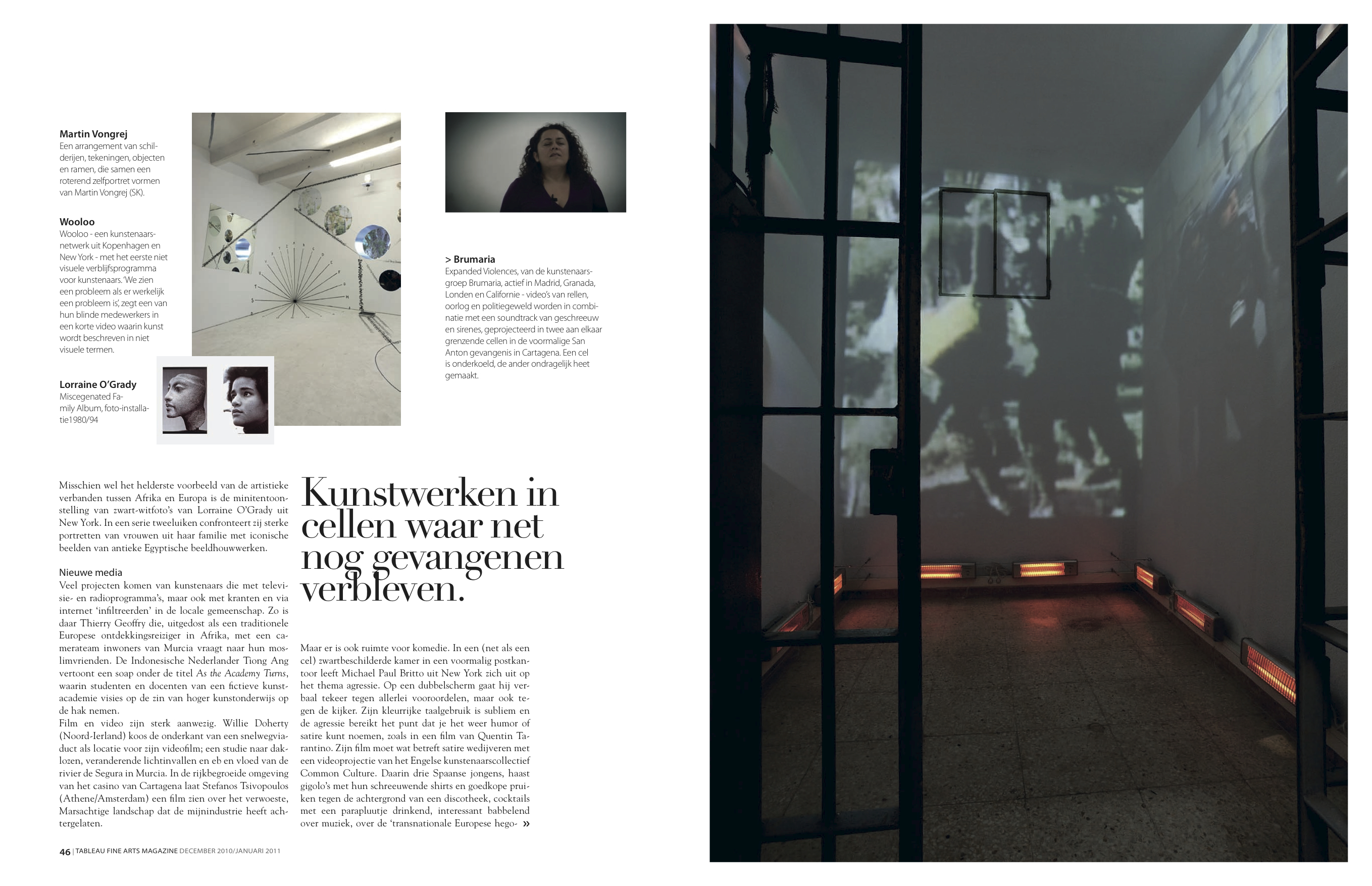
A systematic arrangement of paintings, drawings, objects and windows, which together represent a rotating, self-portrait by Slovakian artist Martin Vongrej.
As part of Manifesta 8, Wooloo (a networked artist group based in Copenhagen and New York) is running the world’s first non-visual residency program for artists. “We see a problem when there really is a problem,” says one of their blind collaborators in a short video, in which art is described in non-visual terms.
page 49
Operating in Madrid, Granada, London and California, the artist group Brumaria presents Expanded Violences. Their videos of riots, war and police brutality, accompanied by a soundtrack of shouting and sirens, are projected in two adjacent cells in the former San Anton Prison in Cartagena. One cell is chilled by air-conditioning, the other made unbearable by heaters turned up high.

AGM Conversation Series, Cairo Session: On Dialogue

AGM Culture Conversation Series, Cairo Session: On Dialogue

During the upcoming Cairo Biennale, AGM will coordinate a recorded conversation between curators, artists and cultural producers on the 16th December 2010. This one day session will focus on social and geo-political topics relevant to the Mediterranean region, opening up to some tactics for producers and audiences to employ via modes of aesthetic journalism, ficto-criticism and political fictions. Having recently interrogated the nature of collective production and collaboration as part of Chamber of Public Secrets’ contribution to Manifesta 8, AGM wishes to expand on this to address the term “dialogue”. If, as in the realm of cultural diplomacy, dialogue is to be understood as a reciprocal act and as a prelude to collaboration/cultural understanding, then the session asks: who sets the terms of dialogue, where is it enacted, how does it function and what are its inherent asymmetries? More specifically, we hope to delve into the realm of questioning the instrumentalisation of “dialogue” in contemporary art and institutional practices as well as on the geo-political scale.
This session will be disseminated through attendees networks and on agmculture.org.
Participants
Khaled Ramadan (Lebanon, Finland & Denmark) Alfredo Cramerotti (Italy & UK) Hannah Conroy (UK) Yesomi Umolu (UK), Khaled Hafez (Egypt), Aida Eltorie (Egypt & USA), (Dermis Leon (Spain), Achilleas Kentonis (Cyprus) Patrizio Travagli (Italy) Giuseppe Moscatello (UAE), Alexandre Gurita (France), Michael Thoss (Germany).
Sponsors/Supporters
Allianz Stiftung
European Union House of Delegation Cairo-Egypt
About AGM Conversation Series
The AGM Conversation Series brings together, in different configurations and venues, artists, curators, thinkers and contributors variously involved in processes of “knowledge production” via art, media, research or other forms of critical engagement. Adopting AGM’s itinerant format, these sessions seek not only to assess the “state-of-play” at various moments in the lead up to the exhibition or research process in which they are involved at that time, but to continue discussions around thematics that are central to their approach and productions.
A significant feature of the Conversation Series is that they have taken place in semi formal settings, requiring no audience but a camera and an amassed group of participants. They sit somewhere between the formal setting of the commonly used artists talk /seminar format and the informal nature of social/networked conversations between arts practitioners and producers. The sessions provide an open forum for sharing and exchange with no underlying pretext but to consider the current state of affairs.
The edited versions of the AGM Conversation series are distributed online through open networked communities such as Facebook, Vimeo, LinkedIn, Flickr, Twitter and also on agmculture.org.
About AGM
AGM Culture is a curatorial project with some of the inbuilt features of a parasite. Each time, by changing partner, location, form and content, its primary focus is to explore the peculiarity of the hosting body – be it a site, an institution or a theme. Previously, AGM has explored new modes of knowledge production within art and the media in Austria, Canada, Denmark, Italy, the Netherlands, Spain, the U.K. and in the Web space
Art Expanded. From theory to practice, and back again.
Lecture at MA in Art and Media Practice in the University of Westminster

Guest speaker: Alfredo Cramerotti, curator at QUAD, Derby, presents his art-as-research practice as curator of Manifesta 8 and author of the book Aesthetic Journalism How to Inform Without Informing (Intellect, 2009).
Session format: Visual Lecture. The author will give a lecture illustrated with images of the artworks of M8 and the book followed by Q&A
Abstract: ” My curatorial approach is not about creating new (artistic) knowledge but rather shifting existing modes of knowledge production and distribution. It implies entering a mutual relationship with other systems such as mass media, science, law, architecture or other areas, constantly shifting society’s perception of itself through non-artistic disciplines.
In my most recent curatorial project, the European biennial of contemporary art Manifesta 8, Region of Murcia, Spain, I opened up a space for artists to cross boundaries with the realm of media information and communication, a daunting terrain as opposed as the ‘safe’ environment of art. By creating new sequences of knowledge and generating what I regard as ‘aesthetic journalism’, artists and audiences alike become active participants of the curatorial concept since they become a part of the information chain, of the sequence of knowledge.
The talk will investigate this approach, from the development of the concept to its practical implementation, and will open up to the audience to discuss how hybrid practices – think about biopolitics, sustainable development, experiential reality and other processes that are the sum of different parts of ‘set’ disciplines- are re-constituting us and our world on a daily basis.”
Reading for week 05
Visit the following websites:
- Alfredo Cramerotti’s own website for text and image resources
- Manifesta 8 website
http://www.manifesta8.com/manifesta/manifesta8.home
Download the press dossier
http://www.murciaturistica.es/manifesta8/descarga_en_9.pdf
read about the projects
http://www.manifesta8.com/manifesta/manifesta8.manifesta_artists
http://www.manifesta8.com/manifesta/manifesta8.artists_commissioners
- Curatorial statement
Alcramer, 210. Curating in the context of Manifesta 8: A conversation between ACAF (Alexandria Contemporary Art Forum), CPS (Chamber
of Public Secrets – Alfredo Cramerotti & Khaled Ramadan) and tranzit.org. [online] Available at: http://www.alcramer.net/cms/publications/Curating%20in%20the%20context%20of%20M8_cut_invisible%C2%A0.pdf [Accessed 7 October 2010].
- Cramerotti, A., 2009. Aesthetic Journalism How to Inform Without Informing. London: Intellect.
Full text available as electronic resource in Westminster catalogue
- Aesthetic Journalism: wikipedia entry
http://en.wikipedia/org/wiki/Aesthetic_Journalism
Etivity for week 05
In the blog “An ABC of Aesthetic Journalism” you are invited to choose one letter from A to Z to respond to the book and Fay’s response to it.
http://fayinc.wordpress.com/category/1-about/
“We invite you to engage in the ABC blog by responding to a post/s or by creating your own. You can add to, comment on, critique, extend, oppose or digress from the current content. Responses can take the form of text, image, video, audio or web link. Directly or indirectly consider our opening bullet points in relation to this invitation. Your approach can be academic, artistic, communicative, reflexive, objective or personal. The only rules are that you cannot delete existing content and that responses are indexed in their respective alphabetical category. You will be given the username and password to the blog.” Alfredo Cramerotti / Fay Nicolson
After you post in the ABC blog, post the full text in the TP blog, with a permalink to your text in the ABC blog.
Furla Award 2011
VOGUE ITALIA
by Fabiana Gilardi
Published:
11/18/2010
The names of the five finalists and of the curators, protagonists of the eighth edition of one of the Italian excellence awards that support young contemporary artists, were announced


Padrino: Christian Boltanski. Presentata a Milano l’ottava edizione del Premio Furla
Exibart.com
Pubblicato mercoledì 17 novembre 2010
L’attesa era forte, ed in effetti decisamente motivata, con l’evento che non ha tradito le aspettative. A Milano si presentava l’ottava edizione del Premio Furla, che ha calato subito un asso in grado di sbaragliare la partita: Christian Boltanski, che sarà l’artista – padrino e l’ideatore dell’immagine grafica e del titolo, Pleur qui peut, rit qui veut. “Una sorta di ossimoro – spiega Chiara Bertola, curatrice del premio – che apre la strada ai finalisti per l’ideazione dei loro progetti”.
E chi sono i cinque artisti finalisti? Alis/Filliol – Andrea Respino e Davide Gennarino, nominati da Simone Menegoi e Marianne Lanavère; Francesco Arena, nominato da Vincenzo De Bellis e Philippe Pirotte; Rossella Biscotti, nominata da Cecilia Canziani e Vincent Honoré; Matteo Rubbi, nominato da Lorenzo Bruni e Carson Chan; Marinella Senatore, nominata da Alfredo Cramerotti ed Emily Pethick.
Una giuria internazionale composta dallo stesso Christian Boltanski, da Stefano Chiodi (storico e critico d’arte), Vit Havranek (curatore e project leader del team curatoriale tranzit.org), Jörg Heiser (co-editor di Frieze Magazine e guest professor all’Art University di Linz, Austria), Miguel Von Hafe Pérez (direttore del Centro Galego de Arte Contemporáneo di Santiago de Compostela, Spagna) sceglierà il vincitore, che sarà annunciato il 28 gennaio 2011 a Bologna.
Il vincitore sarà invitato a realizzare un’opera finanziata dalla Fondazione Furla e destinata alla fruizione pubblica attraverso la concessione in comodato al MAMbo – Museo d’Arte Moderna di Bologna. L’opera del progetto vincitore sarà presentata in anteprima presso la Fondazione Querini Stampalia a Venezia nel giugno 2011, in concomitanza con la 54. Biennale di Arti Visive.
“Con questa ottava edizione che segna la chiusura del primo decennio del Premio Furla – ha detto Giovanna Furlanetto, Presidente della Fondazione Furla -, alla Fondazione Furla si affianca per il futuro la Fondazione Carisbo come partner istituzionale, che ha messo a disposizione per la mostra dei cinque artisti finalisti uno dei suoi spazi più prestigiosi, Palazzo Pepoli a Bologna, recentemente restaurato”.
Radio Papesse Interview: Alfredo Cramerotti – Chamber of Public Secrets @ Manifesta8
RADIO Papesse INTERVISTA/INTERVIEW
Alfredo Cramerotti – CPS
15 NOVEMBRE 2010
>>the interview is in English<<
>>English text below<<
Il discorso sulla contaminazione e il dialogo fra mondo mediatico e mondo artistico non è nuovo. In fondo si può sostenere che l’arte, in ogni sua espressione ‘deve utilizzare dei media’ e che questi attingono a piene mani dall’immaginario artistico; è un dibattito che probabilmente non avrà mai fine e che è nato e sviluppato a pari passo con i media elettronici, dalla nascita della radio e del cinema ad oggi.
Ma cosa succede se si parla di ‘industria dei media’? se un insieme di artisti, scrittori, intellettuali viene invitato a confrontarsi con i sistemi della produzione medicata contemporanea?
È quanto hanno fatto Alfredo Cramerotti e Khaled Ramadan insieme al collettivo Chamber of Public Secrets – cps con il loro progetto per Manifesta8.
CPS non è una struttura formale, non ha una data di fondazione o un’agenda prestabilita, è un gruppo trasversale, un ‘meta-luogo’ di discussione e analisi critica ed è uno dei gruppi curatoriali di Manifesta8.
Abbiamo parlato insieme a Cramerotti di CPS, del metodo utilizzato nel lavoro curatoriale, del loro invito a confrontarsi con le strutture produttive dei media per la creazione di progetti artistici.
la musica che accompagna l’intervista è tratta dall’album a bell and a mirror di Let’s drive to Alaska pubblicato dalla netlabel muertepop
–
The contamination and encounter dicourse about the artworld and the mediatic world isn’t new.
It is a never-ending debate born and developed together with the electronic media: form the early days of radio and cinema until nowadays.
But what happen when we talk about the media industry? what happen when a group of artists, writers, intellectuals is invited to deal with the contemporary media industry production system?
It is what Alfredo Cramerotti and Khaled Ramadan did together with the Chamber of Public Secrets – cps collective curating their project for Manifesta8.
CPS isn’t a formal structure, do not have an official founding date or a fixed agenda, is an horizontal group, an ensemble of dicussion and critical thinking and is one of the curatorial teams of Manifesta8.
We talked with Cramerotti about CPS, about their curatorial method, their invitation to deal with the production structures of the media industry for the creation artistic projects.
The music used in this interview is A bell and a mirror by Let’s drive to Alaska published by the netlabel muertepop
Questa opera è prodotta da Radio Papesse, un progetto di Ilaria Gadenz e Carola Haupt


 Curatorview [Alfredo Cramerotti]
leave a comment