Aesthetic Journalism: How to Inform Without Informing @ Corner College, Zurich, Switzerland

Lecture
Aesthetic Journalism
How to Inform Without Informing
Alfredo Cramerotti
04.05.2012
20,00 Uhr
Italian writer, curator and artist Alfredo Cramerotti will give an introduction in his book “Aesthetic Journalism: How to Inform Without Informing”. Recognising the “blurring of margins between artistic and information practices” as a main feature in contemporary culture, Cramerotti sets out the Who, What, Where, When and How, and Why of Aesthetic Journalism.

Cramerotti identifies this “’investigative approach” in contemporary art and photography as the use of fieldwork, reportage, interviews, document analysis, graphic mapping and information distribution. He cites a number of artists who employ these strategies: Hans Haacke, Martha Rosler, Lukas Einsele, Laura Horelli, Renzo Martens, Alfredo Jaar, Renée Green, The Atlas Group/Walid Raad and Bruno Serralongue. For Cramerotti, Aesthetic Journalism implies the critical use of documentary techniques and journalistic methods where the medium itself undergoes questioning. He posits that aesthetics, understood as a “process in which we open up our sensibility to the diversity of the forms of nature (and manmade environment)” can open up the mechanisms of art and media to expose the limitations of photojournalism, documentation and the ethics of representation. In doing so, Aesthetic Journalism renders productive readings of reality, information, fact, fiction and objectivity.
The concepts outlined in the book have been a key tool in the development of the Chamber of Public Secrets’ curatorial approach for the 8th edition of Manifesta, the European Biennial of Contemporary Art: Manifesta 8 taking place in the region of Murcia, Spain.
Alfredo Cramerotti: The Future of MOSTYN
Alfredo Cramerotti, Director of Mostyn, Wales, will give a talk about his future vision for the gallery.
5pm, 14 March 2012

H6, Rathmell Building,
Caerleon Campus
Newport
NP18 3QT
Alfredo Cramerotti is a writer, curator and artist based in the UK. His cultural practice explores the relationship between reality and representation across a variety of media and collaborations such as TV, radio, publishing, internet, media festivals, photography, writing and exhibition curating. Cramerotti is Director of Mostyn, the largest publicly funded contemporary art gallery in Wales, and was co-curator of Manifesta 8, the European Biennial of Contemporary Art (2009-2010) and Senior Curator, QUAD Derby (2008-2011). He co-directs AGM Culture, roaming curatorial agency; CPS Chamber of Public Secrets, media and art production unit and is Visiting Lecturer in various European universities among others NTU Nottingham Trent University, University of Westminster and DAI Dutch Arts Institute. Cramerotti is also Editor of the Critical Photography book series by Intellect Books, and his own recent publications include Aesthetic Journalism: How to inform without informing (2009) and Unmapping the City: Perspectives of Flatness (2010).
Links
http://www.alcramer.net
http://www.intellectbooks.co.uk/books/view-Series,id=19/
http://www.mostyn.org
Six Memos presents “Species of Space 2” Curatorial Seminar at Limerick City Gallery of Art, Ireland
Six Memos presents Species of Space 2
Friday 25 November 2011, 10.30am – 5.30pm
Limerick City Gallery of Art, The Carnegie Building, Pery Square, Limerick
Saturday 26 November 2011, 12-3pm
Ormston House, 9-10 Patrick Street, Limerick
In partnership with LCGA and eva International, Six Memos is pleased to announce the curatorial seminar, Species of Space 2 on Friday 25 November, 10.30am-5.30pm and Fugitive Dialogues on Saturday 26 November, 12-3pm. This two-day event marks the return of LCGA and eva International to the newly redeveloped Carnegie Building and the launch of Ormston House on Patrick Street under the Creative Limerick initiative.
Species of Space 2 will take place at the Carnegie Building with a panel of distinguished curators presenting case studies on their experiences of negotiating space: Katerina Gregos on The Danish Pavilion at the 54th Venice Biennale – Challenging curatorial orthodoxy in the Biennial Context; Alfredo Cramerotti On Translating, Expanding, Compressing and Misusing Space; Vaari Claffey on Gracelands – Substance Abuse; Simon Rees on EAST by SOUTHWEST; And Annie Fletcher on Be(com)ing Dutch.
The following day, Fugitive Dialogues will take place at Ormston House with James Merrigan and Michaële Cutaya from 12-2pm. Fugitive Papers/Dialogues is an artistic research project to explore ideas about art, writing, criticality and public(s) in Ireland at this time. The project is determinedly experimental and involves opening a temporary critical space within which to organise opinion and reflection on art and art-writing, as a public activity. Discussion is followed by afternoon tea with the artists of the current exhibition, Monkey Wrench, at Ormston House: Sonia Shiel, Kevin Cosgrove and Keef Winter.
The seminar is organised and facilitated by Mary Conlon (Shinnors Scholar, LCGA, 2009-2011; Curator of the Six Memos project; Director of Ormston House; Member of the Board of Directors of eva International; PhD candidate at Limerick School of Art and Design).
Admission is free. Booking is recommended mary@ormstonhouse.com or artgalleryeducation@limerickcity.ie.
Kindly supported by Culture Ireland.
About the speakers:
Vaari Claffey is an Independent curator based in Dublin. She is the founding Director and Curator of Gracelands. This project is a series of live outdoor visual arts events, which take place over the course of one day and night and encompasses commissioned sculpture, performance and film. Gracelands has run annually in Dromahair, Leitrim since 2008 and a Dublin iteration is planned for 2012.
In 2010, Claffey curated Temporarily Shelved with Rana Ozturk under the aegis of Sinopale, the International Sinop Beinnale. Future curatorial projects include an exhibition at Project Arts Centre Gallery, Dublin in April 2012. Vaari Claffey is also curator/producer of the exhibition/filmwork: This is going to take more than one night, for which she invited four artists: Isabel Nolan, Bea McMahon, Alice Rekab and Sarah Pierce to produce new work for an innovative context. Funded by the Arts Council’s New Work Award, the film was directed by Neasa Hardiman. She is now developing another film project, Some Structures, with architects Dominic Stevens and Tom de Paor, and artist Ronan McCrea. This latest work, funded by an Arts Council Touring Award, Some Structures will tour throughout Ireland and internationally in 2011-2012. Vaari Claffey teaches at NCAD and IADT, Dublin and is an associate researcher at GradCAM. She is currently organising a seminar on alternative exhibition practices and venues within Ireland with Francis Halsall (NCAD). This emerges from a recent seminar titled What Do You Stand For? held in March 2011. The next presentation will take place in early 2012.
Title of case study: Gracelands – Substance Abuse
Gracelands is a visual arts exhibition/event that has taken place on a single day every year since 2008. Situated outdoors, it incorporates film/video, performance and sculpture. Mimicking a music or literary Festival, it presents a sequence of works which unfold both over time, and across the site. The event has had four iterations, The Mimetic (2008), Folly (2009), I’m Spartacus (2010) and Substance Abuse (2011).
Artists are invited and supported to realise new sculptural works for the specific conditions of Gracelands. The works, occasionally very large, are often very temporary and many of them operate quite differently as day turns into night. Some of these have had ‘functional’ relationships to the event and have included the construction of lighting for the pathway leading to the main site as well as ‘hospitable’ elements involving food and drink. A number of artists have had long-term and repeated engagements, in various forms, with the Gracelands project.
Gracelands is produced in association with The Model, Sligo. It is supported by The Arts Council/An Comhairle Ealionn, Leitrim County Council and The Goethe Institut. Gracelands is located at the Mimetic House, Dromahair Co. Leitrim and takes place with the support of Grace Weir and Joe Walker, who live and work there.
http://www.gracelands.eu
Alfredo Cramerotti is a writer, curator and artist based in the UK. His cultural practice explores the relationship between reality and representation across a variety of media and collaborations such as TV, radio, publishing, internet, media festivals, writing and exhibition curating. Cramerotti has recently taken up the post of Director at Mostyn, the largest publicly funded contemporary art gallery in Wales. Prior to this he was co-curator of Manifesta 8, European Biennial of Contemporary Art (2009-2011) and Senior Curator, QUAD Derby (2008-2011). Cramerotti is Editor of the Critical Photography book series by Intellect Books, and his own recent publications include the book Aesthetic Journalism: How to inform without informing (2009) and Unmapping the City: Perspectives of Flatness (2010).
Title of case study: On Translating, Expanding, Compressing and Misusing Space
Species of Space 2 reminds me of the work I have done to integrate media space as venues for Manifesta 8, the European Biennial of Contemporary Art in the Region of Murcia, in 2010. And it reminds me that this sort of discussion is part of the integral, expanded idea about Aesthetic Journalism, a body of research I’m developing since 2003, and that recently has expanded to include Critical Photography, Hyperimage, Fictocriticism, Expanded Symposia etc.; all approaches (whatever you want to call them) that are manifesting themselves in the cultural field.
I will present a couple of cases in relation to these approaches, and then open up for discussion about risks and benefits involved in opening up such spaces as agents of translation rather than representation.
Annie Fletcher is Curator of Exhibitions at the Van Abbemuseum, Eindhoven. Recent exhibitions include solo presentations and projects with Jo Baer, Jutta Koether, Cerith Wynn Evans, Deimantas Narkevicius, Minerva Cuevas and the long term project, ‘Be(com)ing Dutch’ with Charles Esche during 2006 – 2009. She is a tutor at De Appel in Amsterdam. From 2005 – 2010 she was the co-founder and a Director with Frederique Bergholtz of the rolling platform ‘If I Can’t Dance, I Don’t Want To Be Part Of Your Revolution’ (www.ificantdance.org) which initiated investigative programmes of performances, art projects and an extensive discursive programme realized in collaboration with various partner institutions in the Netherlands and internationally. As a writer she has most recently contributed to various magazines including ‘Afterall’ and ‘Metropolis M’’. She is on the editorial board of ‘A Prior’ magazine.
Title of case study: Be(com)ing Dutch
Be(com)ing Dutch was a large scale project that was developed by Charles Esche (Director of the Van Abbemuseum) and Annie Fletcher (Curator of the Van Abbemuseum) and took place over a period of a couple of years. Be(com)ing Dutch has attempted to look at the meaning of and context for a global visual culture in Eindhoven in the twenty-first century. It did this through the eyes of artists and production of artwork, but also through an extended preparation of potential viewers through discussions, workshops and a large-scale meeting called ‘Eindhoven Caucus’. The main goal of Be(com)ing Dutch was to put the question of national identity up for question, since the twenty first century appears to have been and still is a battle between globalism and localism. Questions like ‘Can we become a nationality or is it imposed by birth?’, ‘How do visual signifiers acknowledge our belonging’ and ‘As a global medium, what picture do artists offer of the nation states and what critiques or alternatives do they suggest?’ were discussed by artists, experts and museum visitors during debates, symposiums and art projects. The overall concept behind Be(com)ing Dutch was to move the agenda of multiculturalism on from notions of toleration and difference towards building a shared but agonistic democracy on the cultural level through the use of one of the few remaining public sphere institutions left to us: the museum.
Katerina Gregos (born in Athens, Greece, living and working in Brussels, Belgium) is an art historian, curator and writer. She is currently curator of the Danish Pavilion for the 54th Venice Biennial (2011) and on the curatorial team of Manifesta 9 (2012). This year she also curated the 4. Fotofestival Mannheim Ludwigshafen (Germany) together with Solvej Ovesen. She has also curated several international large-scale biennials and exhibitions including Contour 2009 – The 4th Biennial for Moving Image, Mechelen, Belgium (2009) and E V+A, Limerick (2006). From 1997 to 2002 she was director and curator of the Deste Foundation, Athens, and during 2006 and 2007 she was the artistic director of Argos – Centre for Art & Media in Brussels. In 2012 she will be curating “Newtopia: The State of Human Rights”, timed to coincide with the opening of the Kazerne Dossin Museum and Documentation Centre of the Holocaust and of Human Rights, Mechelen, Belgium
Title of case study: The Danish Pavilion at the 54th Venice Biennale: Challenging curatorial orthodoxy in the Biennial Context
Freedom of speech is one of the key issues in the current public debate and one that is becoming increasingly contested, given the steady erosion of civil liberties in many countries today. Denmark has always been at the forefront of the public debate on issues in relation to freedom of speech, but it has also suffered the so-called “trauma of free speech”. This makes the Danish Pavilion an appropriate vehicle from which to visualise and discuss these issues. Freedom of speech is highly relevant in relation to much of what is happening in the world politically today; from press intimidation and censorship, to restrictions on the internet, as well as debates on the limits of freedom of speech, increased surveillance and forms of control. The issue of freedom of speech is highly complex, often subjective – even relative – and invariably debatable. The boundaries surrounding it cannot easily be delineated. The exhibition Speech Matters aims to provoke a considered debate and to complicate the issue of freedom of speech, highlighting the intricacies, ambiguities and grey areas inherent to the subject, and emphasizing the fact that freedom of speech cannot be exercised or applied in any programmatic or strictly proscribed manner. Finally, the exhibition also touches on the essence of visual artistic practice, which fundamentally entails conditions of freedom of expression. Eighteen artists from ten countries were been invited to participate. The majority produced new work for the exhibition.
Simon Rees is currently preparing ENVISIONING BUILDINGS: reflecting architecture in contemporary art photography for the Museum Angewandte Kunst (MAK), Vienna, which opens on December 6. In spring-2011 he lead the third instalment of the project “curatedby_” deployed at 21 galleries throughout Vienna. Titled EAST by SOUTHWEST and that explored new notions of what constitutes ‘Eastern European’ cultural space. And at the start of the year he was the lead curator of the 15th Tallinn Triennial: FOR LOVE NOT MONEY that opened the visual arts programme of “Tallinn – Culture Capital of Europe 2011”.
From 2005–2010 Rees was chief curator and editor at the Contemporary Art Centre (CAC), Vilnius in Lithuania. In his role he was convener of the CAC CAFE TALKS the celebrated monthly international lecture series, which brought major figures from culture to Vilnius and the co-editor of the quarterly bi-lingual (Lithuanian/English) magazine CAC INTERVIU. In that period he curated the opening exhibition of the national programme of “Vilnius – Culture Capital of Europe 2009” titled CODE SHARE: 5 continents, 10 biennales, 20 artists; produced the seven city touring exhibition of French and Lithuanian art You are my mirror (2008); and commissioned the jury-prize winning Lithuanian Pavilion with artists Nomeda & Gediminas Urbonas at the Venice Biennale (2007).
Rees lives and works in Vienna, Austria.
Title of case study: EAST by SOUTHWEST
The title of curated by_vienna 2011 describes a geographical conundrum — to be solved using the compass of contemporary art. This geographical aspect reflects Vienna’s status, at different moments in European history, as an advocate for culture and contemporary art from an expanded Eastern European space. The project hones on regional geography at a time, and in a world, largely governed by global mechanisms and ways of thinking.
The project’s intention was to investigate a wider understanding of Europe and its transformations since the countries formerly behind the Iron Curtain have returned to the heart of continental cultural and political life and since Turkey has been engaged in multilateral discourse.
—
Limerick City Gallery of Art is part of Limerick City Council, funded by the Arts Council and supported by Fás, Fáilte Ireland, Shannon Development and the Heritage Council.
T +353 (0)61-310633 / E artgallery@limerickcity.ie / W http://www.gallery.limerick.ie / Twitter @limerickgallery
For The Record: Fictional images on the frontline between photojournalism and contemporary art
by Ossian Ward
THE ART NEWSPAPER for FRIEZE ART FAIR
Thursday 13 October 2011

Private Investigations: talks and book presentations 8th & 9th November, 2011
Private Investigations is a compilation of texts and image-based contributions by former Büchsenhausen Fellows, addressing their own research-based art practice and discussing the same in contributions specifically created for this publication. The focus of the book is on artistic strategies which attempt to infiltrate the hegemonic discourses of knowledge, which are currently emerging also in the art context, while at the same time proposing own ways of appropriating and processing knowledge. Private Investigations includes contributions by Alfredo CRAMEROTTI, Judith FISCHER, Geoffrey GARRISON, Alison GERBER, Ana HOFFNER, Brigitta KUSTER, Ralo MAYER, Andrei SICLODI and Alexander VAINDORF.
Venues and dates:
Private Investigations
Alfredo CRAMEROTTI, Andrei SICLODI, and others: Book launch and discussion
Tue 08.11.2011, 19.00, Künstlerhaus Büchsenhausen Innsbruck
Private Investigations
Alfredo CRAMEROTTI, Ana HOFFNER, Andrei SICLODI, and others: Book launch and discussion
Wed 09.11.2011, 19.00, SECESSION VIENNA
About the book:
Private Investigations
with contributions by Andrei Siclodi (Ed.), Alfredo Cramerotti, Judith Fischer, Geoffrey Garrison, Alison Gerber, Ana Hoffner, Brigitta Kuster, Ralo Mayer, and Alexander Vaindorf.
Published by Künstlerhaus Büchsenhausen
English language / 144 pages / 2011 / EUR 15,00
Büchs’n’Books, Volume 3
ISBN 978-3-9502583-1-8
V2_ presents BlowUp Reader #2: Every Artist, a Journalist (free download)
This short e-Book, the second in the series of Blowup Readers released by V2_, explores the phenomenon of artists working in documentary and journalistic forms, and what this crossover between art and journalism creates.
Blowup is a series of events and exhibitions that explore contemporary questions from multiple viewpoints. Blowup zooms in on ideas, bringing into focus clear pictures of how art, design, philosophy, and technology are transforming our lives — or reinforcing the status quo.
CONTENTS
1. Introduction, by Michelle Kasprzak
2. Excerpt from Aesthetic Journalism, by Alfredo Cramerotti
3. Temporary Storage, by Ken Hollings
4. The Making of P.A.P.A., by Michelle Kasprzak
5. Reality in the Age of Aesthetics, by Mark Nash
6. From the V2_ Archives: Art, Power, and Communication, by Alexei Shulgin
Free download here:
All That Fits: The Aesthetic of Journalism – General Feeback
 “The show is really impressive”
(Keith Jeffrey, CEO of QUAD)
“There’s some good thinking behind the show”.
(Alex Farquharson, Director of Nottingham Contemporary)
“The show is really impressive”
(Keith Jeffrey, CEO of QUAD)
“There’s some good thinking behind the show”.
(Alex Farquharson, Director of Nottingham Contemporary)
“I enjoyed the exhibition very much and found it chimed at lot with a show we are currently developing for next summer which looks at direct change actions by artists in the public realm.” (Clive Gillman, Director of Dundee Contemporary Arts) “This is an ambitious show for Derby and it is certainly to the curator’s credit that such a highly original exhibition tackling pertinent and current themes has been programmed outside the context of London or a university gallery (I am not aware of any other institutions programming exhibitions on similar themes). Despite Derby not being a well-provided art destination (Quad only opened in 2008) it appears that Quad’s programme over the last three years has not pandered to populism but has presented an interesting and challenging range of work including solo shows from artists such as Ian Breakwell, Dinu Li and Jane & Louise Wilson as well as group shows such as the Format International Photography Festival. This exhibition, All That Fits, continues the trend for original exhibitions and is a good example of Quad’s uncompromising attitude. I don’t know if the exhibition will be touring but it strikes me that it would easily translate to other venues.” (David Gritt, art critic for Art Review and Artistic Assessor for Arts Council England) “Thought the show was very daring – a restrained curation, the space was really serene and quite beautiful and the (video) boxes worked very well. It was also interesting to see how much was semi hidden. I felt you managed to combine approachable / accessible with what is actually a very challenging show and conceptually intricate. Well done to all. I particularly enjoyed Katya Sander’s work – both the showing and the content and Graziela Kunsch’s library of open process and the aesthetic punch of Walid Raad and Eric Baudelaire.” (James Corazzo, Designer) “As a journalist I guess you would expect me to take a keen interest in the current Quad exhibition but I don’t think you need 25 years as a reporter to appreciate what’s on offer at the Derby arts centre. With all that’s going on in the phone hacking scandal at the moment and the changing face of the way information is disseminated thanks to the rise of the internet, an exhibition looking at current trends in journalism and art (and the blurring of those distinctions) seems acutely relevant to us all. All That Fits is currently in its third and last phase, The Militant, looking at counter images and information. I’d urge you to at least drop into the Quad Gallery and check out French photographer Eric Baudelaire’s war diptych The Dreadful Details. This striking image is no less powerful for being posed, encapsulating the nature of modern conflict with an almost biblical composition. Foreign troops prowl dusty, debris-strewn streets where a woman cradles a slaughtered child in her arms. Most tellingly, from the safety of an upstairs balcony a man captures the scene on his mobile, ready presumably to upload the horrors on YouTube. “ (Friday, July 22, 2011: Nigel Powlson in ‘This is Derbyshire’) “Firstly, compliments on the current exhibition at the QUAD, I found it very thought provoking and at times powerfully emotive, Eric Baudelaire’s piece in particular had an intense impact. *…+ regards the All That Fits exhibition catalogue. I found its format and layout quite exquisite and was very impressed with the print quality. “ (Michael Sargeant, Photographer and Curator)
Blowup: Every Artist, A Journalist
Blowup, 25 August 2011
Institute for the Unstable MediaV2_
Rotterdam, NL
This edition of Blowup will examine the tension between documentary methods and artistic expression, and address where notions of truth and beauty fit in this mix.

Lino Hellings (NL), Alfredo Cramerotti (UK), Gair Dunlop (UK)
Documentary images are a common method to measure and reflect on the monumental scale of change occurring in contemporary society. These images are also highly aestheticised, making beauty even of images of the most desolate slum or industrialised landscape. As a crossover point between art and journalism, the documentary image also allows us to question the veracity of world events from multiple viewpoints, often offering multiple uncomfortable realities instead of a single, easily-digestible worldview. In an era of a massive data onslaught that individuals struggle to cope with, the documentary image continues to offer us a human face on information, sometimes elegantly summarising a complex situation. But what balance needs to be struck between honest portrayals of reality and artistic license?
http://entropicmodern.blogspot.com/
—
Institute for the Unstable Media V2_ is an interdisciplinary center for art and media technology in Rotterdam (the Netherlands). V2_’s activities include organizing presentations, exhibitions and workshops, research and development of artworks in its own media lab, distributing artworks through its Agency, publishing in the field of art and media technology, and developing an online archive.
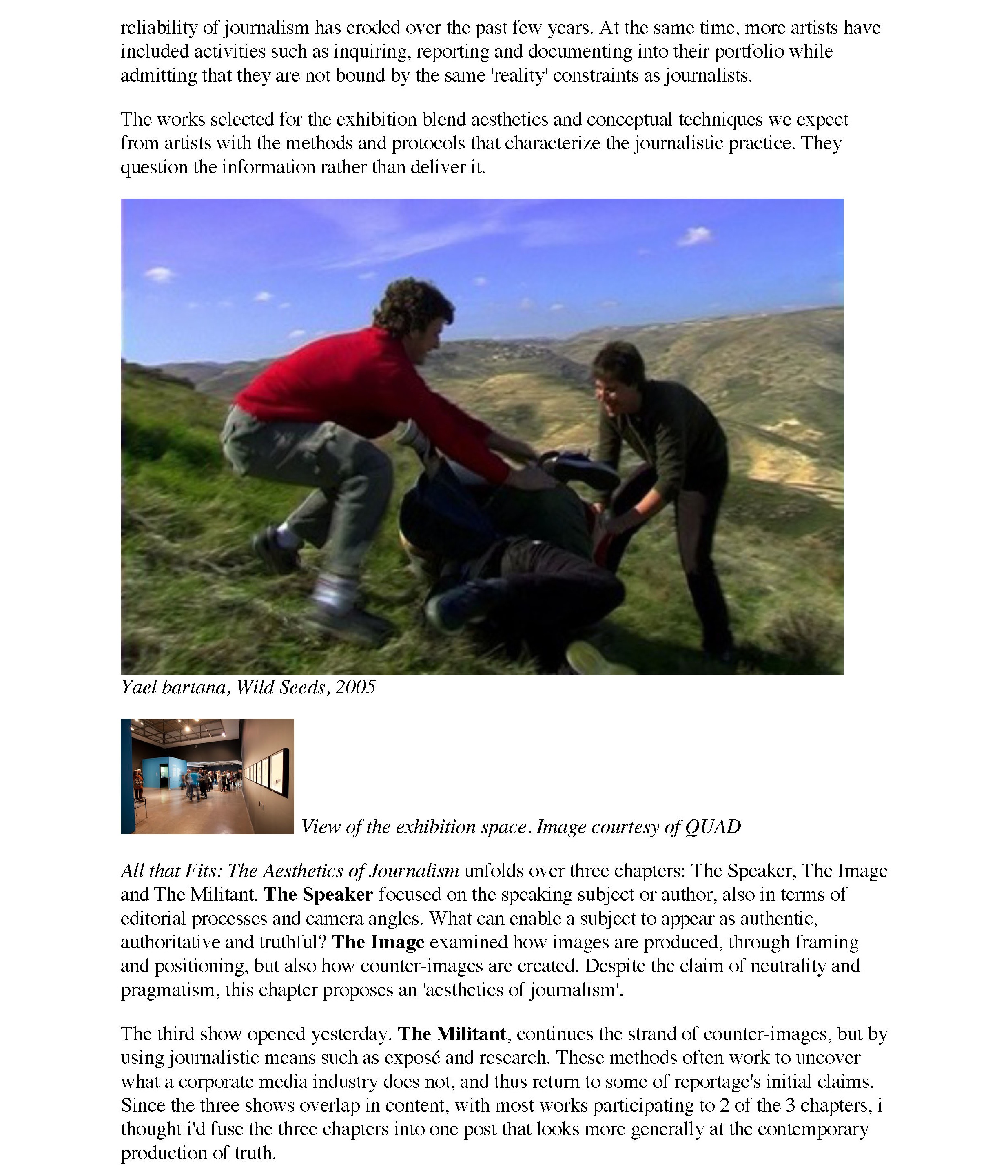
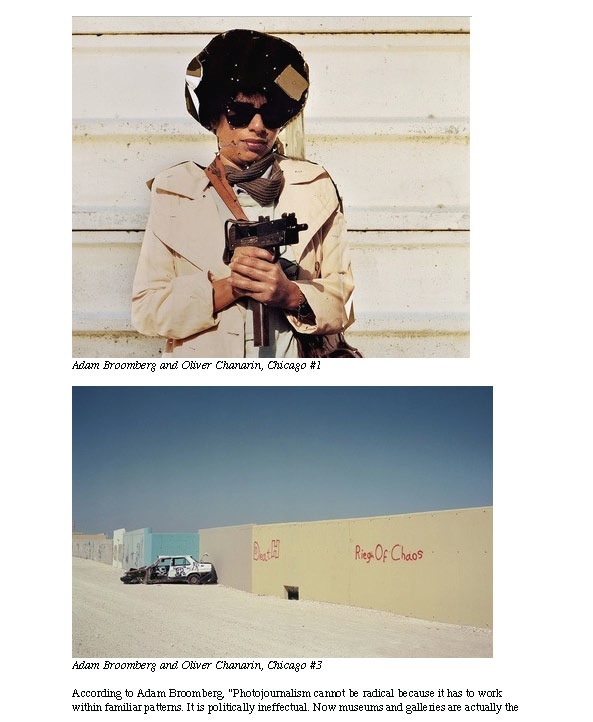
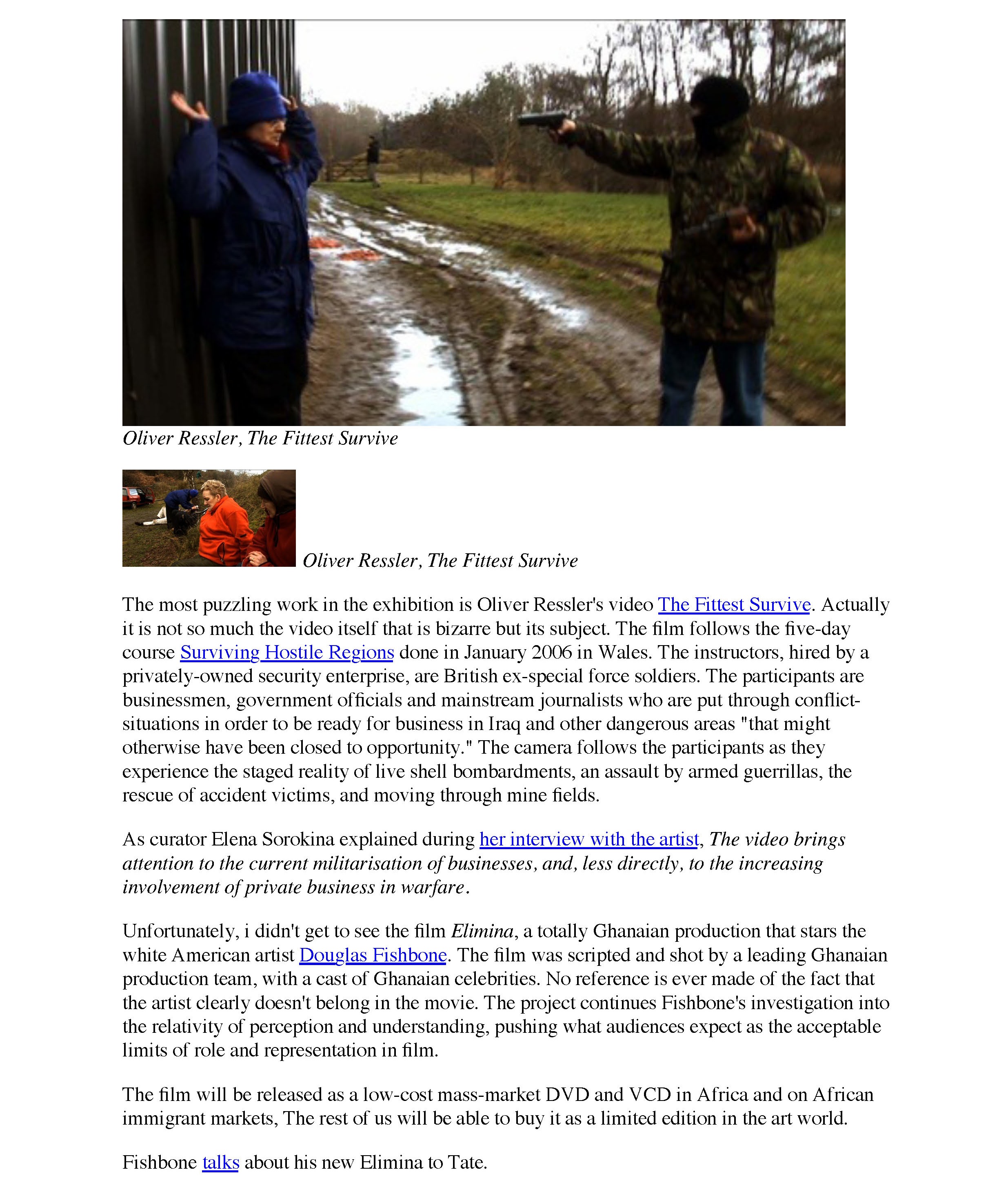
All That Fits: review by Regine Debatty of we-make-money-not-art blog



You can find the original review here


 Curatorview [Alfredo Cramerotti]
leave a comment