Inside-Out: David Rych at Manifesta 8
Art In America – International Review
by Ana Vukadin 10/27/10


Region of Murcia embraces Manifesta 8

The Region of Murcia embraces Manifesta 8 – more than 30.000 visits in the first week
Manifesta8, the European Biennial of Contemporary Art, takes place in the Region of Murcia (Spain) in dialogue with northern Africa, from October 9, 2010 until January 9, 2011

Image: Opening of Manifesta 8 at the former post office in Murcia, venue of Manifesta 8.
© Ilya Rabinovich
http://www.manifesta8.es/ http://www.manifesta.org
+34 868 950 750
contact@manifesta8.es
On October 9, 2010, Manifesta8, the European Biennial of Contemporary Art with its special focus on stimulating the dialogue with northern Africa, opened in the Region of Murcia in south-eastern Spain. Manifesta 8 showcases art from all disciplines featuring multi-media installation, film, performance, dance and music, and makes use of both traditional and unconventional art channels in co-operation with such media outlets as newspapers, radio, television and the Internet.
The event was officially opened by Ramón Luis Valcárcel Siso (President of the Region of Murcia), Pedro Alberto Cruz Sánchez (Minister of Culture and Tourism for the Region of Murcia), Miguel Ángel Cámara (Mayor of Murcia), Pilar Barreiro (Mayor of Cartagena) and Hedwig Fijen (President Manifesta 8/Director Manifesta Foundation).
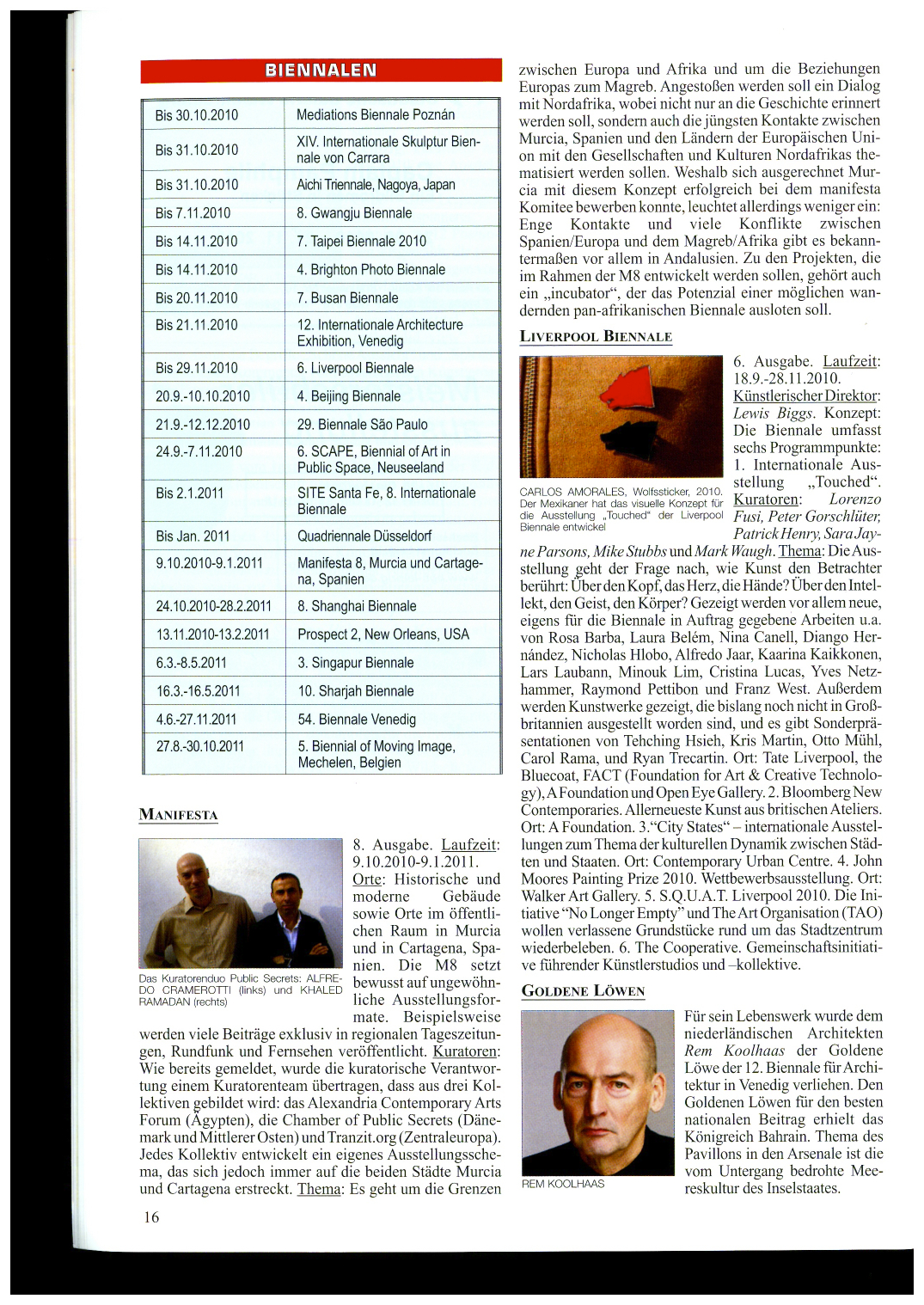
In the first week Manifesta 8 has counted the record number of more than 30.000 visits by local audience, artists, curators, art professionals from around the globe and over 500 international journalists (source: Regional Ministry of Culture and Tourism of the Region of Murcia). Emerging from the experiences gained through former Manifesta Biennials, Manifesta 8 focuses on the concept of collective curating and has been developed by three curatorial teams coming from the most diverse areas of Europe including Scandinavia, the U.K., Central Europe and the Mediterranean as well as the Middle East and the U.S. The curatorial team of Manifesta 8 is composed of ACAF – Alexandria Contemporary Arts Forum (Bassam El Baroni, Jeremy Beaudry), CPS – Chamber of Public Secrets (Khaled Ramadan, Alfredo Cramerotti) and tranzit.org (Vít Havránek, Zbyněk Baladrán, Dóra Hegyi, Boris Ondreička, Georg Schöllhammer).
More than 85% of the exhibited works have been newly commissioned and produced by Manifesta 8, often supported by the most important international cultural bodies, art institutions, museums, art galleries and ministries of culture.
Manifesta Foundation places special focus on sustainability by building networks and creating goodwill in its host regions. “Manifesta 8 is not a social activists group, but many works in the biennial have been conceived in collaboration with unions, political parties, special interest groups, blind associations, the lottery, schools, and other educational services,” says Manifesta Director Hedwig Fijen. “By working with craftsmen, technicians and local professionals, Manifesta creates a greater know-how in the entire region, which remains longer after Manifesta has moved on.”
This is part of Manifesta’s spirit of collaboration, incorporating the use of otherwise discarded examples of local history, namely five previously abandoned buildings – Pavilions 1 and 2 at the former Artillery Barracks and the former Central Post Office in Murcia, the declassified San Anton Prison and the once popular El Parque Restaurant on the highest hill overlooking Cartagena. This is one of the sustainable effects of Manifesta in each of its successive editions. Manifesta leaves behind buildings which were under-utilized in the past, for future use for cultural and social events.
On Sunday, October 10, 2010 the Symposium “Bringing you the answers before you know the question: four positions regarding the idea of a pan-African roaming biennial” took place in Murcia as part of the “Incubator for a pan-African roaming Biennial” initiated in the framework of Manifesta 8. The Incubator is a one-year-long project formed in response to a proposal by two of Manifesta’s curators, Bassam El Baroni and Jeremy Beaudry of Alexandria Contemporary Arts Forum (ACAF), and relates to the motto “in dialogue with northern Africa”. It consists of the symposium during the opening weekend of Manifesta 8, the development of a website, a workshop in April 2011, and the production of a publication in September 2011.
On the same Sunday, October 10, 2010, Toronto-based professor of psychology, John M. Kennedy lectured at MUBAM, Museo de Bellas Artes de Murcia, one of the venues of Manifesta 8, to a large audience on the phenomenon of the blind painter Eşref Armağan whose contribution to the exhibition was curated by Chamber of Public Secrets.
Manifesta 8 – the roaming European Biennial of Contemporary Art is organized by the Manifesta Foundation (Amsterdam) together with the Region of Murcia. Access to all venues and education activities is free. More information on the ongoing education program can be found at: http://www.manifesta8.es/medular and booking via mediacion@manifesta8.es. The Manifesta 8 catalogue in English is available for purchase at http://www.silvanaeditoriale.it.
On the occasion of the opening of Manifesta 8, the next destination of the roaming Manifesta biennial was announced. In 2012 Manifesta 9 will be hosted by the region of Limburg, Belgium.
Manifesta 8: Im Dialog mit Nordafrika
(German)
Radio WDR 3 Resonanzen
Die Welt aus dem Blickwinkel der Kultur
Donnerstag, 14.10.10
Ein Beitrag von Dorothea Breit
Manifesta 8, Europäische Biennale für Zeitgenössische Kunst
Die Manifesta wurde als Europäische Biennale für Zeitgenössische Kunst 1993 in Amsterdam gegründet. Sie wandert durch Europa mit dem Ziel, die geografischen und gesellschaftlichen Territorien Europas mit künstlerischen Mitteln zu erforschen. Nach Stationen in Luxemburg, Lublijana, Frankfurt und Südtirol findet die Manifesta 8 in der Universitätsstadt Murcia und in dem 50 Kilometer entfernten Hafenstädtchen Cartagena in Spanien statt. Die Geschichte beider Städte wurde Jahrhunderte lang durch die maurische Welt geprägt.
Diese historisch begründete Präsenz der arabischen Kultur in Europa will die Manifesta 8 unter der Überschrift „Im Dialog mit Nordafrika“ ins Bewusstsein rufen. Drei Kuratoren-Kollektive luden über 100 internationale KünstlerInnen dazu ein. Deren Werke, fast alle neu zur Manifesta 8 entstanden – Videos, Filme, Fotografien, Zeichnungen, Texte, Skulpturen, Tanz- und Musikperformances – sind an 19 Ausstellungsorten zu sehen.
http://www.wdr3.de/resonanzen/details/artikel/wdr-3-resonanzen-cde52ba77b.html
Appendix Manifesta: shifting centres
KunstBeeld NL
Dienstag 19 Oktob
by Daphne Peppers

Bericht uit Murcia en Cartagena: Manifesta 8
 Nieuws
zondag 17 oktober 2010
Beeldverslag
Sam Steverlynck | Manifesta is een zwervende kunstbiënnale die elke editie opereert vanuit een ander (grens)gebied. De biënnale positioneert zich als een tegengewicht voor locatiegebonden biënnales zoals bijvoorbeeld die van Venetië.
De achtste editie – die zojuist werd geopend – vindt plaats in de Zuid- Spaanse steden Murcia en Cartagena. Ze werd samengesteld door drie curatorcollectieven: ACAF (Alexandria Contemporary Arts Forum) CPS (Chamber of Public Secrets) en tranzit.org.
Manifesta 8
9 okt. 2010 t/m 9 jan. 2011
www.manifesta8.com
Lees verder en bekijk het beeldverslag…

Curatoren Khaled Ramadan en Alfredo Cramerotti van CPS
Uitgemolken
De ondertitel van de biënnale luidt: ‘Region of Murcia (Spain) in dialogue with northern Africa’. Dat klinkt als een interessant uitgangspunt door de eeuwenlange vetes, contacten en invloeden tussen beide regio’s. Alleen blijkt al gauw dat die ondertitel nogal problematisch is.
Er is weliswaar het Egyptische curatorencollectief ACAF, maar verder telt de biënnale niet bijster veel Noord-Afrikaanse kunstenaars. Van de uitgemolken term ‘dialoog’ is al helemaal geen sprake. Manifesta flirt met een politiek activisme dat zeer ongeloofwaardig overkomt. Het is niet meer dan holle retoriek en een vorm van cerebrale masturbatie, die intelligent noch diepgaand is.
Een van de dieptepunten is het buurtcentrum van Santa Lucia in Cartagena waar een hele zaal wordt ingenomen met researchmateriaal van Archivo F.X. Het ‘research’ van de kunstenaars leidt niet tot inspirerende bevindingen en nog minder tot knappe kunstwerken. Ook The Arts Assembly in Murcia kickt blijkbaar op stencils, prikborden en tabellen. Als men al een trend kan spotten op deze biënnale, moet het de terugkeer zijn van het fotokopieerapparaat dat hier blijkbaar overuren presteert.

Het fotokopieerapparaat onmisbaar op deze biënnale.

…en nog wat meer papier
Gevangeniscellen
Wel geslaagd zijn dan weer de originele locaties: van een in onbruik geraakte gevangenis, tot een casino en van een voormalig autopsiecentrum tot een postkantoor. In de San Anton gevangenis in Cartagena is Thierry Geoffroy (Colonel) één van de weinige kunstenaars die verwijst naar die zogenaamde ‘dialoog met Noord-Afrika;. Hij sprokkelt op sensationele wijze opinies bij de lokale bevolking over hun Noord-Afrikaanse buren.
Ook bekritiseert hij op ironische wijze de afwezigheid van Noord-Afrikaanse kunstenaars door hen een cel voor te behouden waar ze alsnog hun werk kunnen tentoonstellen. Eén van de weinige geslaagde ‘papers’ is een reader over geweld van Brumaria, een collectief dat daarnaast in gevangeniscellen een spervuur van beelden van gewelddadig politiegeweld op de bezoeker afvuurt.
Bijproduct
De curatorcollectieven vallen het klassieke model van “the authorship of the single curator” aan en zijn op zoek naar een andere manier van kennisproductie. Hun alternatief is echter helemaal niet overtuigend. Ondanks een overgewicht aan theoretisering en discursieve praktijken slagen ze er maar niet in een coherente visie of concept te ontwikkelen. Natuurlijk zijn er op deze biënnale ook knappe werken te ontdekken (Laurent Grasso, Lorraine O’Grady, Metahaven, Erlea Maneros Zabala, …) maar die slagen er alsnog niet in om Manifesta 8 te redden.
Kunst wordt hier blijkbaar toch eerder gezien als bijproduct.

De gevangenis van San Anton in Cartagena.

Gevangenis van San Anton

Thierry Geoffroy’s cel voor Noord- Afrikanen

Thierry Geoffroy, aka Colonel

De holle retoriek van The Arts Assembly.

The Arts Assembly in Murcia

Erlea Maneros Zabala’s deconstructie van mediabeelden

Michael Takeo Magruders werk over de aanslagen in het Atocha treinstation Madrid.

Stefanos Tsivopoulos’ diareeks en film in Casino van Cartagena.

Stormloop op het MURAM in Cartagena.
Foto’s: Sam Steverlynck
Lees ook:
– 02/08/2010 Manifesta brengt eerste ‘non-visuele residency’
– 25/06/2010 Manifesta zal ‘ingrijpende verandering’ teweegbrengen
In het oktobernummer van Kunstbeeld vind je het Dagboek van… curatorencollectief CPS
CPS Chamber of Public Secrets – Diary
Published on Kunstbeeld / Art Magazine, The Netherlands, Issue October 2010.
Thanks to Daphne Pappers, Research & Publications, Amsterdam.
(Dutch)

Wooloo at Manifesta 8
Known for “New Life Copenhagen,” an initiative that paired international visitors with host families during the city’s climate summit last year, the collective Wooloo is currently operating “New Life Residency” as part of Manifesta 8 in Murcia, Spain. For this project, commissioned by CPS Chamber of Public Secrets (Alfredo Cramerotti & Khaled Ramadan), the group has invited five artists to live and work entirely in the dark. In addition, each artist has been paired with a visually impaired assistant. Here, cofounders Sixten Kai Nielsen and Martin Rosengaard describe their latest project.

WHEN WE WERE PRESENTED WITH the curatorial investigation by Manifesta and the Chamber of Public Secrets into the history of the visual, we found it worthwhile to consider a broader view of this chronicle. We wanted to explore the impact of visuality on human history as a whole—the effects of society’s seemingly uncontrollable production and consumption of images. How could we imagine something different? What would a nonvisual world be like?
We have also been interested in the artist residency as a form. Especially now, in a financial crisis, as it’s the only way many artists can afford a studio. Yet most contemporary residency programs seem to have a very odd idea of isolating the artistic “genius” for him or her to create work. With “New Life Residency,” we wanted to do it differently––we wanted to create a situation that would not be comfortable or give room for the artists to “be themselves,” but rather the opposite.
In short, these were our initial thoughts when we came to Murcia. Then we encountered the city and began meeting its blind community. Being visually impaired in Murcia means walking through the streets to get things done, or working by selling lottery tickets, for instance, on behalf of ONCE, the local organization for visually impaired people. We began talking to these men and women, asking them if they knew about Manifesta; they didn’t. Actually, it seemed like no one locally had heard about the biennial. We began to think even more about the relation between Murcia and Manifesta. And the more we thought, the more we wanted to do something that didn’t pretend to understand the city or region. Because of course we don’t. We wanted to create a situation in which the artists were lost.
Most of the participating artists normally produce visual work. But the most important reason we selected them is for their interest in experimentation and their proposed collaboration with their assistant, as well as their ability to go beyond simply presenting a fixed work in a dark space. The selected artists all demonstrated awareness of the fact that what they initially proposed will most likely end up being very different due to the process. A lot of applicants seemed to forget that this is a residency program, not an exhibition series.
We found the participating assistants by speaking to them. ONCE has also been a tremendous help in communicating our initial idea. Funnily enough, only women wanted to take part. We spoke to several visually impaired men, but they were not interested. For us, this work is not about a challenge of darkness as much as it is a challenge of collaboration; to leave the visual production behind and see what is left. This project is also a lot about translation and communication. And what can be lost (and gained) in that process: A language barrier is present in some of the collaborations, but no more than is already the case between Manifesta and Murcia. We see this as part of the project and an integrated part of working internationally in a local setting.
All of our work explores new ways of living and working together. This has been our interest since we built wooloo.org, our very first social sculpture, almost ten years ago. Today, the website functions as a working platform for artists and cultural producers, but in the beginning, it was also an experiment in online space—long before Facebook and the social network explosion we see now. Overall, the mission of Wooloo is to explore new ways of living together on this planet. Each of our different projects is, in one way or another, a social experiment in collectivism. The antiglobalization movement has this slogan—“Another World Is Possible.” We agree, but we would like to take another angle: What world is possible? Let’s begin the testing now, please.


 Curatorview [Alfredo Cramerotti]
leave a comment