Aesthetic Journalism Book Review in Flash Art
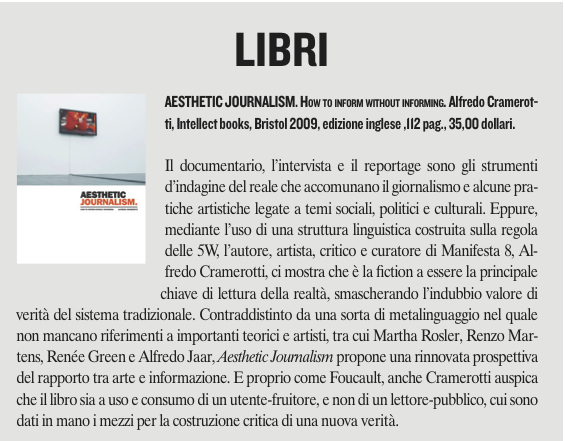
Flash Art Italia, agosto-settembre 2010
by Veronica Valentini
(in italiano – Italian only)
David Rych about Encounter 2010
David Rych talks about his video installation “Encounter 2010” at the MUBAM Murcia at Manifesta 8.
Interview by Peter Lind & Ada Ortega Camara


Out of the Ghetto?
WikiLeaks’ capacity to inflict damage depends on its relations with the establishment media: “There’s a lesson here for the multitudes: get out of the ghetto and connect with the Oedipal other”, write Lovink and Riemens.
You can find the complete article on Eurozine Newsletter – I pasted here a short version:
Twelve theses on WikiLeaks
Vindictive, politicized, conspiratorial, reckless: one need not agree with WikiLeaks’ modus operandi to acknowledge its service to democracy. Geert Lovink and Patrice Riemens see in WikiLeaks indications of a new culture of exposure beyond the traditional politics of openness and transparency.
Thesis 0
“What do I think of WikiLeaks? I think it would be a good idea!” (after Mahatma Gandhi’s famous quip on “Western Civilization”)
Thesis 1
Changing media — Media in change
[…] WikiLeaks becomes symbolic for a transformation in the “information society” at large, holding up a mirror of things to come. So while one can look at WikiLeaks as a (political) project and criticize it for its modus operandi, it can also be seen as the “pilot” phase in an evolution towards a far more generalized culture of anarchic exposure, beyond the traditional politics of openness and transparency.
Thesis 2
[…] WikiLeaks manages to capture that attention by way of spectacular information hacks, where other parties, especially civil society groups and human rights organizations, are desperately struggling to get their message across. While the latter tend to play by the rules and seek legitimacy from dominant institutions, WikiLeaks’ strategy is populist insofar that it taps into public disaffection with mainstream politics. Political legitimacy, for WikiLeaks, is no longer something graciously bestowed by the powers that be. WikiLeaks bypasses this Old World structure of power and instead goes to the source of political legitimacy in today’s info-society: the rapturous banality of the spectacle. WikiLeaks brilliantly puts to use the “escape velocity” of IT, using IT to leave IT behind and rudely irrupt the realm of real-world politics.
Thesis 3
[…] WikiLeaks in its present manifestation remains a typically “western” product and cannot claim to be a truly universal or global undertaking.
Thesis 4
One of the main difficulties with explaining WikiLeaks arises from the fact that it is unclear (also to the WikiLeaks people themselves) whether it sees itself and operates as a content provider or as a simple conduit for leaked data (the impression is that it sees itself as either/or, depending on context and circumstances). […]
Thesis 5
[…] The shift from information to infotainment has been embraced by journalists themselves, making it difficult to publish complex stories. WikiLeaks enters this state of affairs as an outsider, enveloped by the steamy ambiance of “citizen journalism”, DIY news reporting in the blogosphere and even faster social media like Twitter. What WikiLeaks anticipates, but so far has been unable to organize, is the “crowd sourcing” of the interpretation of its leaked documents. That work, oddly, is left to the few remaining staff journalists of selected “quality” news media. Later, academics pick up the scraps and spin the stories behind the closed gates of publishing stables. But where is networked critical commentariat? Certainly, we are all busy with our minor critiques; but it remains the case that WikiLeaks generates its capacity to inspire irritation at the big end of town precisely because of the transversal and symbiotic relation it holds with establishment media institutions. There’s a lesson here for the multitudes – get out of the ghetto and connect with the Oedipal other. Therein lies the conflictual terrain of the political.
Thesis 6
[…] Sovereign hacker Julian Assange is the identifying figurehead of WikiLeaks, the organization’s notoriety and reputation merging with Assange’s own. What WikiLeaks does and stands for becomes difficult to distinguish from Assange’s rather agitated private life and his somewhat unpolished political opinions.
Thesis 7
[…] Computer scientists and programmers have shaped the information revolution and the culture of openness; but at the same time they have also developed encryption (“crypto”), closing access to data for the non-initiated. What some see as “citizen journalism” others call “info war”.
Thesis 8
[…] WikiLeaks operates with ridiculously small staff – probably no more than a dozen of people form the core of its operation. While the extent and savviness of WikiLeaks’ tech support is proved by its very existence, WikiLeaks’ claim to several hundreds of volunteer analysts and experts is unverifiable and, to be frank, barely credible. This is clearly WikiLeaks Achilles’ heel, not only from a risk and/or sustainability standpoint, but politically as well – which is what matters to us here.
Thesis 9
[…] Is WikiLeaks a virtual project? After all, it does exist as a (hosted) website with a domain name, which is the bottom line. But does it have a goal beyond the personal ambition of its founder(s)? Is WikiLeaks reproducible? Will we see the rise of national or local chapters that keep the name? What rules of the game will they observe? Should we rather see it as a concept that travels from context to context and that, like a meme, transforms itself in time and space?
Thesis 10
[…] The term “organized network” has been coined as a possible term for these formats. Another term has been “tactical media”. Still others have used the generic term “internet activism”. Perhaps WikiLeaks has other ideas about the direction it wants to take. But where? It is up to WikiLeaks to decide for itself. Up to now, however, we have seen very little by way of an answer, leaving others to raise questions, for example about the legality of WikiLeaks’ financial arrangements (Wall Street Journal).
Thesis 11
[…] So before we call for one, ten, many WikiLeaks, let’s be clear that those involved run risks. Whistleblower protection is paramount. Another issue is the protection of people mentioned in the leaks. The Afghan Warlogs showed that leaks can also cause “collateral damage”. Editing (and eliding) is crucial. Not only OPSEC, also OPETHICS. If publishing is not carried out in a way that is absolutely secure for all concerned, there is a definite risk that the “revolution in journalism” – and politics – unleashed by WikiLeaks will be stopped in its tracks.
Thesis 12
[…] Despite all its drawbacks, and against all odds, WikiLeaks has rendered a sterling service to the cause of transparency, democracy and openness. As the French would say, if something like it did not exist, it would have to be invented. The quantitative – and what looks soon to become the qualitative – turn of information overload is a fact of contemporary life. The glut of disclosable information can only be expected to continue grow – and exponentially so. To organize and interpret this Himalaya of data is a collective challenge that is clearly out there, whether we give it the name “WikiLeaks” or not.
This is [the shortened version of] an extended version of an article first published on the nettime mailing list and elsewhere in August 2010
Interview: Erlea Maneros Zabala at Manifesta8 – part 2
Second part of short interview to Erlea Maneros Zabala on her work shown at MURAM in Cartagena. Footage and interview by Davis Berg and Henna Hyvärinen.
Produced by the Finnish Academy of Fine Arts and CPS Chamber of Public Secrets
Interview: Erlea Maneros Zabala at Manifesta8 – part 1
Short interview to Erlea Maneros Zabala on her work shown at MURAM in Cartagena. Footage and interview by Davis Berg and Henna Hyvärinen.
Produced by the Finnish Academy of Fine Arts and CPS Chamber of Public Secrets.
Interview: Stefanos Tsivopoulos at Manifesta8
Short interview to Stefanos Tsivopoulos on his work ‘Amnesialand’ shown at the Casino Society in Cartagena. Footage and interview by Davis Berg and Henna Hyvärinen.
Produced by the Finnish Academy of Fine Arts and CPS Chamber of Public Secrets.
On Tsivolopolus’s work:
” In fact one of the most effective works, Amnesialand by Stefanos Tsivopolous, was devised in response to a site not previously used for contemporary art exhibition – the Casino in Cartagena. This was one of a relatively small number of works in ‘¿The Rest is History?’ to fulfil the potential of aesthetic journalism, as theorised by Cramerotti, through its fusion of fictional and documentary modes of address. In addition, while numerous contributions to Manifesta 8 employed a self-consciously ‘archival’ mode of display, Amnesialand was one of the few video installations to make effective use of – and clearly acknowledge – already existing archives. ”
[Aesthetic Journalism in Practice: Manifesta 8 and the Chamber of Public Secrets by Maeve Connolly, variant 39/40 Winter 2010]

Radio Papesse Interview: Alfredo Cramerotti – Chamber of Public Secrets @ Manifesta8
RADIO Papesse INTERVISTA/INTERVIEW
Alfredo Cramerotti – CPS
15 NOVEMBRE 2010
>>the interview is in English<<
>>English text below<<
Il discorso sulla contaminazione e il dialogo fra mondo mediatico e mondo artistico non è nuovo. In fondo si può sostenere che l’arte, in ogni sua espressione ‘deve utilizzare dei media’ e che questi attingono a piene mani dall’immaginario artistico; è un dibattito che probabilmente non avrà mai fine e che è nato e sviluppato a pari passo con i media elettronici, dalla nascita della radio e del cinema ad oggi.
Ma cosa succede se si parla di ‘industria dei media’? se un insieme di artisti, scrittori, intellettuali viene invitato a confrontarsi con i sistemi della produzione medicata contemporanea?
È quanto hanno fatto Alfredo Cramerotti e Khaled Ramadan insieme al collettivo Chamber of Public Secrets – cps con il loro progetto per Manifesta8.
CPS non è una struttura formale, non ha una data di fondazione o un’agenda prestabilita, è un gruppo trasversale, un ‘meta-luogo’ di discussione e analisi critica ed è uno dei gruppi curatoriali di Manifesta8.
Abbiamo parlato insieme a Cramerotti di CPS, del metodo utilizzato nel lavoro curatoriale, del loro invito a confrontarsi con le strutture produttive dei media per la creazione di progetti artistici.
la musica che accompagna l’intervista è tratta dall’album a bell and a mirror di Let’s drive to Alaska pubblicato dalla netlabel muertepop
–
The contamination and encounter dicourse about the artworld and the mediatic world isn’t new.
It is a never-ending debate born and developed together with the electronic media: form the early days of radio and cinema until nowadays.
But what happen when we talk about the media industry? what happen when a group of artists, writers, intellectuals is invited to deal with the contemporary media industry production system?
It is what Alfredo Cramerotti and Khaled Ramadan did together with the Chamber of Public Secrets – cps collective curating their project for Manifesta8.
CPS isn’t a formal structure, do not have an official founding date or a fixed agenda, is an horizontal group, an ensemble of dicussion and critical thinking and is one of the curatorial teams of Manifesta8.
We talked with Cramerotti about CPS, about their curatorial method, their invitation to deal with the production structures of the media industry for the creation artistic projects.
The music used in this interview is A bell and a mirror by Let’s drive to Alaska published by the netlabel muertepop
Questa opera è prodotta da Radio Papesse, un progetto di Ilaria Gadenz e Carola Haupt
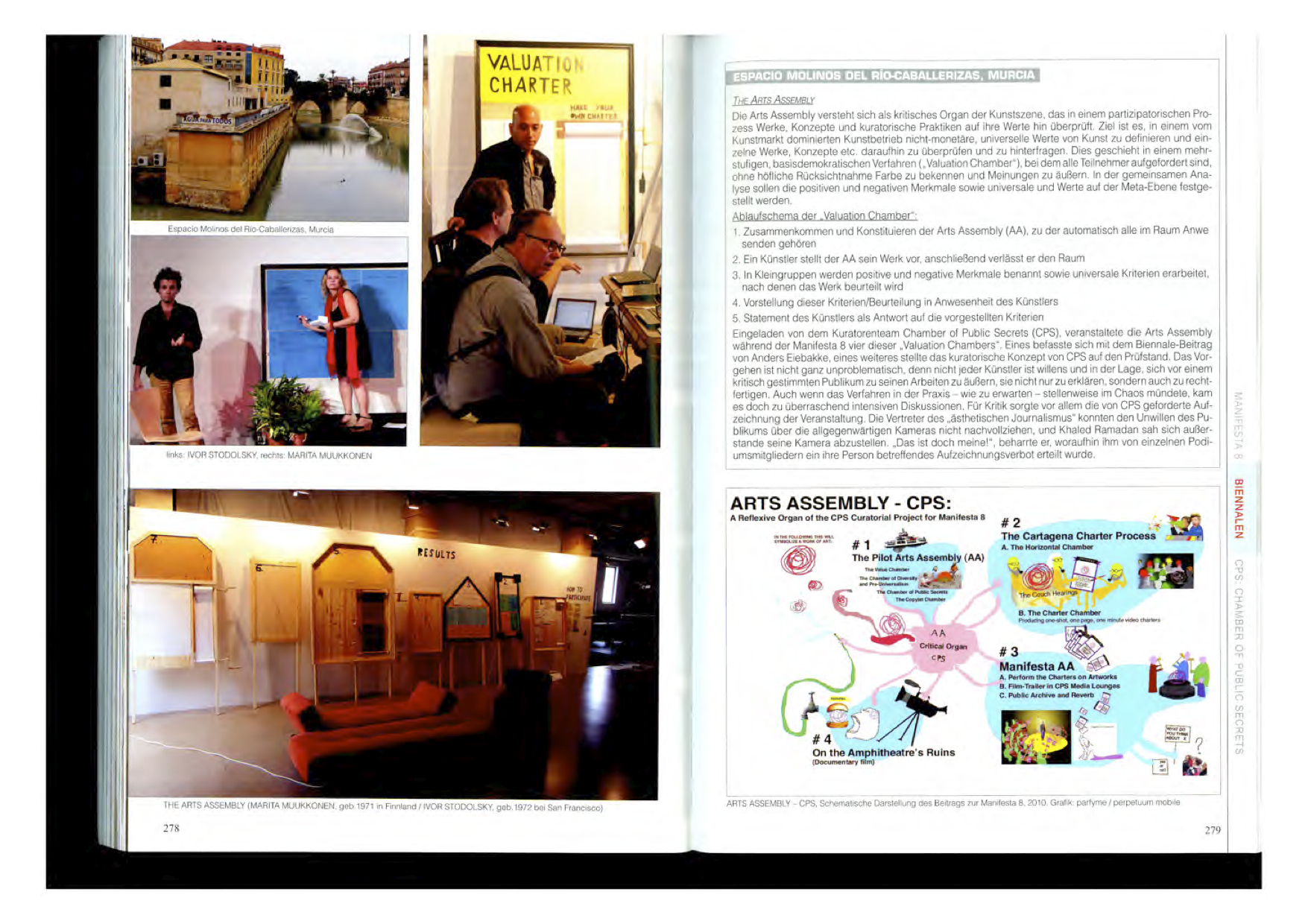
Kunstforum International: CPS for Manifesta 8
Die Europäische Biennale zeitgenössischer Kunst die Region Murcia (Spanien) im Dialog mit Nordafrika
Texte und Auswhal: Susanne Boecker
Fotorundgang: Wolfgang Träger


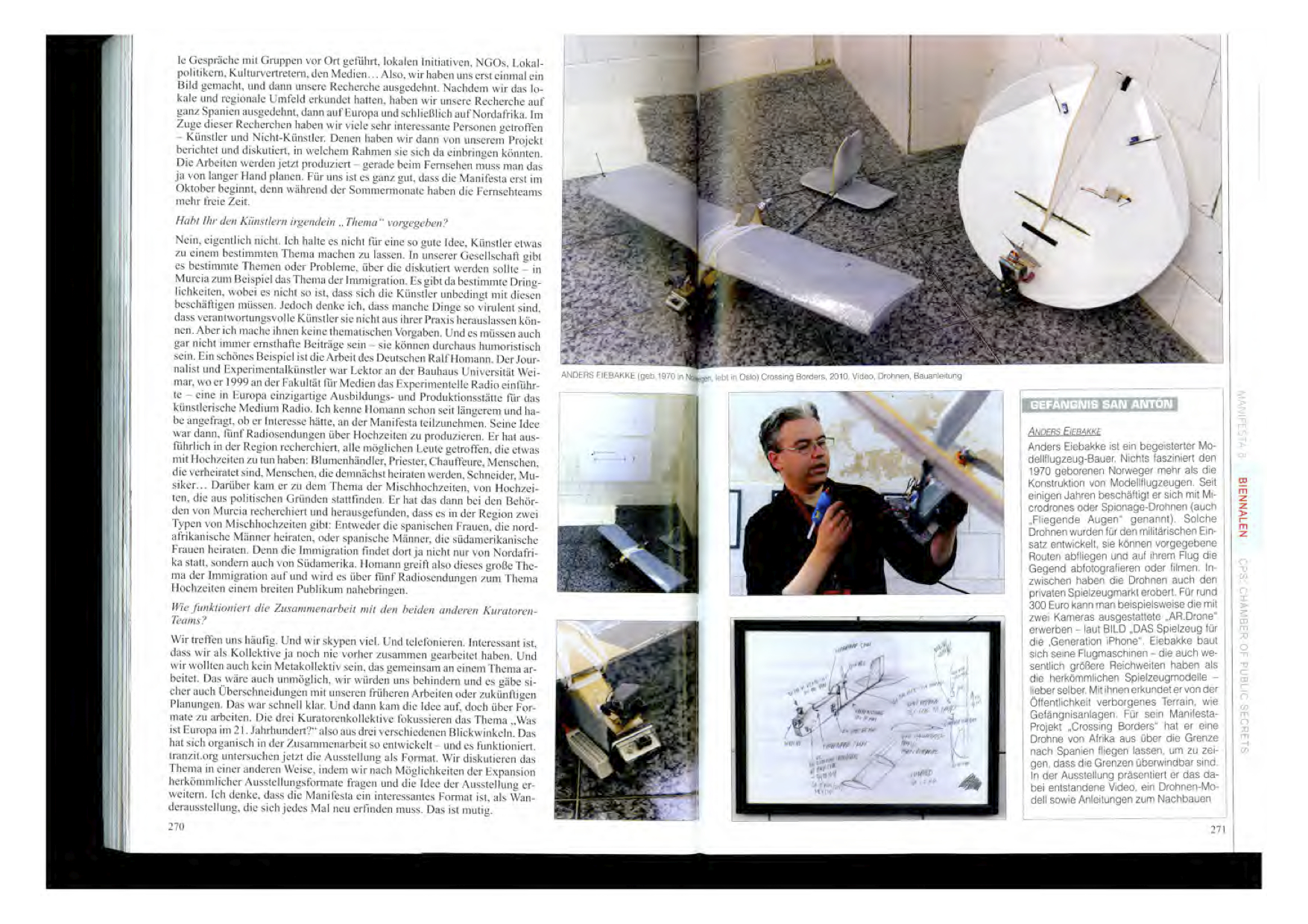
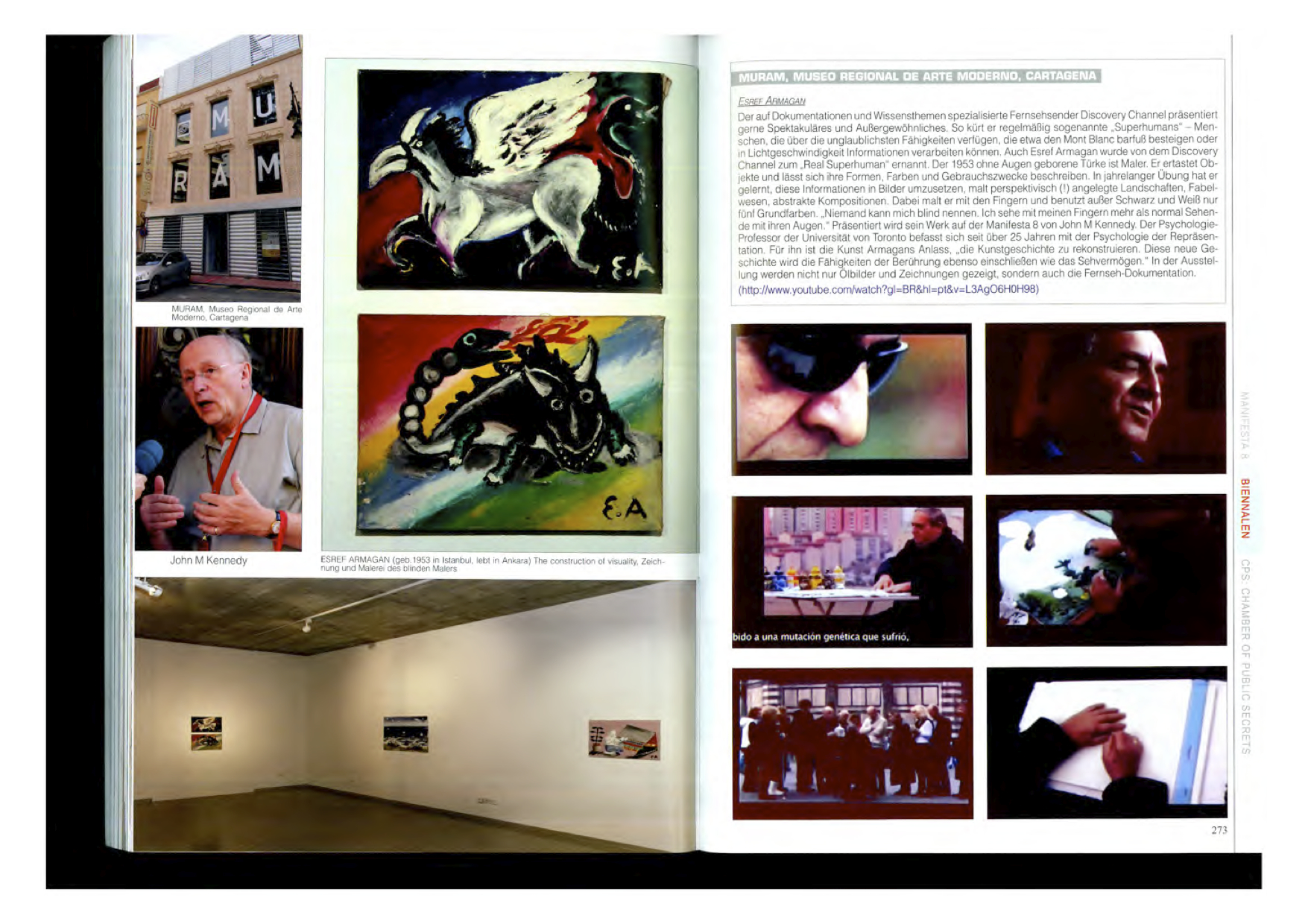
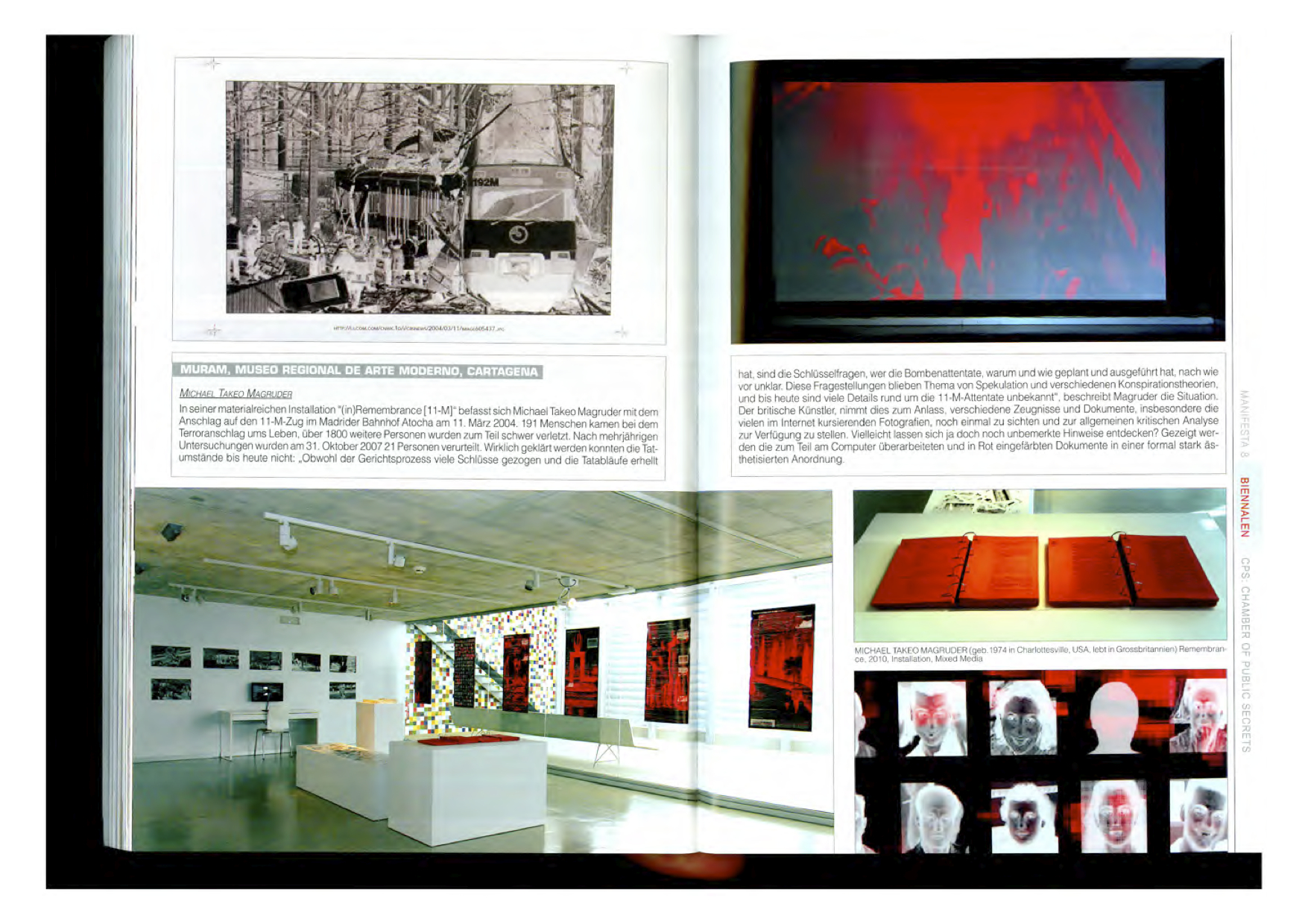



 Curatorview [Alfredo Cramerotti]
1 comment