HumanKind: Interview with Alfredo Cramerotti
Introducing Alfredo Cramerotti, Associate Curator of Format International Photo Festival, Editor of the “Critical Photography” book series, and a member of the jury of “HumanKind”.
“HumanKind” is the New York Photo Festival’s second juried photo invitational (following the smash success of Capture Brooklyn), ongoing now and open until November 28, 2010
For more information, please visit humankind.newyorkphotofestival.com
CPS Chamber of Public Secrets – Diary
Published on Kunstbeeld / Art Magazine, The Netherlands, Issue October 2010.
Thanks to Daphne Pappers, Research & Publications, Amsterdam.
(Dutch)

Expanded Violences by Brumaria
Expanded Violences is a project realized in the framework of Manifesta 8, The European Biennial of Contemporary Art.

IS VIOLENCE
THE ONLY MEANS TO CHANGE THIS
DEADLY WORLD?
Expanded Violences
Throughout the past two years in Brumaria, we have been working on and over multifocal-terrorism art-war relations. A product of this has been a series of forays— Art and Terrorism, Iconoclasm-Iconolatry, and now Expanded Violences— which, by means of different formats—research projects, exhibition projects, artistic work, seminars and publications—have permitted us to affirm the amplitude of these topics and the conceptual, thematic, and discursive gaps that today persist in the art institution both in the Spanish region and in the world of global art.
We understand that we neither want nor are able to isolate contemporary art from the world in which it is produced, commercialized, or museumized, especially if we keep in mind the present characteristics of armed conflict and if we affirm that we live in a state of permanent war. Although in the past war (the institutionalized phase of violence) defined itself as a conflict among sovereign nation-states, given that in the last few decades this sovereign authority of the nation-state has been decaying in favour of the emergency of a supranational sovereignty, the nature and the conditions of both war and political violence in our present times have necessarily and considerably changed, leaving behind the memory of the defeated, the humiliated, the offended…the murdered. In our current environment war is a global phenomenon. We live in a state of ubiquitous, brutal, and permanent “civil war”: a new and monstrous state of exception.
Expanded Violences focuses its attention on a triangulation between violence as representation strategically administered by power, the operation by which mass media and the use of art form a critical vertex of this multiple dialectic. If it seems obvious that there exists interdependence between political and economic power and the strategic operations used in mass media, the role of art is not so clear in this context.
• Theodor W. Adorno & Max Horkheimer • Aeschylus • Giorgio Agamben • Louis Althusser • Anonymus (Deuteronomy) • Aristotle • Antonin Artaud • Graco Babeuf • Alain Badiou • Jean Baudrillard • Walter Benjamín • Ursula Biemann • Bertlolt Brecht • Pierre Bourdieu • Gustavo Bueno • Stokely Carmichael • Pedro Casaldáliga • Paul Celan • The Clash • Leonard Cohen • Alfredo Cramerotti • Noam Chomsky • Mike Davis • Guy Debord • Gilles Deleuze & Felix Guattari • Jacques Derrida • Terry Eagleton • Albert Einstein • Friedrich Engels • Euripides • Frantz Fanon • Michel Foucault • Sigmund Freud • Mohandas Karamchand Gandhi • Jean-Luc Godard • Antonio Gramsci • Peter Handke • G. W. F. Hegel • Jimi Hendrix • Eric Hobsbawm • Homer • Dolores Ibárruri • Peter Kropotkin • Jacques Lacan • Lao Tse • Sylvain Lazarus • Maurizio Lazzarato • Vladimir Ilyich Lenin • Robert Linhart • Lucretius • Rosa Luxemburg • Jean-François Lyotard • Malcolm X • Mao Zedong • Nicolò Machiavelli • Filippo Tommaso Marinetti • Karl Marx • Vladimir Mayakovsky • Mario Moretti • Muhammed • Jean Luc Nancy • Nawal El Saadawi • Antonio Negri • Friedrich Nietzsche • Anton Pannekoek • Cesare Pavese • Fernando Pessoa • Plato • Nicos Poulantzas • Khaled Ramadan • Jacques Rancière • Wilhelm Reich • RETORT • Los Reyes Católicos • Arthur Rimbaud • Maximilien Robespierre • Martha Rosler • Louis de Saint-Just • Saint Augustine • Saint Matthew • Saint Paul • Jean-Paul Sartre • Carl Schmitt • William Shakespeare • The Smiths • Sophocles • Susan Sontag • Baruch Spinoza • Hito Steyerl • Tacitus • Leon Trotsky • Tristan Tzara • Ramón María del Valle-Inclán • Víctor Hugo • Virgil • Paul Virilio • Paolo Virno • Oswald Wiener • Jean Ziegler • Slavoj Zizek • Joseba Zulaika •
With a foreword by Alejandro Arozamena, Darío Corbeira & Daniel Patrick Rodríguez
Brumaria works #1
– Double installation with moving images, sound and temperature.
– Two publications in English and Spanish.
– A seminar.
Mediascapes. Nolens Volens 4
This fourth issue of Nolens Volens has been edited in collaboration with Alfredo Cramerotti, member of the curatorial group Chamber of Public Secrets, in the framework of their participation in Manifesta 8.
The subject explored was “mediascapes”. And the contributors have worked with the concept of how the media construct rather than reflect the world; they are hardly a public forum, and have transformed into an industry which has a powerful influence and exerts discursive manipulation over the audience and society.
Extending the notion of reality as a construct, as symbolic coordinates that determine our experience of reality, the central importance of the media in the definition of the framework in which reality takes place in the contemporary world is evident. Since the spread of what is denominated as communication technologies, the construction of reality through the media establishes the limits of our possible experience in a construction of the world with a totalizing vocation. Baudrillard’s critical considerations of simulacra and hyper-reality or Debord’s spectacle are positions which, although they are an efficient diagnostic of the state of matters, do not leave many options for operating in an effective way in the construction of a set if images that determines our experience of reality from other positions, opposing the versions of media power. Thus, the experiential framework proposed by the business conglomerates of communication should be confronted with other forms of treating, narrating and, finally, constructing this certain sense of reality.
Lastly, we are printing an excerpt of Alfredo Cramerotti’s book “Aesthetic journalism: How to Inform Without Informing” (2009), published by Intellect, which discusses how the production of truth has shifted from the domain of the news media to that of art and aestheticism, which marks a new approach to the debate of the possibility of the critical potential of art within the aestheticization of the information.
The contributors to this issue are: Los colaboradores de este número de Nolens Volens son: Carlos Jiménez, Alfredo Cramerotti, Arturo/ fito Rodríguez Bornaetxea, Jesús Aguilera, Ramon Parramon, Anders Eiebakke, Erlea Maneros Zabala, Andreja Kulunčić, Daniel García Andújar, Extrastruggle, Michael Takeo Magruder, Nada Prlja, Nemanja Cvijanovic, GenderArtNet, Virginia Villaplana and Michael Baers
On Failure
Video, sound essay, 15 min, on the downsides, prestiges and spaces of failure, via the figure of Orson Welles, who is paradigmatic for his relationship with failure. Among our contemporaries, failure has no space, no room for development –in other words – it should not exist.
But failure is a precious space where we can stretch our boundaries and experiment with another dimension of living. At this point, most of you will feel the urge to ask why should we fail. It’s not that we should fail in order to live better. Rather I believe we should allow ourselves the space, the mental dimension, of failure.
Welles is considered not for what he manage to realize in relation to his non-materialized ideas, rather for the way he – through the notion of failure – involuntarily played a game according to his rules.
Symposium: How to Inform without Informing, Collective Gallery, Edinburgh
Symposium at Collective, City Observatory, Calton Hill
Edinburgh, UK
Friday 30 July 2010
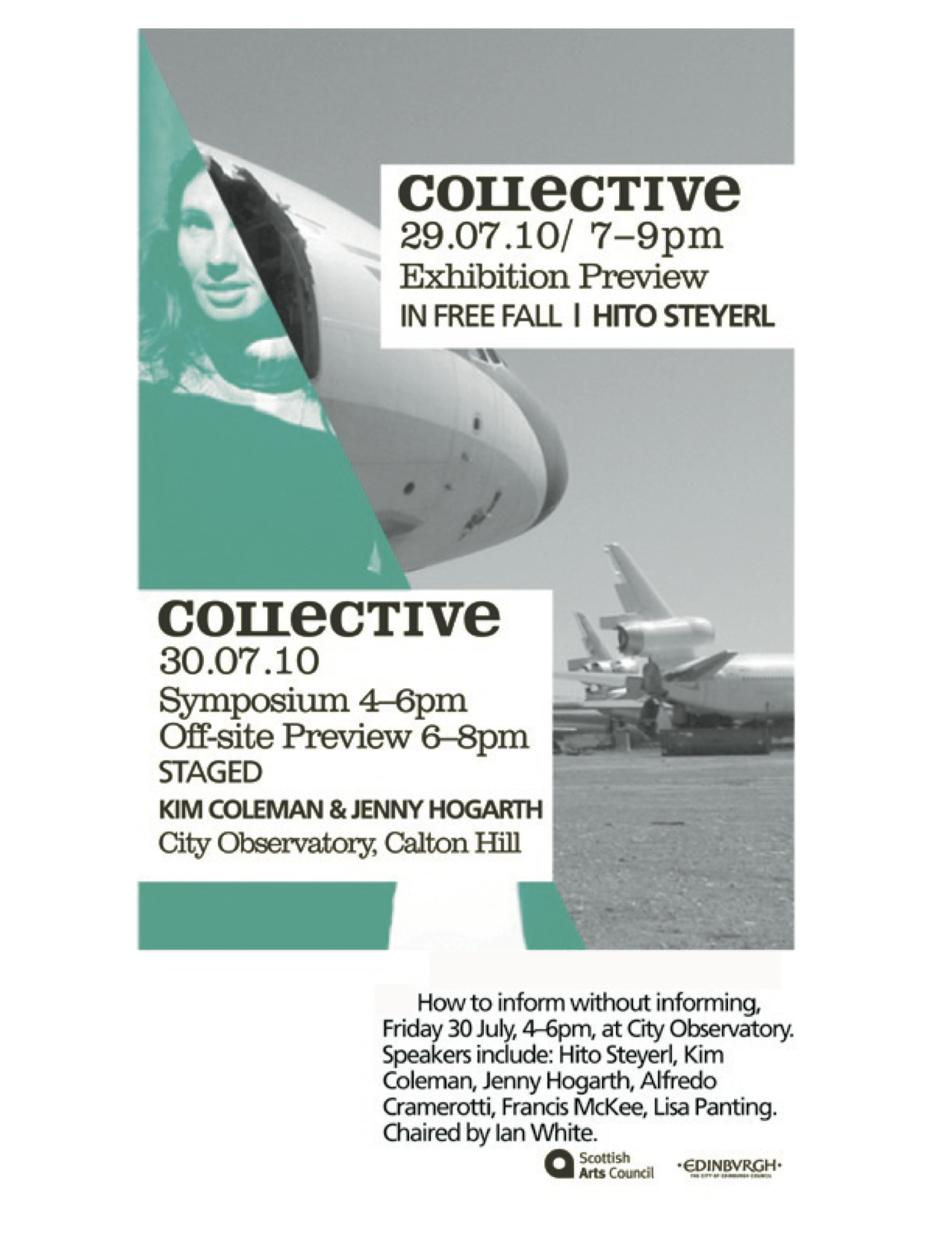

To celebrate the launch of two new commissions, Collective devised a symposium which took place on 30th July 2010 featuring exhibiting artists Hito Steyerl, Kim Coleman and Jenny Hogarth. Other speakers included theorist Alfredo Cramerotti (author of Aesthetic Journalism), Francis McKee (curator and writer), Lisa Panting (Director of Picture This, Bristol) and Collective director Kate Gray. The symposium was chaired by Ian White (LUX, London) and was held at the City Observatory atop Calton Hill.
Audio of the Symposium available at: http://collectivegallery.podomatic.com/entry/2010-08-15T09_36_37-07_00
MANIFESTA 8 | Collective Curating: Means in Common at Art Basel 41
ART BASEL 41 | Art Salon Program
Friday June 18, 2010

Participants:
Alfredo Cramerotti, Chamber of Public Secrets (CPS), Denmark, Italy, Lebanon, Member of the M8 Curatorial Collective
Esther Regueira, General Coordinator, Manifesta 8, Murcia
Georg Schöllhammer, Member of the collective tranzit.org, Central Europe.
Nottingham Contemporary – The Geopolitical Turn: Art and the Contest of Globalisation / Evidence and imagination: the urgency of geopolitics and the necessity of geopoetics by Alfredo Cramerotti


Talk for The Geopolitical Turn: Art and the Contest of Globalisation Conference 08 May 2010 at Nottingham Contemporary, UK.
What are the reference points for contemporary art in a global economy that creates enormous wealth as well as widening inequality? The opening conference explores the many strategies artists use to reveal the processes and human consequences of the globalised market economy.
Over the past five years Alfredo Cramerotti has written about the aesthetic merger of contemporary art and the news media. By adopting the ubiquitous tropes of interviews, graphic mapping, and Magnum style photography an increasing number of artists have borrowed from these visual languages to present their work into a context closely aligned with investigative journalism. Drawing from his recent book Aesthetic Journalism: How to inform without informing (2009, Intellect) and select works from Uneven Geographies, Cramerotti will be speaking about the growing overlap between global news media and contemporary art.
By addressing this topic Cramerotti will seek to answer a number of questions including: Does such an integration of art and journalism emancipate art from a closed sphere of discourse allowing it a more social and political dimension? Does the use of an investigative methodology within contemporary art practice shift an understanding of truth and subjectivity? By borrowing from forms of news media, what new modes of exhibition practice are artists, curators, and writers enabling to develop cultural relationships between the global relevance to local issues?
Audio of talk available at: nottinghamcontemporary.org/sites/default/files/Alfredo_Cramerotti.mp3
Italo Calvino – Six Memos for the [Present] Millennium / 1NYC
Video, sound essay based on the book “American Lectures” by Italo Calvino, 10 min.
In 1984, he was invited to deliver a cycle of lectures at Harvard University in the United States. The writer elected five themes: lightness, rapidity, exactitude, multiplicity and consistency. Calvino has written the first five, but died before the completion of the last. The conferences never took place, but the texts were collected in a book that serves as an important inheritance to the newly born millennium. My thanks to Gian Zelada of mamutemidia.com.br, who has inspired this work.


 Curatorview [Alfredo Cramerotti]
leave a comment