Touching the Taboo
The Wall Street Journal
15 October 2010
by Mariana Schroeder

Bericht uit Murcia en Cartagena: Manifesta 8
 Nieuws
zondag 17 oktober 2010
Beeldverslag
Sam Steverlynck | Manifesta is een zwervende kunstbiënnale die elke editie opereert vanuit een ander (grens)gebied. De biënnale positioneert zich als een tegengewicht voor locatiegebonden biënnales zoals bijvoorbeeld die van Venetië.
De achtste editie – die zojuist werd geopend – vindt plaats in de Zuid- Spaanse steden Murcia en Cartagena. Ze werd samengesteld door drie curatorcollectieven: ACAF (Alexandria Contemporary Arts Forum) CPS (Chamber of Public Secrets) en tranzit.org.
Manifesta 8
9 okt. 2010 t/m 9 jan. 2011
www.manifesta8.com
Lees verder en bekijk het beeldverslag…

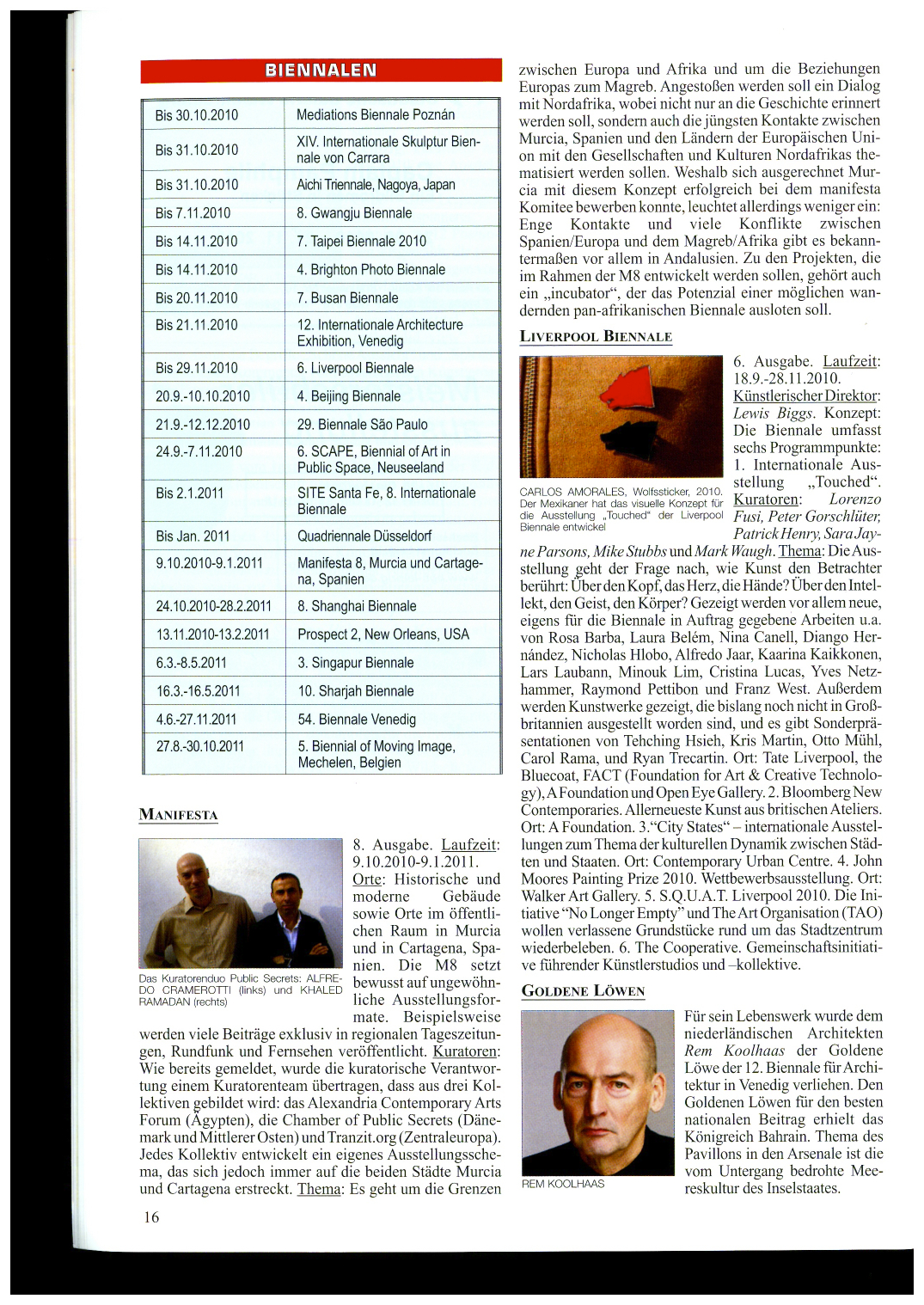
Curatoren Khaled Ramadan en Alfredo Cramerotti van CPS
Uitgemolken
De ondertitel van de biënnale luidt: ‘Region of Murcia (Spain) in dialogue with northern Africa’. Dat klinkt als een interessant uitgangspunt door de eeuwenlange vetes, contacten en invloeden tussen beide regio’s. Alleen blijkt al gauw dat die ondertitel nogal problematisch is.
Er is weliswaar het Egyptische curatorencollectief ACAF, maar verder telt de biënnale niet bijster veel Noord-Afrikaanse kunstenaars. Van de uitgemolken term ‘dialoog’ is al helemaal geen sprake. Manifesta flirt met een politiek activisme dat zeer ongeloofwaardig overkomt. Het is niet meer dan holle retoriek en een vorm van cerebrale masturbatie, die intelligent noch diepgaand is.
Een van de dieptepunten is het buurtcentrum van Santa Lucia in Cartagena waar een hele zaal wordt ingenomen met researchmateriaal van Archivo F.X. Het ‘research’ van de kunstenaars leidt niet tot inspirerende bevindingen en nog minder tot knappe kunstwerken. Ook The Arts Assembly in Murcia kickt blijkbaar op stencils, prikborden en tabellen. Als men al een trend kan spotten op deze biënnale, moet het de terugkeer zijn van het fotokopieerapparaat dat hier blijkbaar overuren presteert.

Het fotokopieerapparaat onmisbaar op deze biënnale.

…en nog wat meer papier
Gevangeniscellen
Wel geslaagd zijn dan weer de originele locaties: van een in onbruik geraakte gevangenis, tot een casino en van een voormalig autopsiecentrum tot een postkantoor. In de San Anton gevangenis in Cartagena is Thierry Geoffroy (Colonel) één van de weinige kunstenaars die verwijst naar die zogenaamde ‘dialoog met Noord-Afrika;. Hij sprokkelt op sensationele wijze opinies bij de lokale bevolking over hun Noord-Afrikaanse buren.
Ook bekritiseert hij op ironische wijze de afwezigheid van Noord-Afrikaanse kunstenaars door hen een cel voor te behouden waar ze alsnog hun werk kunnen tentoonstellen. Eén van de weinige geslaagde ‘papers’ is een reader over geweld van Brumaria, een collectief dat daarnaast in gevangeniscellen een spervuur van beelden van gewelddadig politiegeweld op de bezoeker afvuurt.
Bijproduct
De curatorcollectieven vallen het klassieke model van “the authorship of the single curator” aan en zijn op zoek naar een andere manier van kennisproductie. Hun alternatief is echter helemaal niet overtuigend. Ondanks een overgewicht aan theoretisering en discursieve praktijken slagen ze er maar niet in een coherente visie of concept te ontwikkelen. Natuurlijk zijn er op deze biënnale ook knappe werken te ontdekken (Laurent Grasso, Lorraine O’Grady, Metahaven, Erlea Maneros Zabala, …) maar die slagen er alsnog niet in om Manifesta 8 te redden.
Kunst wordt hier blijkbaar toch eerder gezien als bijproduct.

De gevangenis van San Anton in Cartagena.

Gevangenis van San Anton

Thierry Geoffroy’s cel voor Noord- Afrikanen

Thierry Geoffroy, aka Colonel

De holle retoriek van The Arts Assembly.

The Arts Assembly in Murcia

Erlea Maneros Zabala’s deconstructie van mediabeelden

Michael Takeo Magruders werk over de aanslagen in het Atocha treinstation Madrid.

Stefanos Tsivopoulos’ diareeks en film in Casino van Cartagena.

Stormloop op het MURAM in Cartagena.
Foto’s: Sam Steverlynck
Lees ook:
– 02/08/2010 Manifesta brengt eerste ‘non-visuele residency’
– 25/06/2010 Manifesta zal ‘ingrijpende verandering’ teweegbrengen
In het oktobernummer van Kunstbeeld vind je het Dagboek van… curatorencollectief CPS
CPS Chamber of Public Secrets – Diary
Published on Kunstbeeld / Art Magazine, The Netherlands, Issue October 2010.
Thanks to Daphne Pappers, Research & Publications, Amsterdam.
(Dutch)

Wooloo at Manifesta 8
Known for “New Life Copenhagen,” an initiative that paired international visitors with host families during the city’s climate summit last year, the collective Wooloo is currently operating “New Life Residency” as part of Manifesta 8 in Murcia, Spain. For this project, commissioned by CPS Chamber of Public Secrets (Alfredo Cramerotti & Khaled Ramadan), the group has invited five artists to live and work entirely in the dark. In addition, each artist has been paired with a visually impaired assistant. Here, cofounders Sixten Kai Nielsen and Martin Rosengaard describe their latest project.

WHEN WE WERE PRESENTED WITH the curatorial investigation by Manifesta and the Chamber of Public Secrets into the history of the visual, we found it worthwhile to consider a broader view of this chronicle. We wanted to explore the impact of visuality on human history as a whole—the effects of society’s seemingly uncontrollable production and consumption of images. How could we imagine something different? What would a nonvisual world be like?
We have also been interested in the artist residency as a form. Especially now, in a financial crisis, as it’s the only way many artists can afford a studio. Yet most contemporary residency programs seem to have a very odd idea of isolating the artistic “genius” for him or her to create work. With “New Life Residency,” we wanted to do it differently––we wanted to create a situation that would not be comfortable or give room for the artists to “be themselves,” but rather the opposite.
In short, these were our initial thoughts when we came to Murcia. Then we encountered the city and began meeting its blind community. Being visually impaired in Murcia means walking through the streets to get things done, or working by selling lottery tickets, for instance, on behalf of ONCE, the local organization for visually impaired people. We began talking to these men and women, asking them if they knew about Manifesta; they didn’t. Actually, it seemed like no one locally had heard about the biennial. We began to think even more about the relation between Murcia and Manifesta. And the more we thought, the more we wanted to do something that didn’t pretend to understand the city or region. Because of course we don’t. We wanted to create a situation in which the artists were lost.
Most of the participating artists normally produce visual work. But the most important reason we selected them is for their interest in experimentation and their proposed collaboration with their assistant, as well as their ability to go beyond simply presenting a fixed work in a dark space. The selected artists all demonstrated awareness of the fact that what they initially proposed will most likely end up being very different due to the process. A lot of applicants seemed to forget that this is a residency program, not an exhibition series.
We found the participating assistants by speaking to them. ONCE has also been a tremendous help in communicating our initial idea. Funnily enough, only women wanted to take part. We spoke to several visually impaired men, but they were not interested. For us, this work is not about a challenge of darkness as much as it is a challenge of collaboration; to leave the visual production behind and see what is left. This project is also a lot about translation and communication. And what can be lost (and gained) in that process: A language barrier is present in some of the collaborations, but no more than is already the case between Manifesta and Murcia. We see this as part of the project and an integrated part of working internationally in a local setting.
All of our work explores new ways of living and working together. This has been our interest since we built wooloo.org, our very first social sculpture, almost ten years ago. Today, the website functions as a working platform for artists and cultural producers, but in the beginning, it was also an experiment in online space—long before Facebook and the social network explosion we see now. Overall, the mission of Wooloo is to explore new ways of living together on this planet. Each of our different projects is, in one way or another, a social experiment in collectivism. The antiglobalization movement has this slogan—“Another World Is Possible.” We agree, but we would like to take another angle: What world is possible? Let’s begin the testing now, please.

Mediascapes. Nolens Volens 4
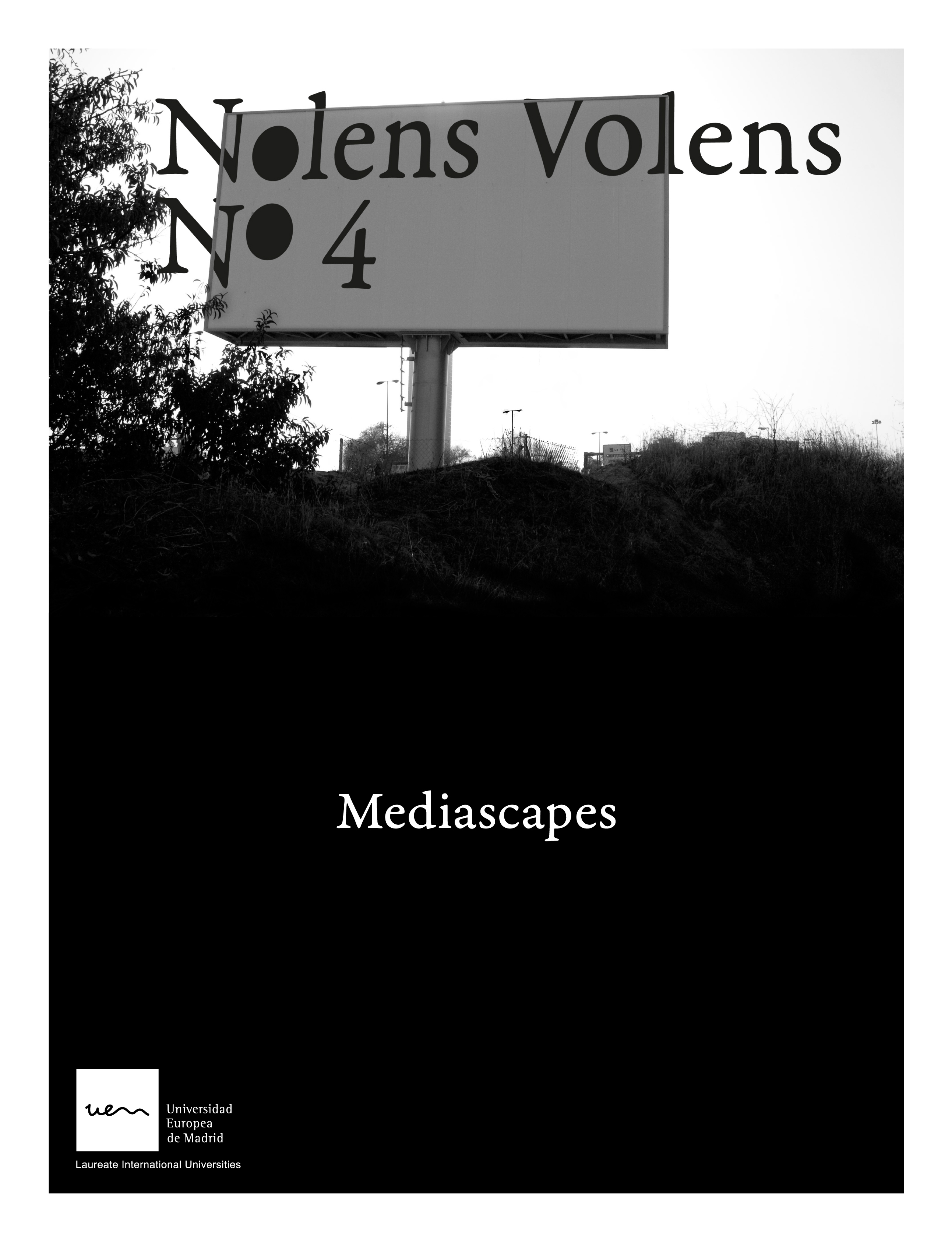
This fourth issue of Nolens Volens has been edited in collaboration with Alfredo Cramerotti, member of the curatorial group Chamber of Public Secrets, in the framework of their participation in Manifesta 8.
The subject explored was “mediascapes”. And the contributors have worked with the concept of how the media construct rather than reflect the world; they are hardly a public forum, and have transformed into an industry which has a powerful influence and exerts discursive manipulation over the audience and society.
Extending the notion of reality as a construct, as symbolic coordinates that determine our experience of reality, the central importance of the media in the definition of the framework in which reality takes place in the contemporary world is evident. Since the spread of what is denominated as communication technologies, the construction of reality through the media establishes the limits of our possible experience in a construction of the world with a totalizing vocation. Baudrillard’s critical considerations of simulacra and hyper-reality or Debord’s spectacle are positions which, although they are an efficient diagnostic of the state of matters, do not leave many options for operating in an effective way in the construction of a set if images that determines our experience of reality from other positions, opposing the versions of media power. Thus, the experiential framework proposed by the business conglomerates of communication should be confronted with other forms of treating, narrating and, finally, constructing this certain sense of reality.
Lastly, we are printing an excerpt of Alfredo Cramerotti’s book “Aesthetic journalism: How to Inform Without Informing” (2009), published by Intellect, which discusses how the production of truth has shifted from the domain of the news media to that of art and aestheticism, which marks a new approach to the debate of the possibility of the critical potential of art within the aestheticization of the information.
The contributors to this issue are: Los colaboradores de este número de Nolens Volens son: Carlos Jiménez, Alfredo Cramerotti, Arturo/ fito Rodríguez Bornaetxea, Jesús Aguilera, Ramon Parramon, Anders Eiebakke, Erlea Maneros Zabala, Andreja Kulunčić, Daniel García Andújar, Extrastruggle, Michael Takeo Magruder, Nada Prlja, Nemanja Cvijanovic, GenderArtNet, Virginia Villaplana and Michael Baers
MANIFESTA 8 | DESAYUNO DE PRENSA Madrid
09 DE SEPTIEMBRE 10,45H
Restaurante Museo Nacional Centro de Arte Reina Sofía (MNCARS)
Acceso por la Plaza Del Museo

Hedwig Fijen directora de la Fundacion Manifiesta, Esther Regueira Coordinadora general de Manifesta 8 y representantes de los equipos curatoriales Alexandria Contemporary Arts Forum (Bassam el Baroni) y Chamber of Public Secrets Forum (Alfredo Cramerotti) presentarán en Madrid los avances de la preparación de Manifesta 8.
Se entregará dossier de prensa con información general, descripción detallada de proyecto, listado de artistas e imágenes para publicar.
Una de las innovaciones de esta edición es la introducción de un equipo curatorial compuesto por tres colectivos – Alexandria Contemporary Arts Forum (Egipto), Chamber of Public Secrets (Escandinavia y el Medio Oriente) y tranzit.org (Europa Central) – responsables tanto del enfoque temático como de la selección de artistas. Como la muestra dinámica que es, Manifesta 8 se sitúa en una intersección, en un lugar en el que los tres colectivos curatoriales ofrecerán respuestas a los desafíos planteados por las nociones del diálogo transregional y transcontinental a través de diversos formatos. http://www.manifesta8.com
Manifesta 8 sbarca sulle coste spagnole, Roma ne parla…
Francesca Campli / Art a part of cult(ure) newsletter
3 giugno 2010

Presentation of Manifesta 8 in Rome / Alfredo Cramerotti’s interview
29 May 2010
Interview to Alfredo Cramerotti, co-curator Manifesta 8, in occasion of the presentation of the biennial in Rome

At the historic Belle Époque cafe, Bar della Pace in Via Santa Maria della Pace, one-minute walk from Piazza Navona, from 11.00am to 12.30pm
The event will see the participation of Hedwig Fijen (Director Manifesta Foundation, Amsterdam), Alfredo Cramerotti (curator M8, from the curatorial group Chamber of Public Secrets, Copenhagen), Lisa Mazza (Manifesta Foundation, Amsterdam), Esther Regueira (the new general co-coordinator of M8 in Murcia) and Jonathan Turner (M8 editor, Rome).
The presentation will take place in concurrence with the art fair Roma – The Road to Contemporary Art, and with the press launch and official opening of the new MAXXI – Museum of 21st Century Art in Rome, designed by Zaha Hadid.


 Curatorview [Alfredo Cramerotti]
leave a comment